Victory

At Yorktown in 1781, the Continental Army and allied French forces on land and at sea trapped the British army led by Lord Cornwallis. His surrender marked a stunning defeat for the 18th century’s greatest superpower, and back in Britain it sapped political support for continuing the war to keep the 13 former colonies. The American and French victory prompted celebrations across the new republic—including in Princeton—as well as an outpouring of news accounts, eyewitness testimony, and art.

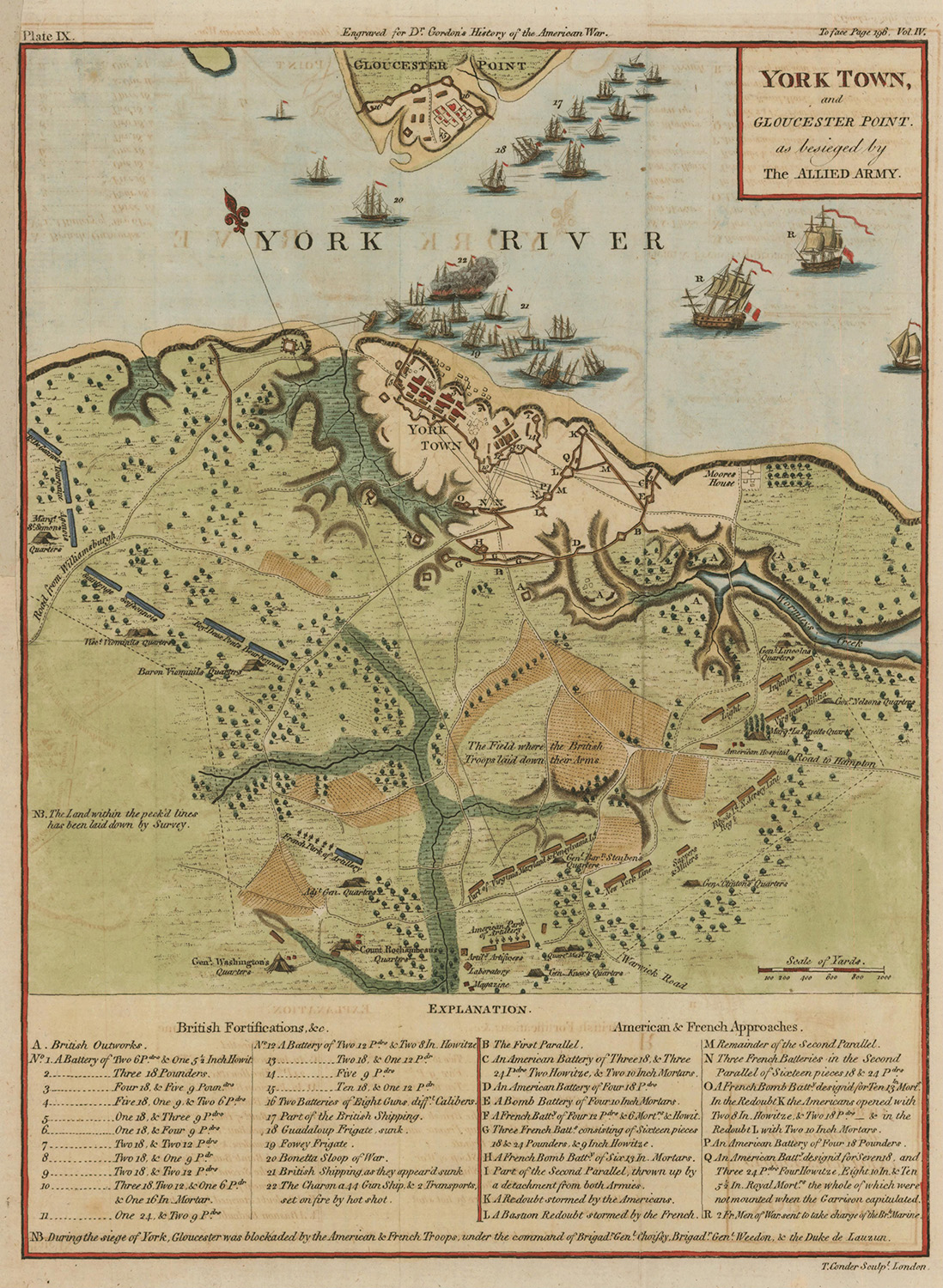
York Town, and Gloucester Point: As Besieged by the Allied Army. Engraved for William Gordon’s History of the Rise, Progress, and Establishment of the Independence of the United States
Thomas Conder (1746 or 1747–1831)
London: Printed by Charles Dilly and James Duckland, 1788
This hand-colored map of the siege of Yorktown appeared in the first history of the Revolutionary War published by an American: William Gordon’s 1788 History of the Rise, Progress, and Establishment of the Independence of the United States of America. Depicting British fortifications, sunken transport vessels, and Washington’s and Rochambeau’s positions, the map underscores both the magnitude of the victory and the essential role of French forces in securing it.

Conclusion de la Campagne de 1781 en Virginie. Le Marquis de La Fayette
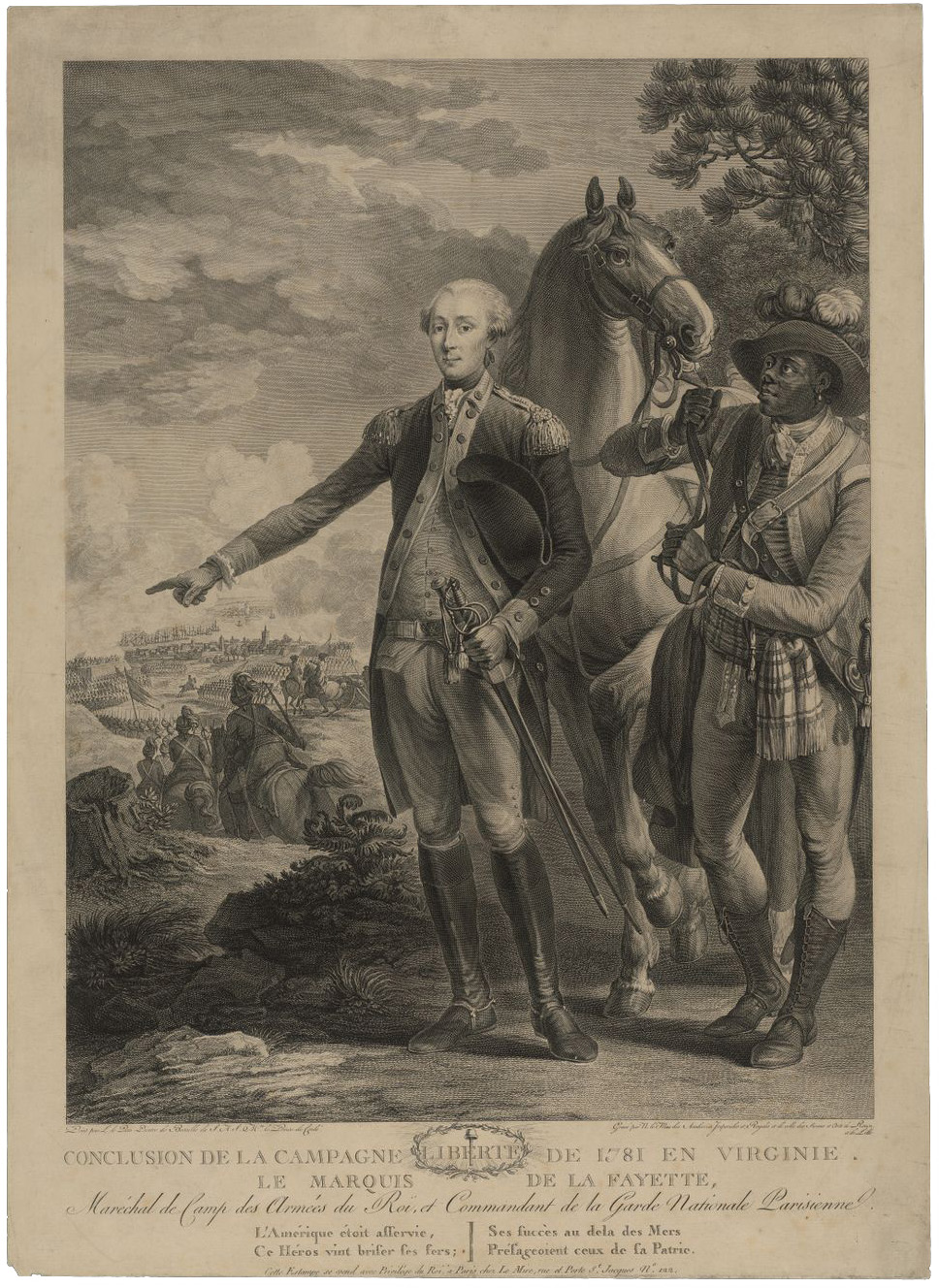
Noël Le Mire (1724–1801)
Engraving after a painting by Jean-Baptiste Le Paon. Paris, circa 1785
The Marquis de Lafayette (Marie-Joseph Paul Yves Roch Gilbert du Motier) played a central role in cornering Lord Cornwallis during the siege of Yorktown. In this engraving—dedicated to General Washington—the Marquis directs the viewer’s gaze toward the French troops under his command. Next to him stands James Armistead Lafayette, an enslaved African American who gained his freedom in 1787 for his service as a spy for the Continental Army.

Camp à Prince-Town, le 31 Aoust [1781], 14 miles de Sommerset Court-house
Camp à Williamsburg, le 26 Septembre [1781], 7 miles de Arche’s-Hupe
![Image of hand-sketched map of "Camp à Prince-Town, le 31 Aoust [1781], 14 miles de Sommerset Court-house"](/uploads/spotlight/attachment/file/6924/Item_52.jpg)
![Image of hand-sketched map of "Camp à Williamsburg, le 26 Septembre [1781], 7 miles de Arche’s-Hupe"](/uploads/spotlight/attachment/file/6923/Item_53.jpg)
Louis-Alexandre Berthier (1753-1815)
Gift of Harry C. Black, Class of 1909
After the momentous victory at the Battle of Saratoga, the United States secured a critical alliance with France. In 1780, King Louis XVI dispatched over 5,000 troops across the Atlantic, where they disembarked in Rhode Island. Though initially intending to attack New York City, George Washington and the French commander, the Comte de Rochambeau, decided instead to march 680 miles to Virginia, where the two armies would join with the French navy for an attack.
At each encampment during this long summertime march, French cartographer Louis-Alexandre Berthier sketched his surroundings. In his map of Princeton, you can see buildings along present-day Nassau Street, including Nassau Hall, as well as encampment locations and artillery. After 14 weeks of marching (and over 100 maps later), the allied forces arrived at Yorktown, where their siege would prove decisive.

 Letter from Alexander Hamilton (1755 or 1757–1804) to Elizabeth Schuyler Hamilton, October 12, 1781
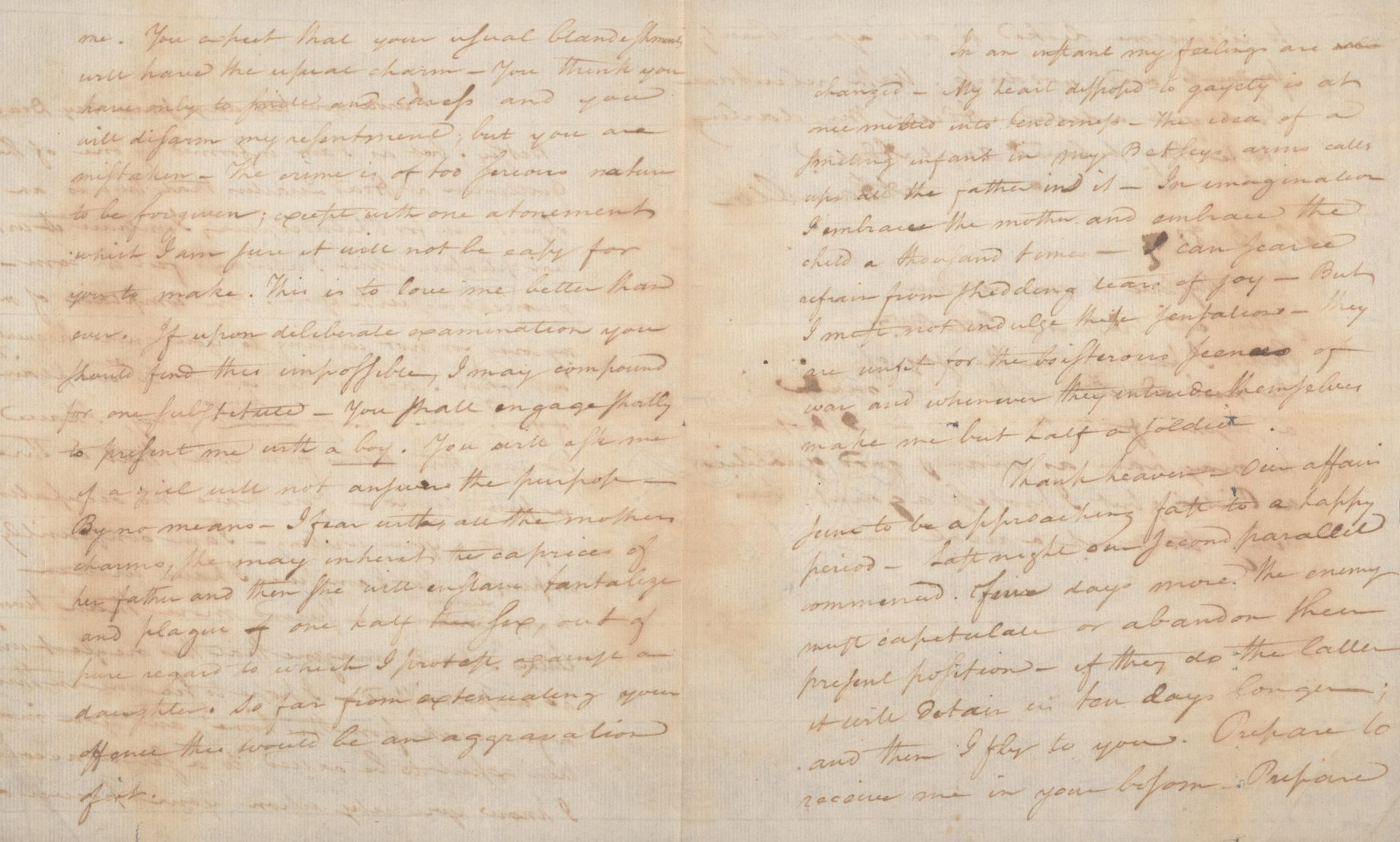
Bequest of Andre De Coppet, Class of 1915
Often remembered for his duel with Aaron Burr, Class of 1772, Alexander Hamilton served in the Continental Army, the Constitutional Convention, and as Washington’s Secretary of the Treasury. From the allied siege of British forces huddled at Yorktown, Hamilton wrote his wife, chastising her for not writing him and asking her to atone by giving birth to a son. Two days later he commanded the attack on Redoubt 10, a key British defensive position

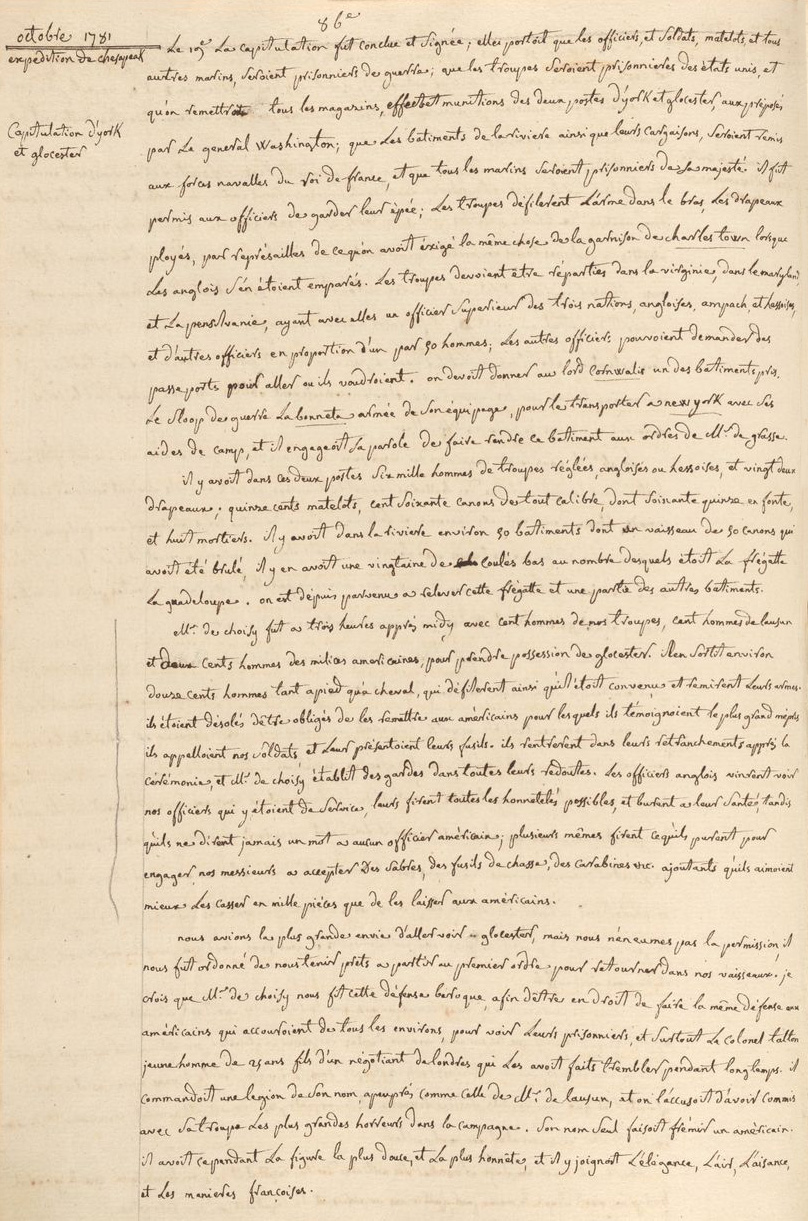
Journal particulier d'une campagne aux Indes Occidentales, 1780–1782
Joachim du Perron, comte de Revel (1756–1814)
Gift of Stuart W. Jackson
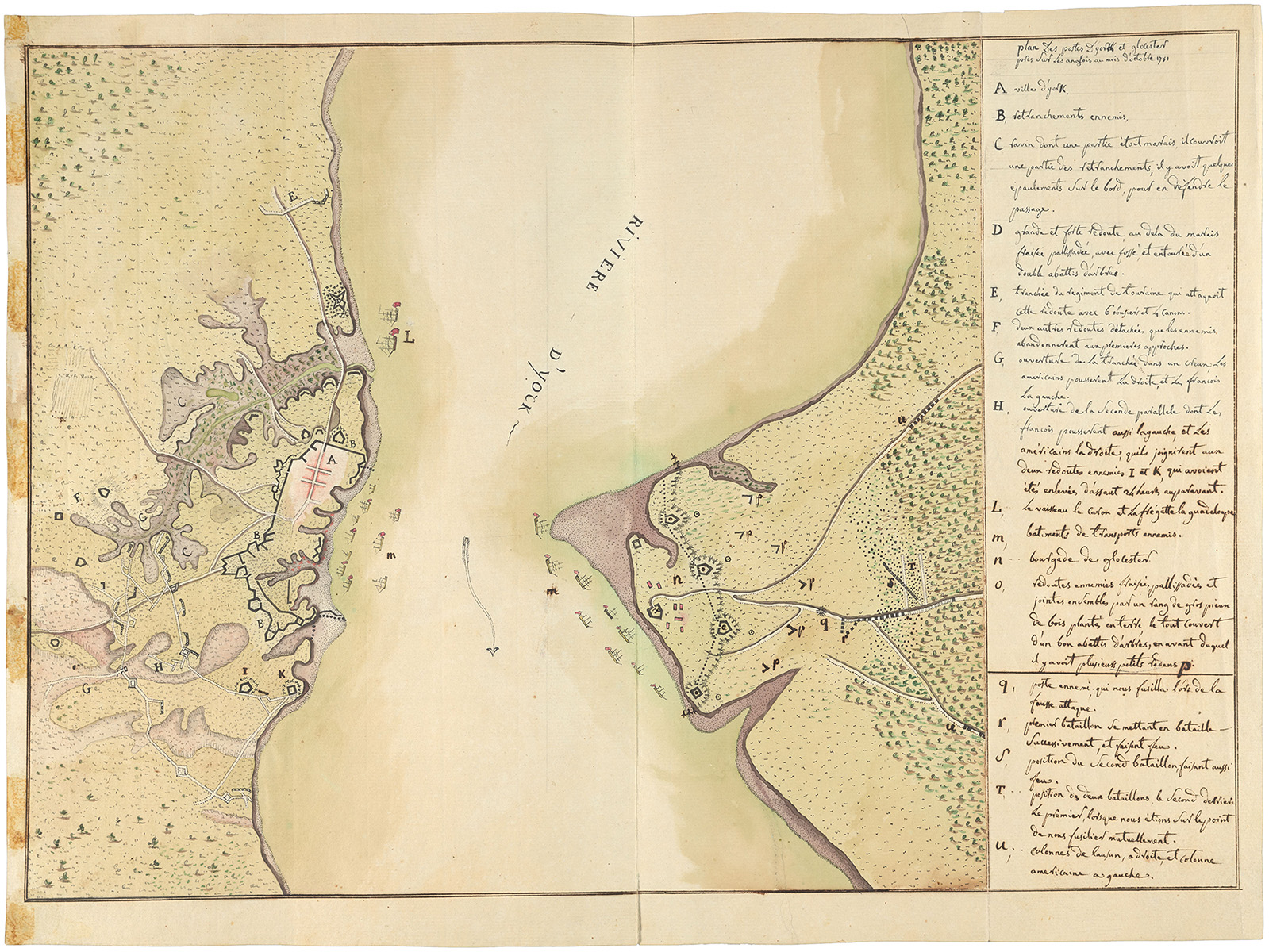
The roar of cannons kept the Comte de Revel, a French officer who sailed with Admiral de Grasse’s fleet, on edge throughout the night of October 16, 1781. By morning, the firing suddenly ceased—after nearly three weeks, the British had finally capitulated. After witnessing the surrender and breaking camp, de Revel detoured through Gloucester, Virginia, to view the battle’s gruesome aftermath. Examining the disfigured remains of British defenses, he pieced together British positions and plans in order to sketch this battlefield map.

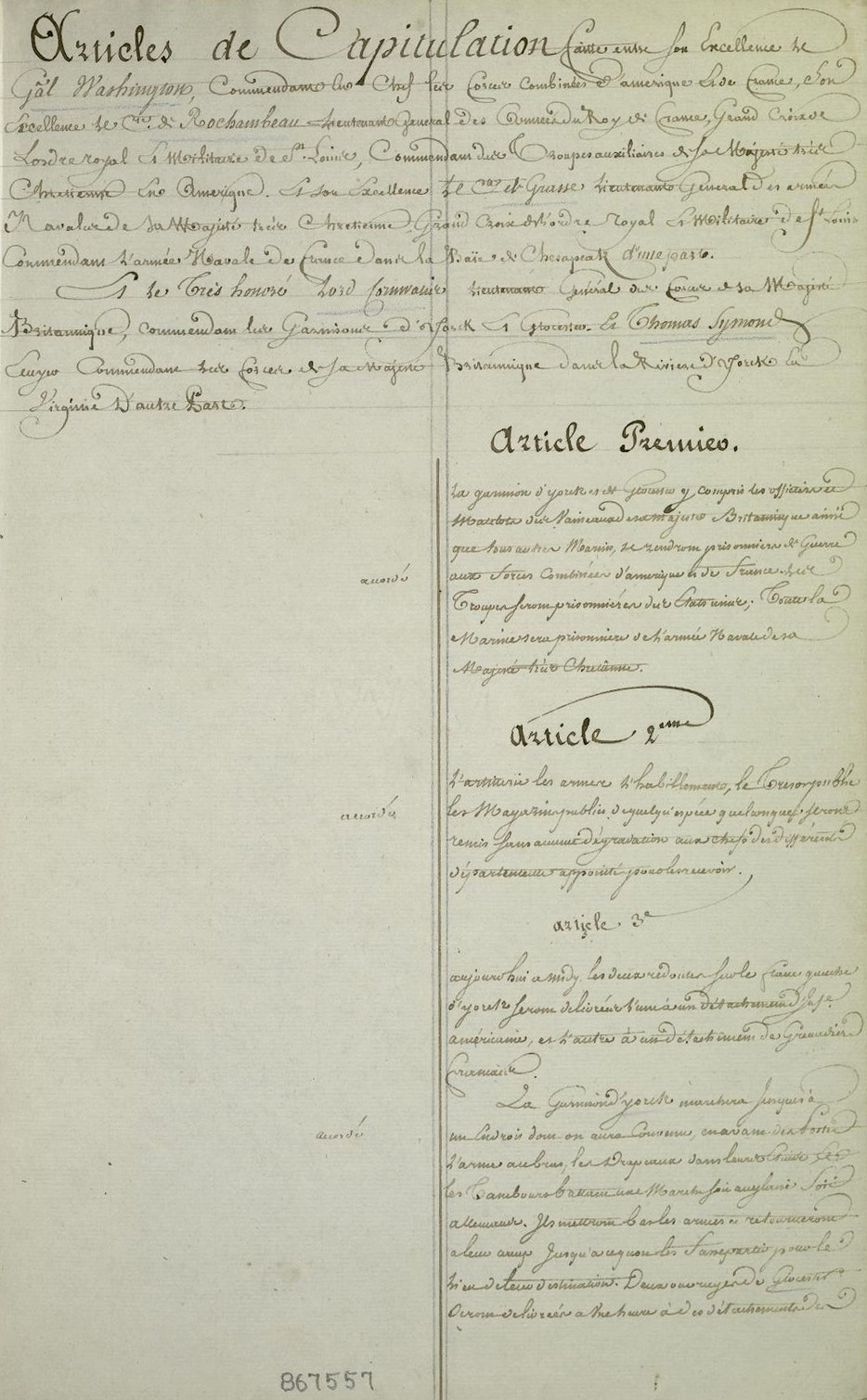
Capitulation du Siege d’Yorck, October 19, 1781
Gift of Harry C. Black, Class of 1909
A drummer emerged from battered Yorktown, followed by a soldier with a white handkerchief. After three weeks trapped in the town under deafening bombardment, the British Army was ready to surrender. The Articles of Capitulation, negotiated by Washington, Rochambeau, and Cornwallis, settled the terms of the battle—but not the war. The victory brought hope, but whether it would secure independence remained an open question for two more grueling years.
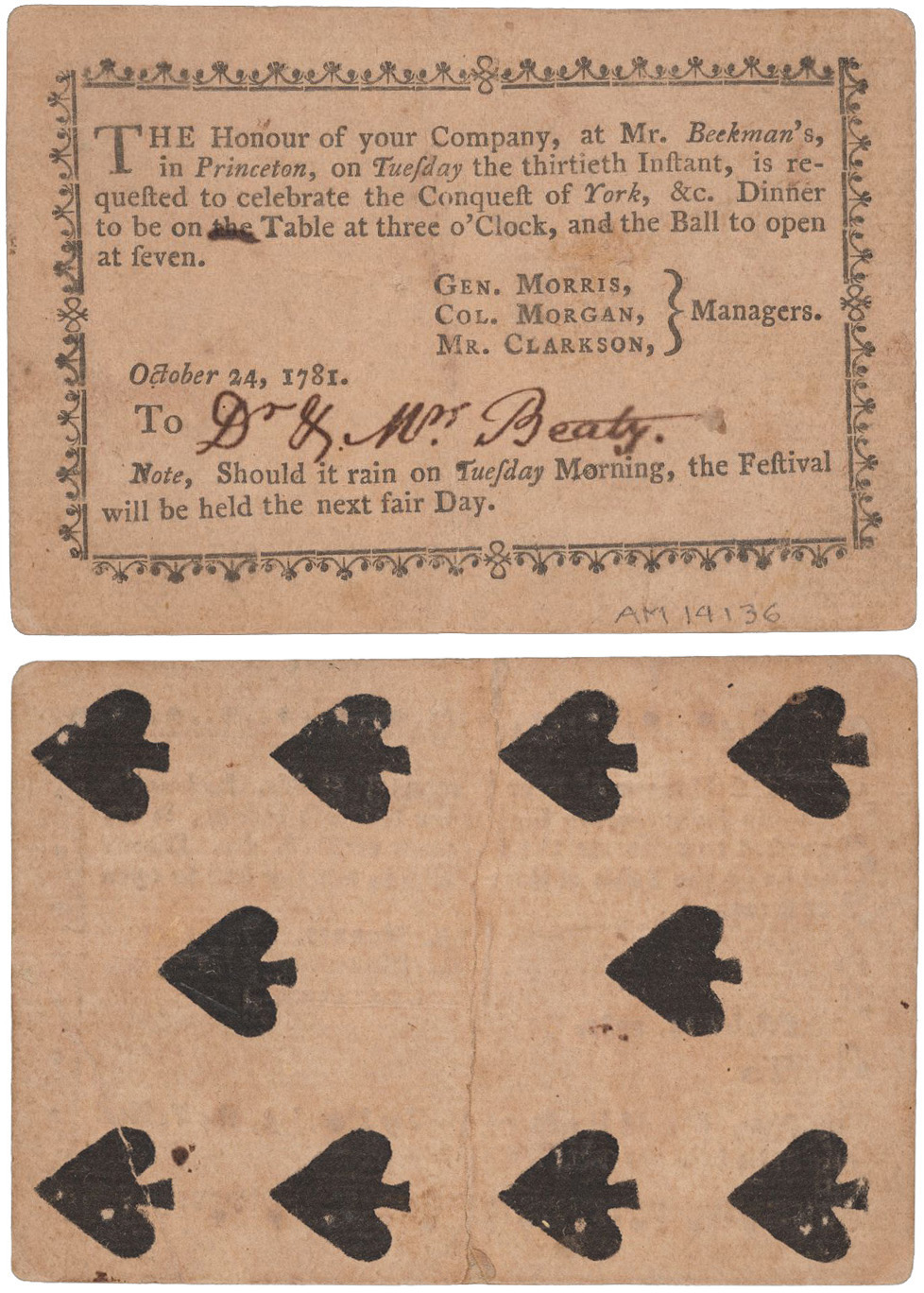
Invitation to a ball celebrating the victory at Yorktown, on the back of a playing card, October 24, 1781
Gift of Carl Otto Kretzschmar von Kienbusch, Class of 1906
Though the war would not officially end until 1783, victory at Yorktown sparked celebrations across the United States. In Princeton, festivities took place at Mr. Beekman’s—likely the College Inn, operated by Christopher Beekman, predecessor of today’s Nassau Inn. Playing-cards-turned-invitations enticed elite guests, such as future Congressman John Beatty and his wife Catherine, addressed here, who would have spent the night dining, dancing, and hoping this victory might finally secure independence.