Rebellion

Colonial resistance became armed rebellion in April 1775. The news from Lexington and Concord forced people to declare loyalties and prepare for war, and in Princeton it galvanized students at the college. In the months that followed, the Continental Congress established a Continental Army to coordinate the defense of American liberties while also affirming their loyalty to Britain and imploring the king for redress. George III instead declared the colonies in rebellion, and by early 1776, ordinary colonists were debating whether the British empire was the source of their rights and prosperity or their biggest threat. When New Jersey sent a fresh delegation to Congress, including John Witherspoon and Richard Stockton of Princeton as well as John Hart of nearby Hopewell, their presence helped tilt the balance toward independence.

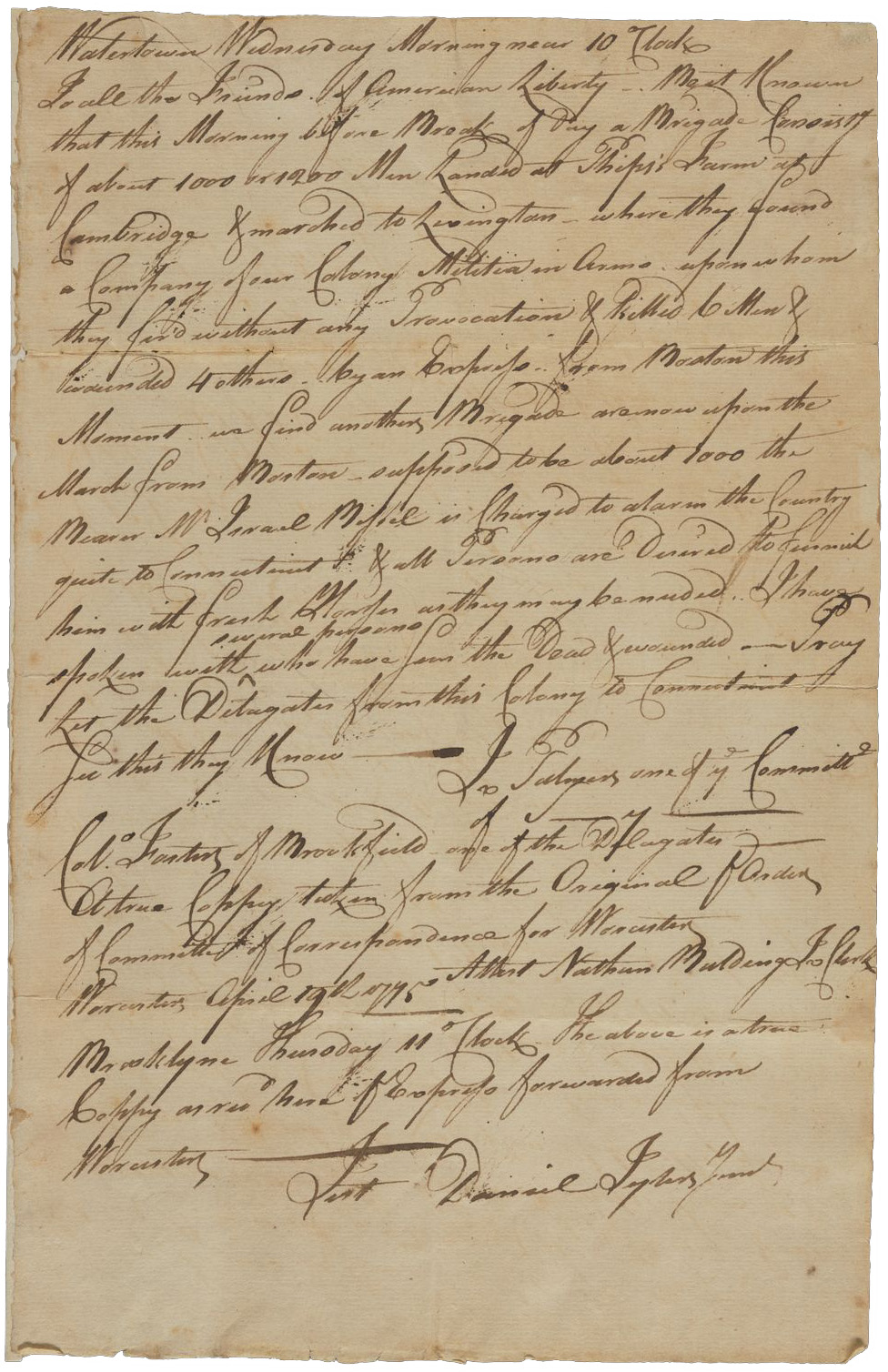
The Lexington Alarm, by Daniel Tyler, Jr., for the Committee of Brooklyne, forwarding the announcement of the British attack at Lexington, April 20, 1775
Bequest of William H. Scheide, Class of 1936
Express riders galloped from town to town with shocking news: “before Break of Day” on April 19, British regulars had opened fire on colonial militiamen at Lexington. At each stop, a patriot Committee of Correspondence hastily copied the message and forwarded it to “Friends of American Liberty” in the next town, signing their names to “alarm the Country” that the news of blood spilled at Lexington was true. Traveling through this network, the chain-letter alert took five days to reach Princeton and Philadelphia.

Bloody Butchery, by the British Troops; or The Runaway Fight of the Regulars, 1775
Salem, Mass.: Printed and sold by E. Russell
Bequest of William H. Scheide, Class of 1936
The Battles of Lexington and Concord were the “shot heard ‘round the world”—the world having primarily heard it through widely-circulated broadsides, such as this one printed in Salem, Massachusetts. Broadsides were posted in public spaces like marketplaces or taverns, spreading the alarming news that war had broken out in Massachusetts and rallying intercolonial sympathy for the ordinary farmers who “died fighting in the glorious cause of Liberty” against “brutal” British hostility.



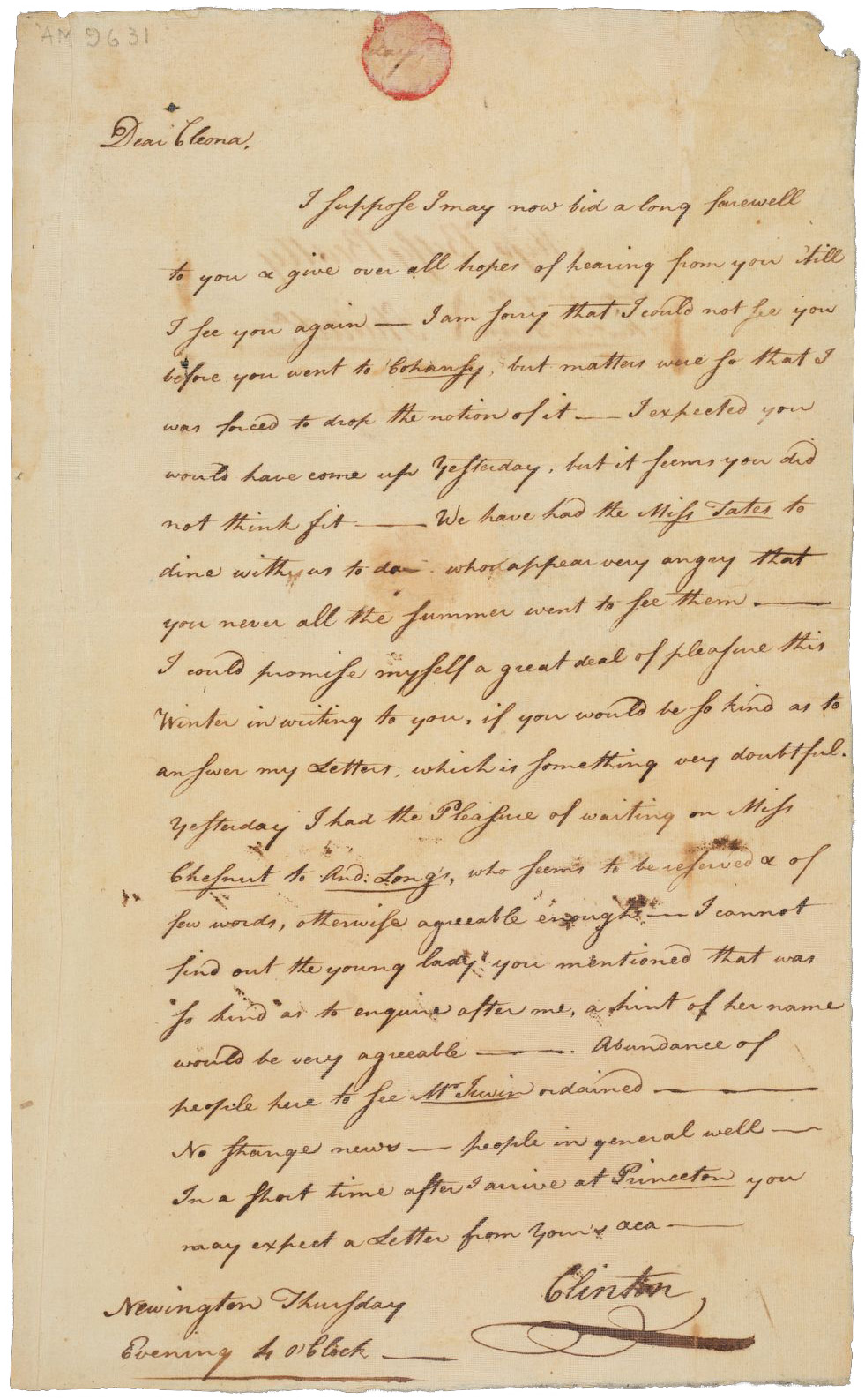
Letter from Charles Clinton Beatty (1756-1776), Class of 1775, to Betsy Beatty, May 28, 1775
Gift of Dr. Ralston Fithian Elwell and his sister, Florence Beatty Bixler
“You need not speak here [unless] it is about Liberty,” Charles Clinton Beatty wrote from Princeton to his sister Betsy five weeks after Lexington and Concord. Students had formed a militia company, and “every man handles his Musket and hastens in his preparations for war.” Charles chastised Betsy for insufficient patriotism, indicating the significance of women’s political opinions as the colonies mobilized for war. But he wanted her to contribute through a traditionally domestic role: by supplying him with homespun commencement attire to replace the imported academic robes students had spurned.

Instructions for the Inlisting of Men, June 28, 1775
Provincial Congress at New-York
Bequest of Andre De Coppet, Class of 1915
Two months after Lexington and Concord, the Continental Congress voted to create a “Continental Army” for the defense of American liberty. With this broadside, New York’s provincial assembly promised officer’s commissions to those who enlisted a company of 72 men for the new army. The handwritten final instruction—to enlist “no apprentice or servant . . . without the consent of the master”—reveals the military conflict’s potential to destabilize social hierarchy in the colonies.

Letter and poem to George Washington, October 26, 1775, in The Pennsylvania Magazine: or, American Monthly Museum
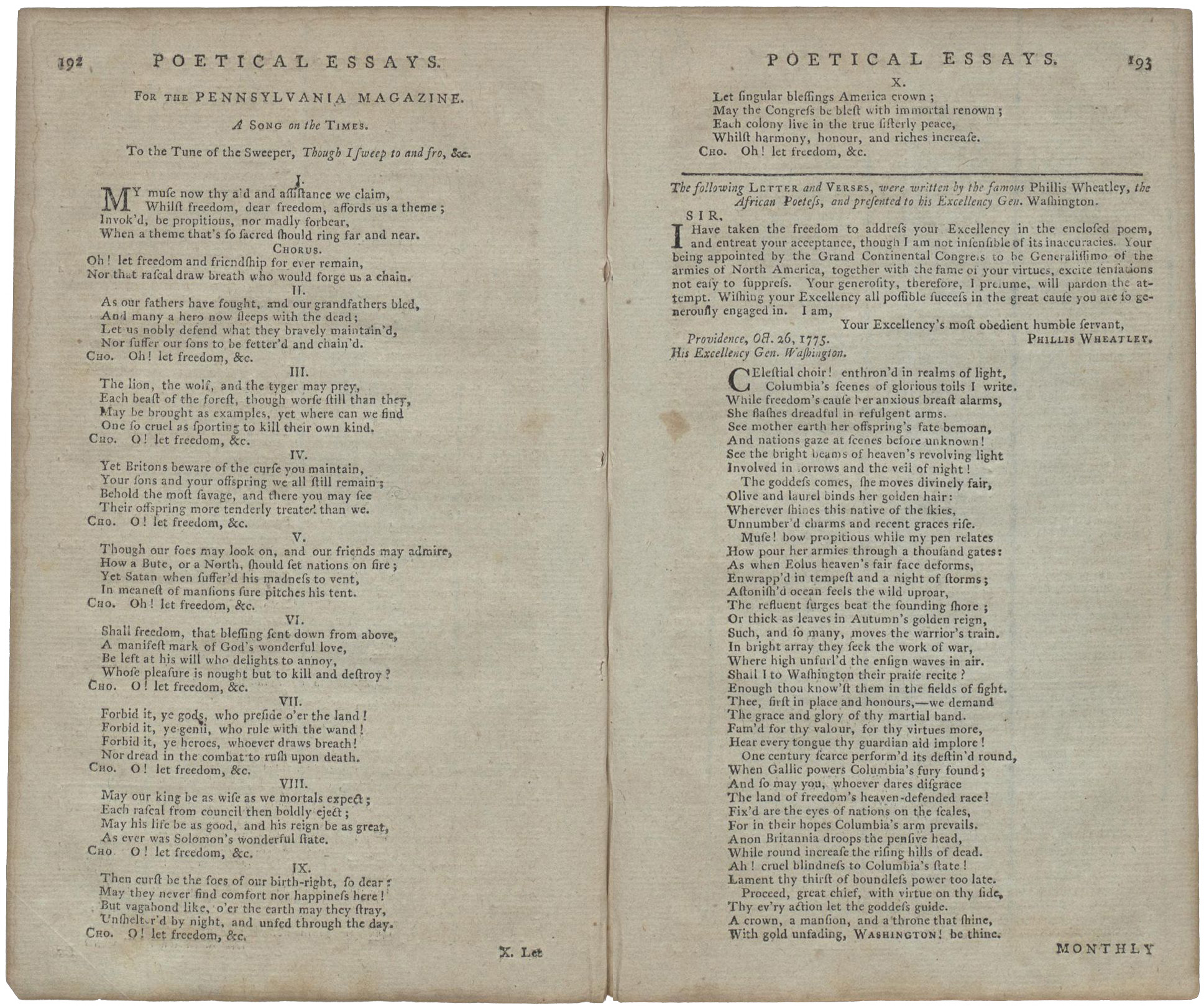
Phillis Wheatley (circa 1753–1784)
Philadelphia: Printed by R. Aitken, April 1776
Gift of Sid Lapidus, Class of 1959
The outbreak of armed rebellion prompted the Wheatleys to flee Boston for Providence, Rhode Island, and it was there that Phillis Wheatley wrote her poem marking George Washington’s appointment as commander-in-chief of the Continental Army. Wheatley enclosed the poem in a letter to Washington, to which he replied, “the elegant Lines you enclosed . . . exhibit a striking proof of your poetical Talents.” First published in the Virginia Gazette, the poem was reprinted in Thomas Paine’s Pennsylvania Magazine.

Die Zerstörung der Königlichen Bild Säule zu Neu Yorck [The Destruction of the Royal Statue in New York], circa 1776
![Image of hand-colored etching of "Die Zerstörung der Königlichen Bild Säule zu Neu Yorck [The Destruction of the Royal Statue in New York], circa 1776"](/uploads/spotlight/attachment/file/6891/Item_31.jpg)
Franz Xaver Habermann (1721-1796)
Hand-colored etching / vue d’optique
After the Declaration of Independence was publicly read in New York on July 9, 1776, a group of soldiers and Sons of Liberty toppled the statue of George III on Manhattan’s Bowling Green and melted it down for bullets. This print dramatized the unrest in Britain’s colonies for a European audience. The artist, a German printer who had never been to North America, depicted New York as if it were a fashionable Bavarian town—but prominently featured enslaved Africans to evoke the event’s colonial setting.

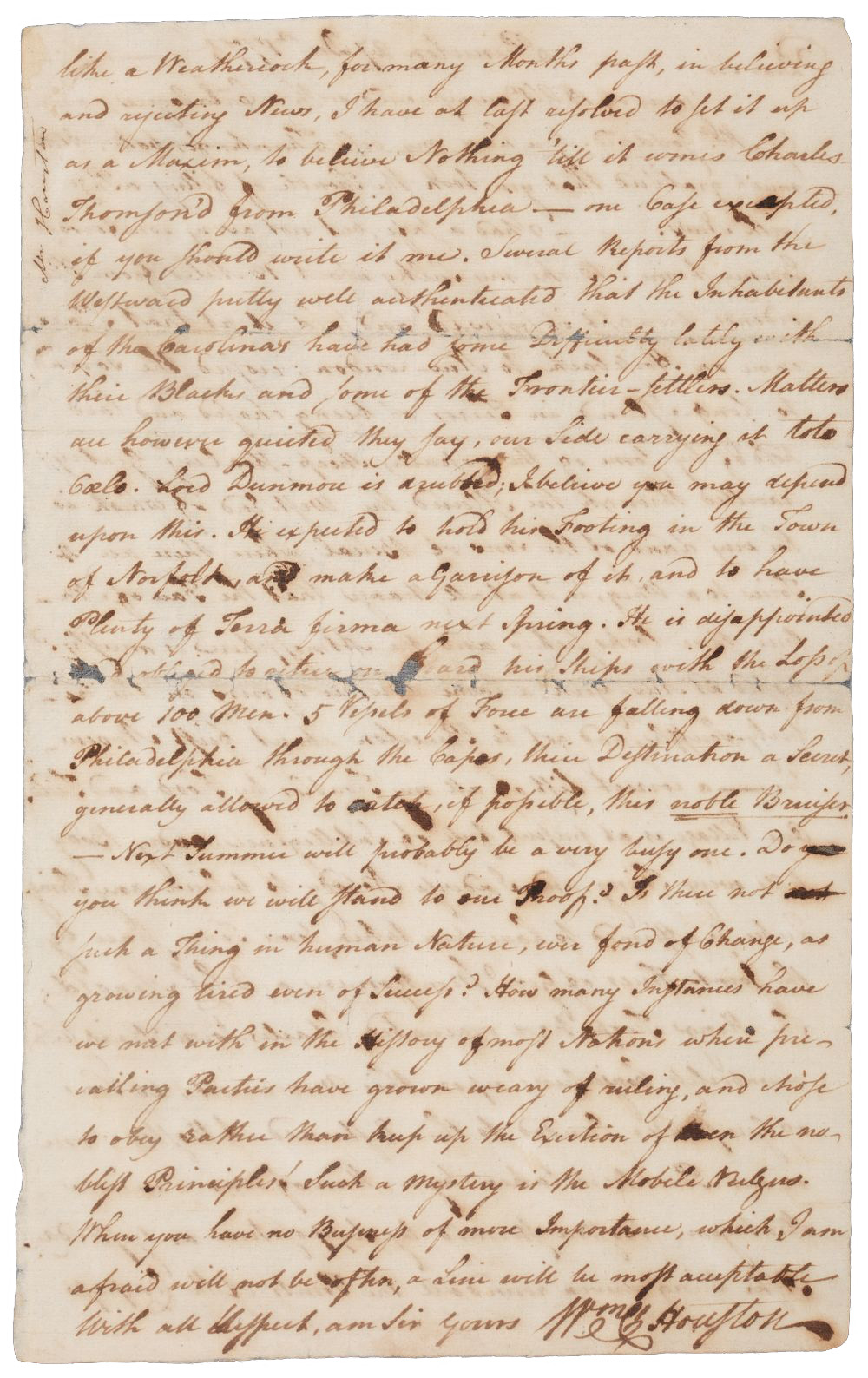
Letter from William Churchill Houston (1746–1788), Class of 1768, to John Winthrop, December 27, 1775
Bequest of Andre De Coppet, Class of 1915
William Churchill Houston was the college’s first Professor of Mathematics and Natural Philosophy. In this letter to his Harvard counterpart, he relayed the news and rumors swirling around Princeton in late 1775: about Congress’s invasion of Quebec, troop movements around Boston, fears of slave rebellion in the Carolinas, and the defeat of Governor Dunmore’s redcoats and Black loyalists in Virginia. Houston worried that colonists might soon grow weary of fighting for the cause and choose “to obey rather than keep up the Exertion.”

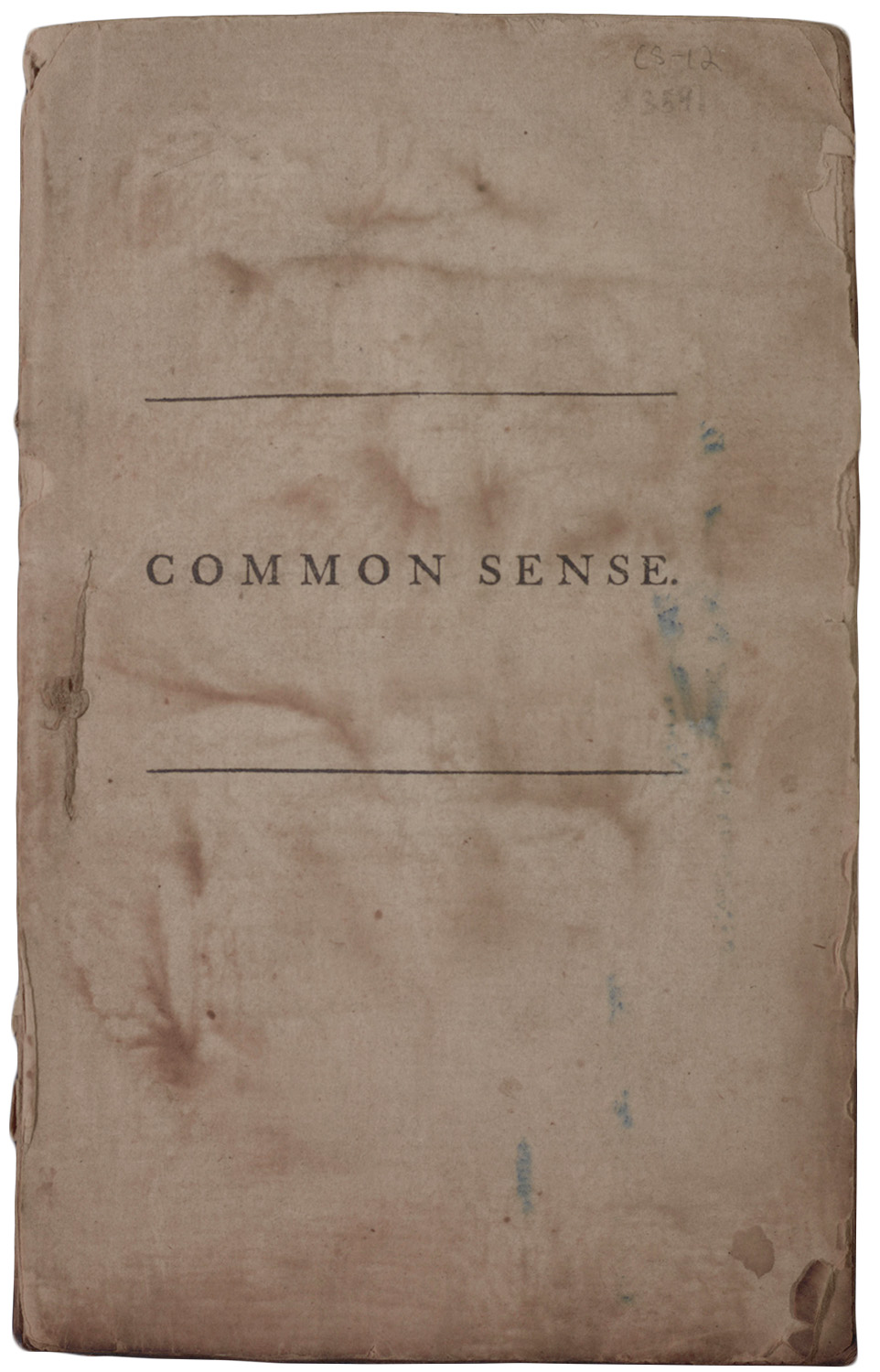
Common Sense; Addressed to the Inhabitants of America
Philadelphia: W. and T. Bradford, 1776. Gift of Sid Lapidus, Class of 1959 (left)
London: re-printed for J. Almon, 1776. Bequest of William H. Scheide, Class of 1936 (bottom)
Inspiring, irreverent, and compulsively readable, Thomas Paine’s Common Sense burst onto the scene in January 1776. Paine, an obscure corsetmaker recently arrived from England, argued that the British constitution was corrupt beyond repair, and that rather than continue trying to fix the British empire, Americans should simply leave it. He championed republican society and kingless government, insisting that independence was not just desirable but pragmatically possible and casting the patriots’ struggle in universal terms: “the cause of America is in a great measure the cause of all mankind.”
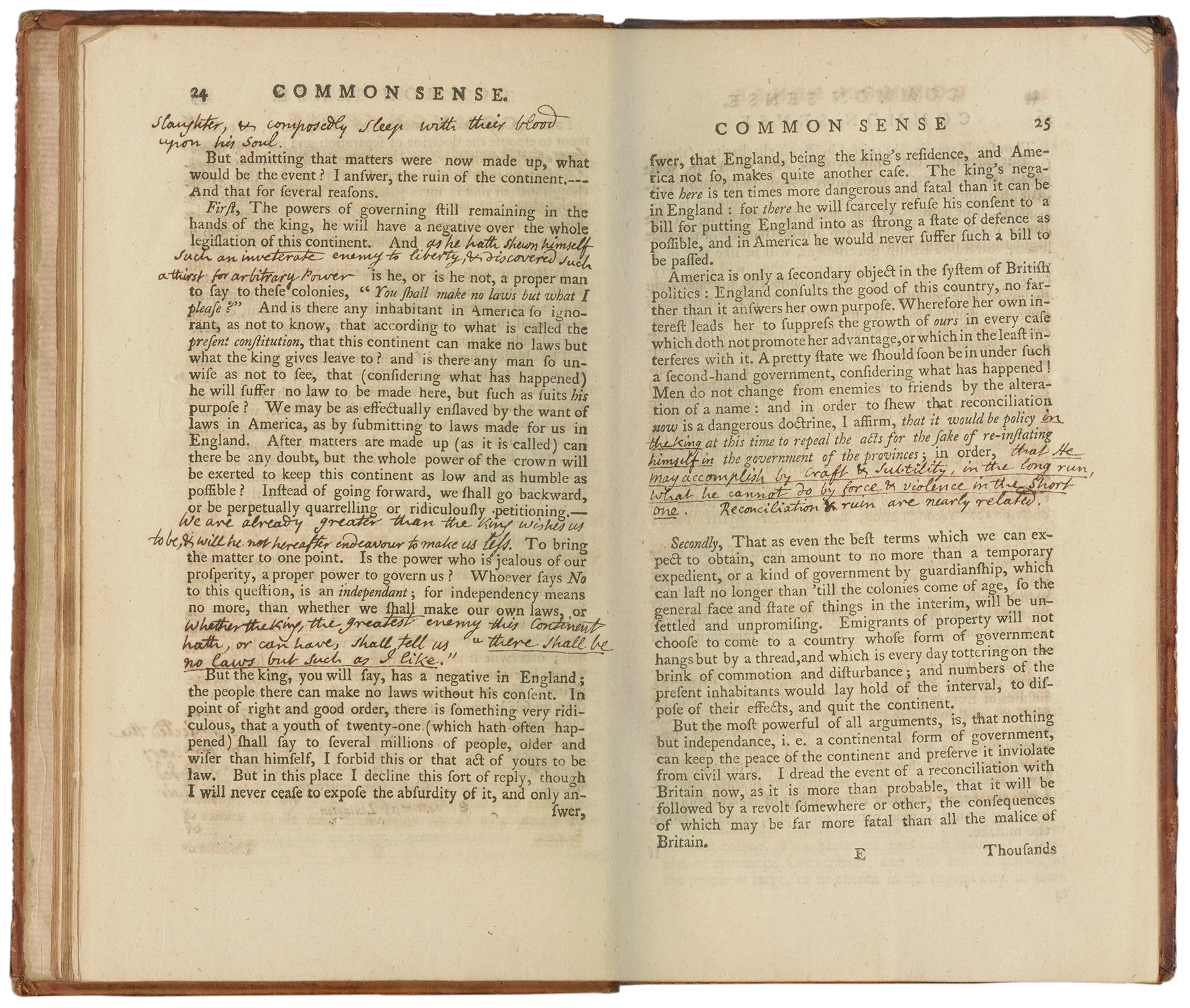
Published as an affordable pamphlet, Common Sense sold more than 100,000 copies in a few months. It was soon reprinted in England, where Paine’s most radical attacks on monarchy and George III were censored as libellous. Some readers, like the owner of the English edition on the right, wrote in the missing text themselves.


The Dominion of Providence Over the Passions of Men. A Sermon Preached at Princeton, on the 17th of May, 1776
John Witherspoon (1723-1794)
Philadelphia: Printed and sold by R. Aitken, 1776
The only college president—and clergyman—to sign the Declaration of Independence, John Witherspoon was a central figure in fostering Princeton’s revolutionary fervor. In this sermon, delivered a month before his election to the Continental Congress, he aligned the college with the patriot cause, declaring that “the cause in which America is now in arms, is the cause of justice, of liberty, and human nature.” Witherspoon led the college throughout the war, and many of his pupils would play pivotal roles in the nation’s founding.
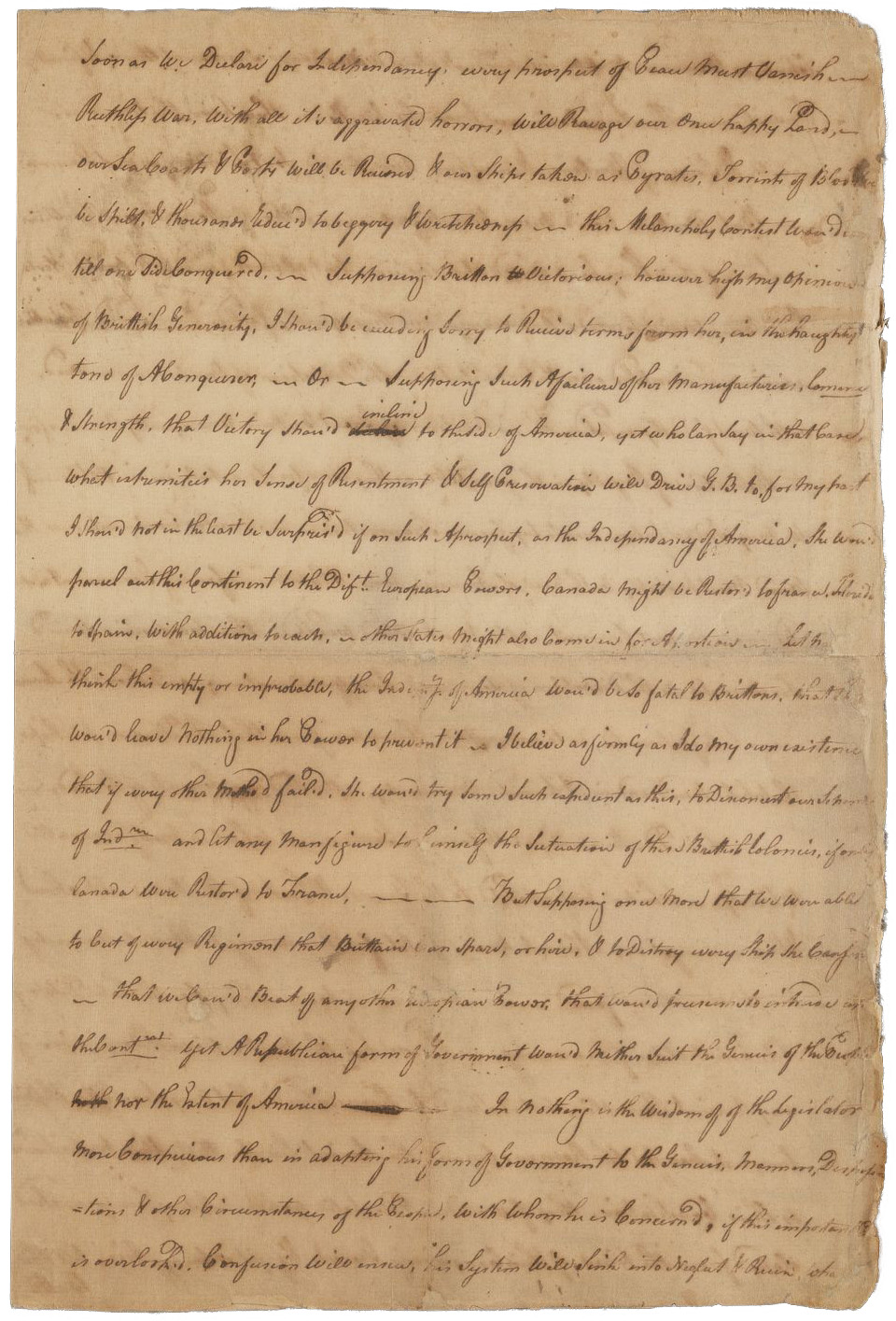
“Thoughts on the present State of Affairs,” June 11, 1776
Bequest of Andre De Coppet, Class of 1915
This anonymous manuscript is an unsolved puzzle. Borrowing heavily from The Deceiver Unmasked—a controversial loyalist pamphlet written in response to Paine’s Common Sense—the manuscript also takes the form of a speech. The writer denounces republicanism and warns that independence will “Ravage our once happy Land” with “Ruthless war” and “Torrints of Blood.” Given its date, the manuscript may relate to New Jersey’s Provincial Congress, which convened on June 11, 1776, and would quickly arrest the royal governor, send a pro-independence delegation to Philadelphia, and draft a state constitution.