Congress at Princeton

In 1783, Princeton became the Revolution’s epicenter for a second time. Following a mutiny by unpaid Continental soldiers in Philadelphia, Congress left the city for Princeton, which for four months served as the new nation’s makeshift capital.
Convening in Nassau Hall, only partially repaired after the battle seven years prior, leading statesmen worked cheek-by-jowl with teenage scholars. The delegates shared cramped quarters, holding committee meetings amid the mess and noise of student lodgings. According to Congress’s secretary, they were “extremely out of humour and dissatisfied with their situation.”
Nevertheless, in this unlikely setting, the members of Congress received some of the nation’s first visiting diplomats. They hosted an official audience with Washington and learned that the definitive peace treaty with Britain had been signed in Paris. And they confronted some of the new republic’s most pressing questions: where it fit on the world stage, how to pay for the war that had just been won, and whether 13 states united by war could hold together in peace.

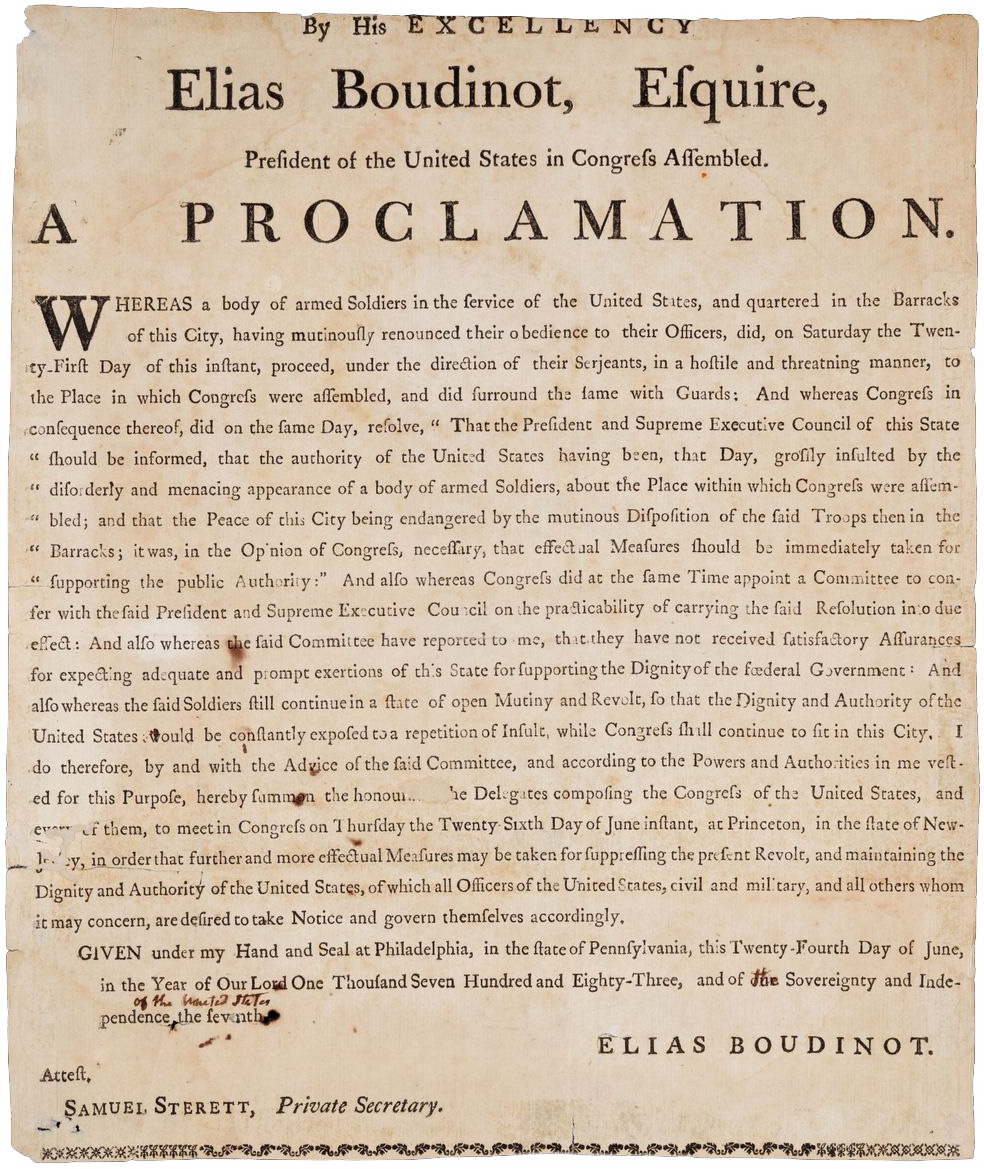
By His Excellency Elias Boudinot, Esquire, President of the United States in Congress Assembled. A Proclamation, June 24. 1783
Philadelphia: Printed by David C. Claypoole
Though victorious on the battlefield, the patriots still faced a massive fiscal crisis. Congress lacked the authority to tax and struggled mightily to fund the Continental Army. In June 1783, several hundred soldiers surrounded Independence Hall with fixed bayonets to demand their back pay. Shaken and humiliated, Congress left Philadelphia—in part to publicly demonstrate the need for a stronger national government. With this proclamation, Elias Boudinot, Congress’s president, adjourned the delegates to Princeton, where he was a college trustee.

A Map of the United States of America Agreeable to the Peace of 1783
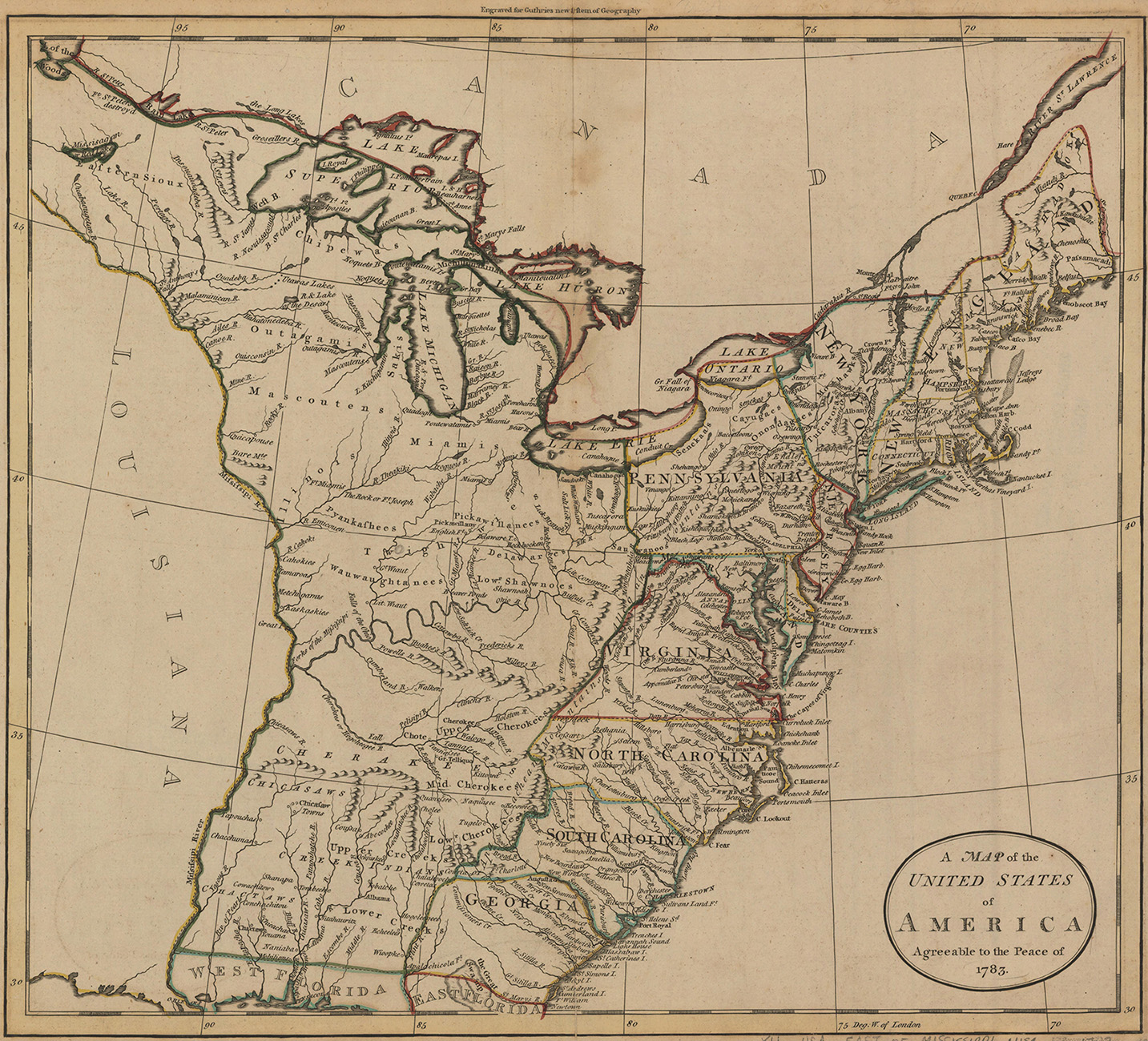
John Russell (circa 1750–1829)
Engraving by William Darton. London, 1783
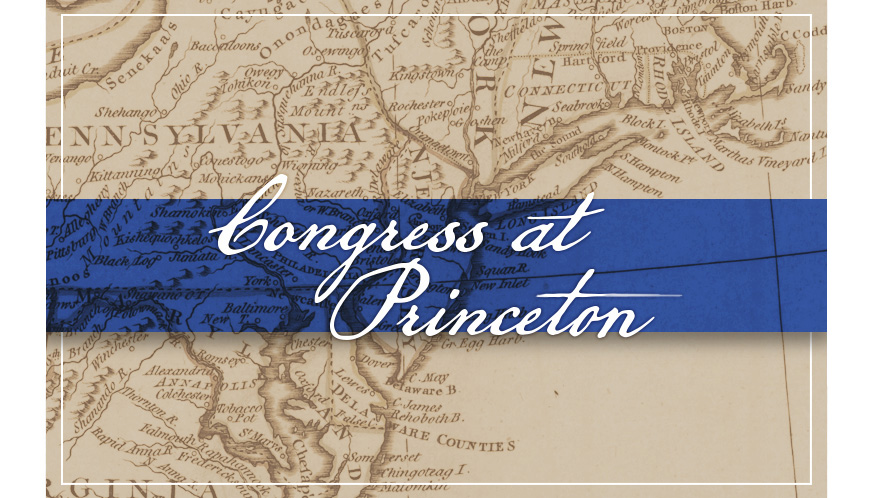
After two years of negotiations, news of peace with Great Britain was rushed to Nassau Hall. The United States now possessed all of the former British land claims between Canada, Florida, and the Mississippi River. This map was among the first to visualize the new borders. The war was won, but it begged new questions: how could these vast claims—already densely populated with Native nations—become a part of the republic?

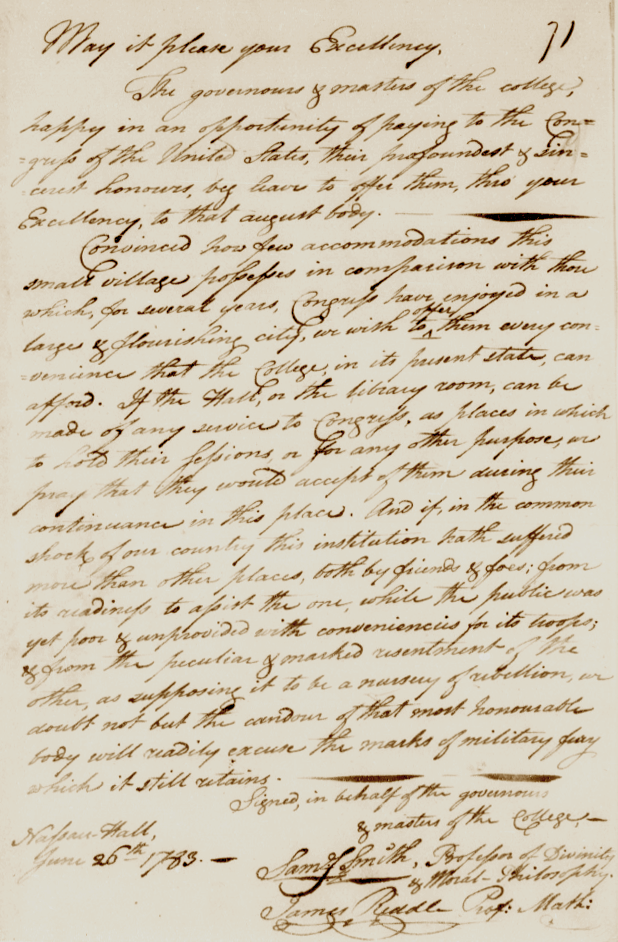
Letter from the governors and masters of the College of New Jersey to the President of Congress, June 26, 1783
Courtesy, National Archives & Records Administration, Washington, D.C.
In this letter, the college faculty invited Congress to meet in Nassau Hall. Offering up the use of its prayer hall and library, they made apologies for the state of campus, which still bore the “marks of military fury.” The building, they explained, had suffered hard use as a Continental barracks—and had been a target of the British army’s “peculiar & marked resentment” on account of the college’s reputation as a “nursery of rebellion.”
Articles of Confederation and Perpetual Union Between the States of New-Hampshire, Massachusetts-Bay, Rhode-Island and Providence Plantations, Connecticut, New-York, New-Jersey, Pennsylvania, Delaware, Maryland, Virginia, North-Carolina, South-Carolina and Georgi
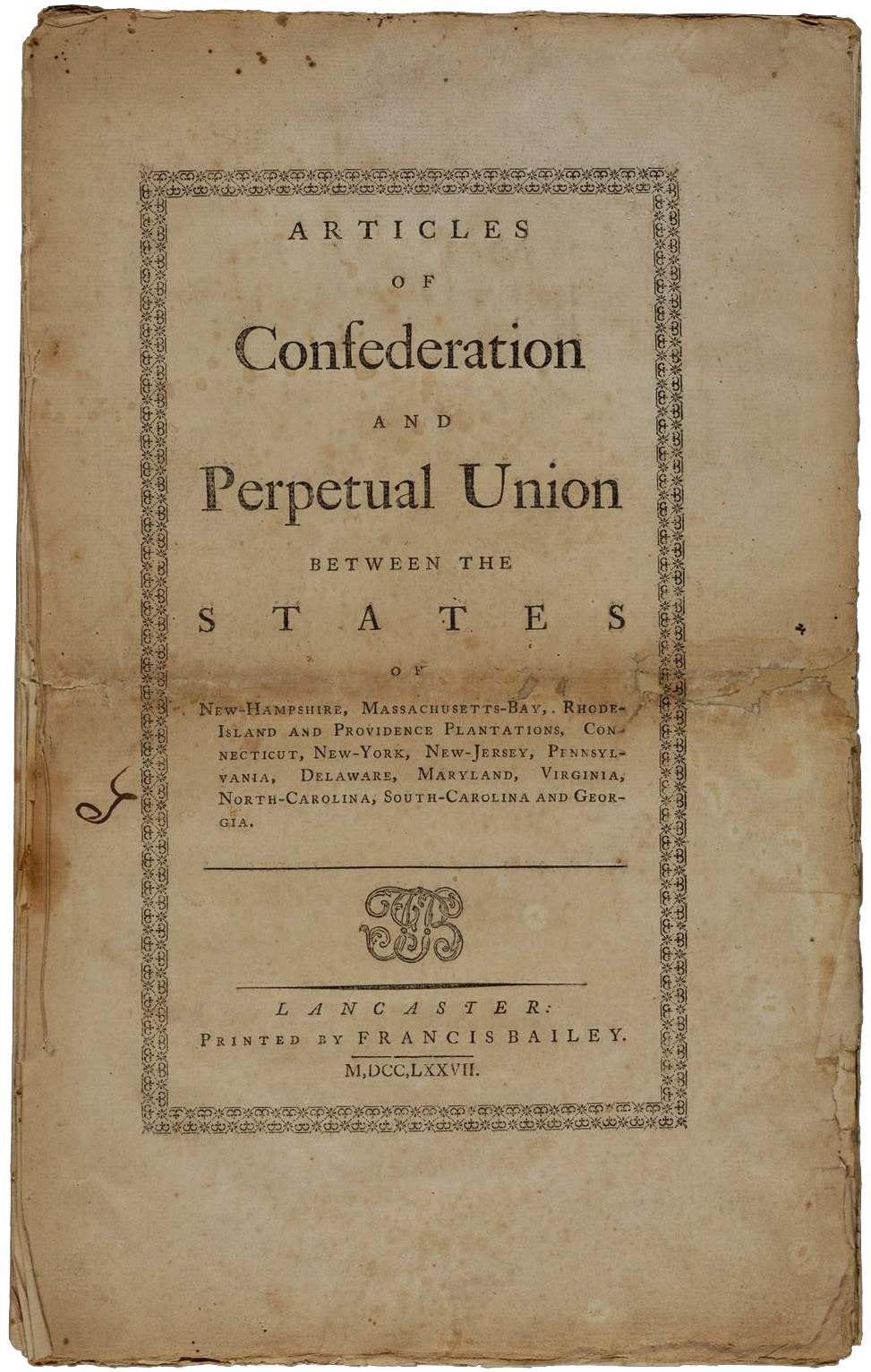
Lancaster, Pennsylvania: Printed by Francis Bailey, 1777
Bequest of William H. Scheide, Class of 1936
Congress’s evacuation to Princeton was already a sign of problems. When disgruntled, underpaid soldiers rioted outside the Pennsylvania State House, the national government had no defense. Under the Articles of Confederation, Congress was a tenuous link between states, barely able to tax or regulate commerce, let alone control the military. The system carried them through a revolution, but cracks began to show. As the delegates convened at Nassau Hall, they faced a pressing question: could they unify the nation without creating another king?

Letter from Samuel Beach (1761-1793), Class of 1783, to John Croes, July 9, 1783
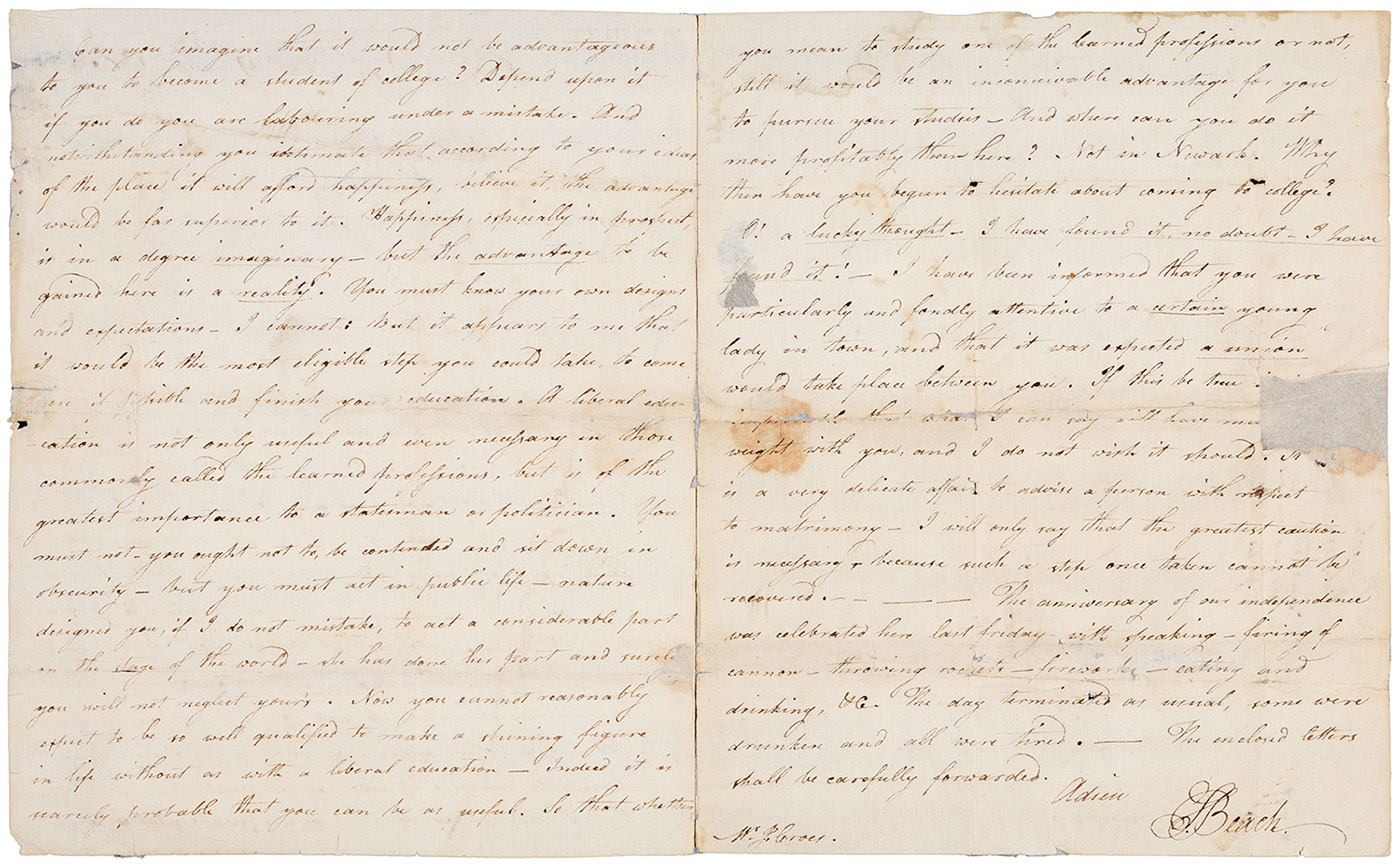
Gift of Alexander Graham
Trying to persuade a friend to join him in attending the college at Princeton, Samuel Beach, writing from Nassau Hall, described the official Fourth of July festivities in 1783, just days after Congress took up residence in town: “The anniversary of our independence was celebrated here last friday, with speaking, firing of cannon, throwing rockets, fireworks, eating and drinking, &c. The day terminated as usual, some were drunken and all were tired.”

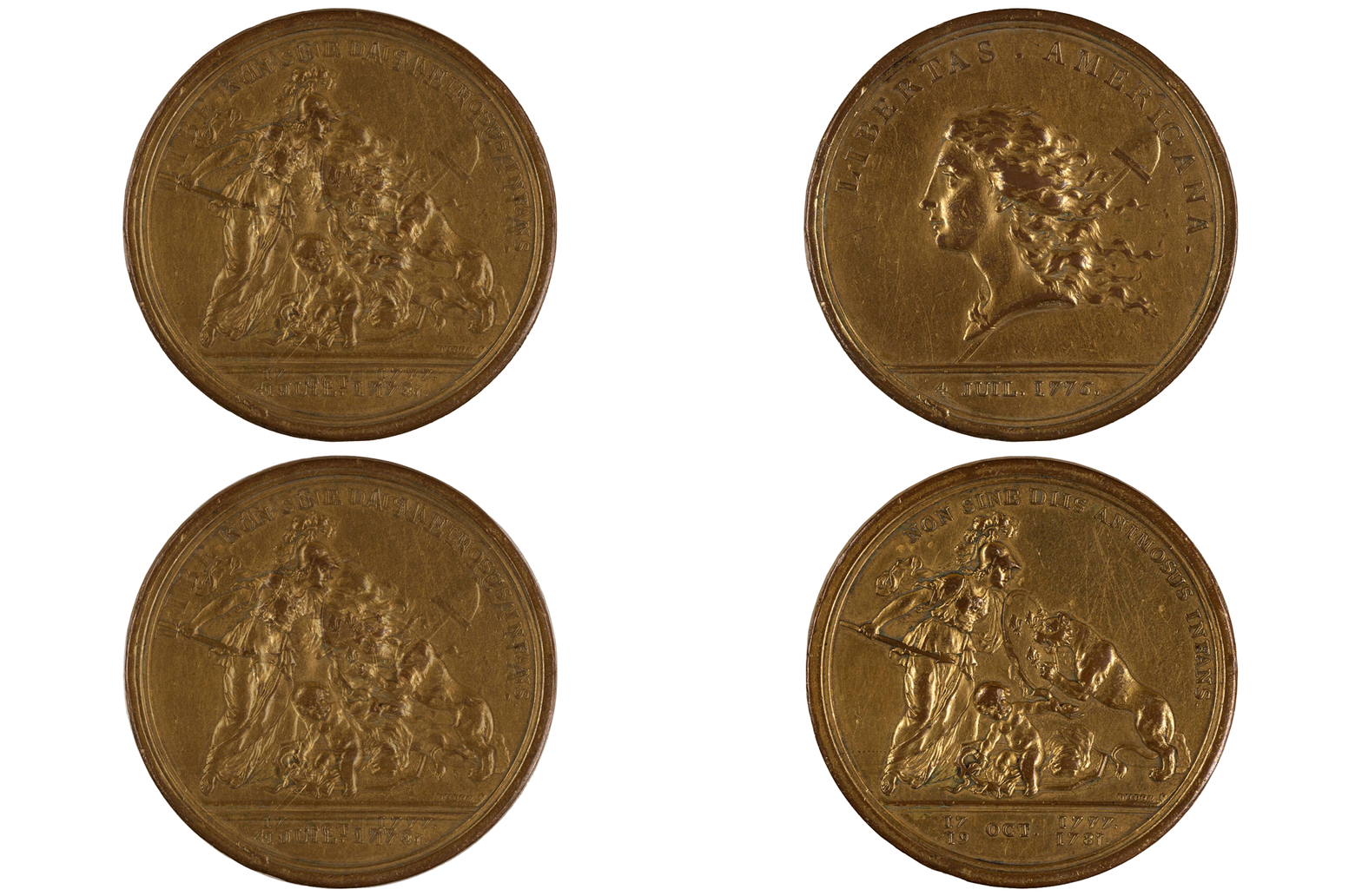
Libertas Americana, 1783
Augustin Dupré (1748–1833)
Gilt bronze medal
Gift of Rodman Wanamaker, Class of 1886
In October 1783, the Congress at Princeton learned that British and American negotiators had signed the Treaty of Paris. Back in France, Benjamin Franklin sponsored the creation of this medal to celebrate the alliance that had helped secure U.S. independence. One side represents Liberty as a woman with free-flowing hair. On the other side, Minerva (France) protects the infant Hercules (the United States) from two snakes and an attacking leopard (Great Britain). Franklin distributed some 300 examples to members of Congress, the French king and queen, and other supporters of the American cause.
Use the 3D viewer to explore the object. Click and drag to rotate, and scroll or pinch to zoom in for a closer look.

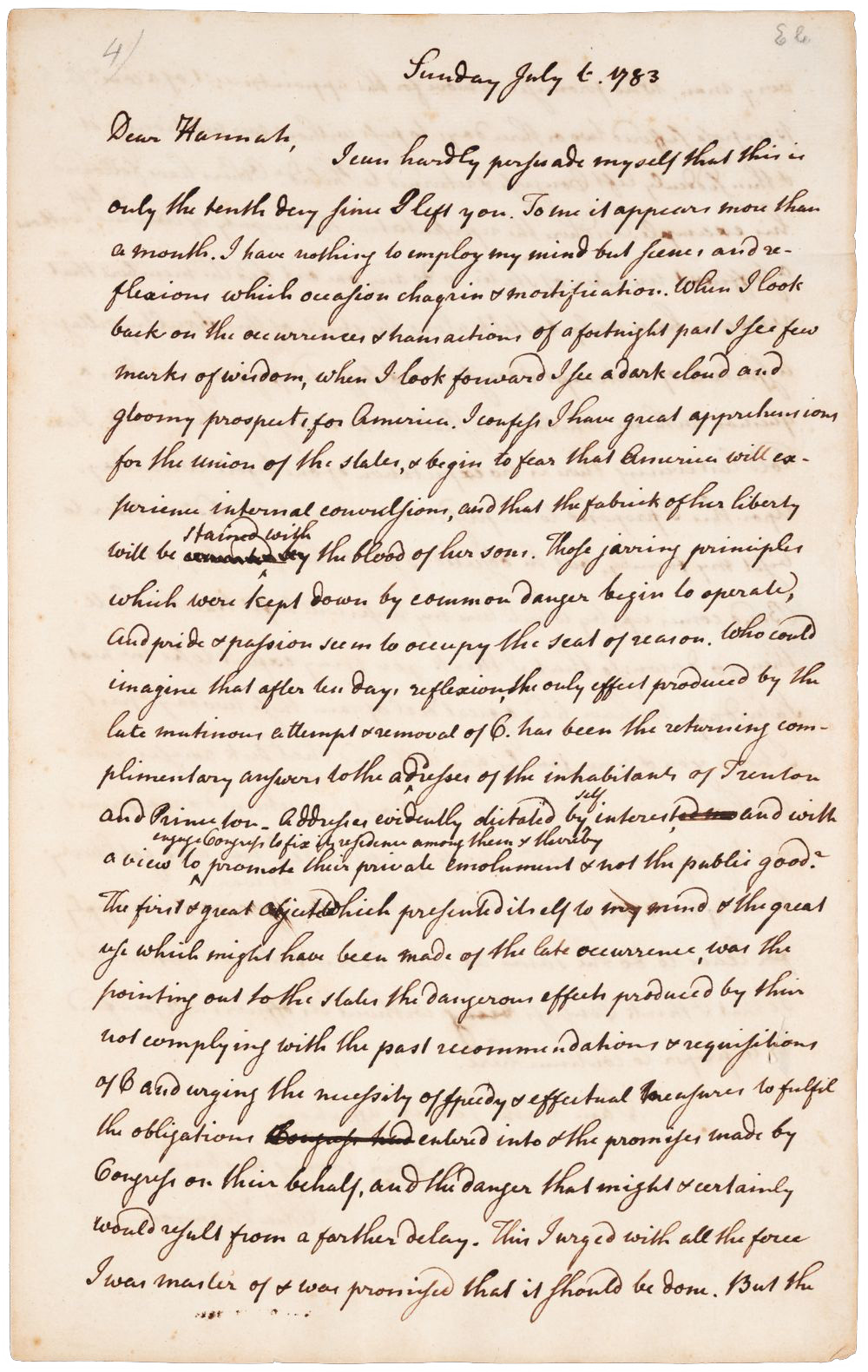
Letter from Charles Thomson (1729-1824) to Hannah Thomson, July 6, 1783
“When I look forward I see a dark cloud and gloomy prospects for America,” Charles Thomson wrote to his wife Hannah from Congress’s exile in Princeton. As secretary of the Continental Congress, Thomson had a front-row seat to the Revolution’s ups and downs. By 1783, the loss of a common enemy in Britain had left the states bickering among themselves. Thomson feared the union might splinter, warning that “the fabrick of her liberty will be stained with the blood of her sons.”
 Letter from George Washington (1732–1799) to James Madison, Class of 1771, November 30, 1785
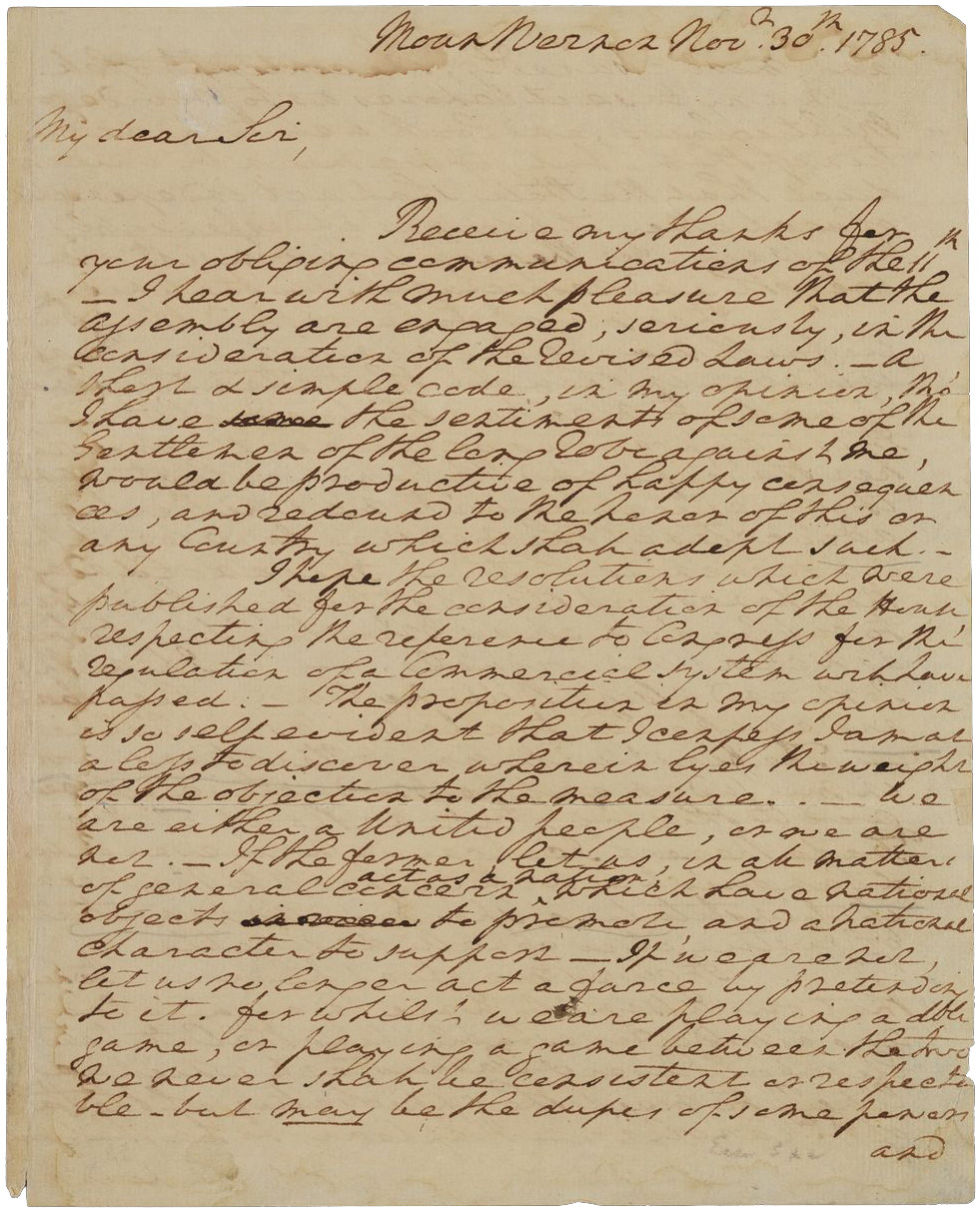
Bequest of Andre De Coppet, Class of 1915
During the war, Washington grew exasperated by the states’ reluctance to support the Continental Army beyond their individual borders. Such frustrating sectionalism only increased after 1783. In this letter to James Madison, Washington criticized Virginia’s hesitancy to augment Congress’s powers. With Congress unable to regulate trade, Washington feared foreign powers would exploit the states’ competing economic interests. He bluntly named the nation’s defining crisis under the Articles of Confederation: “We are either a United people, or we are not.”