Prime’s Revolutionary Ordeal

When war came to Princeton, Prime, an enslaved man in his early 20s, lived across Nassau Street at a house that still stands. His enslaver, Absalom Bainbridge, was a college alumnus, a physician, and a loyalist. After the Battle of Princeton, when Bainbridge fled to British-held Long Island, Prime followed. But in 1778, Prime ran away—becoming one of the tens of thousands of Black Americans who leveraged the turmoil of war to escape slavery. Returning to Princeton, he joined the Continental Army as a wagon driver, hoping that military service would earn him legal freedom. Yet still, at war’s end, Prime faced a new battle—in court—to secure his emancipation.

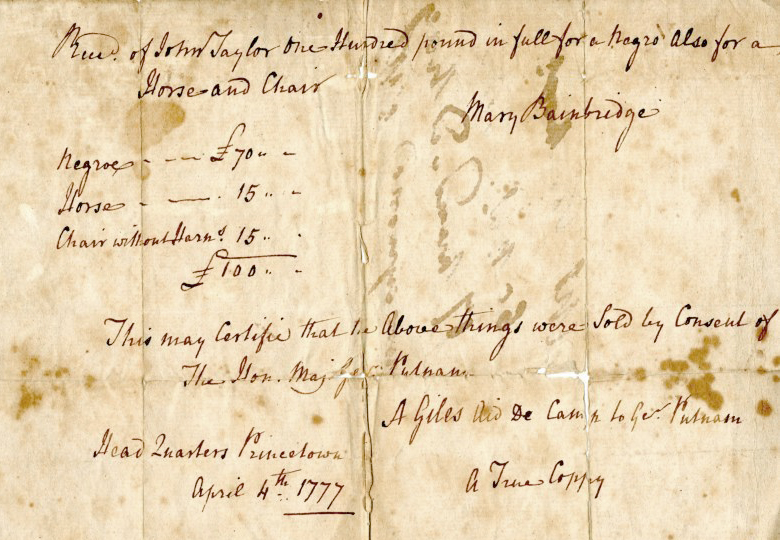
Receipt for enslaved person, April 4, 1777
Mary Bainbridge
Collection of the Historical Society of Princeton
Prime was living free in Trenton in 1784 when a White man claiming to have purchased him years prior dragged him back into slavery. Citing this receipt, Prime’s new enslaver argued that Mary Bainbridge, Absalom’s wife, had sold Prime before the revolutionary government confiscated Bainbridge’s property for loyalist treason. Who had owned Prime when? The courts took two years to investigate, ultimately determining that Prime was still enslaved—but belonged to the state government of New Jersey.

“An Act for Setting Free Negro Prime,” November 21, 1786. Acts of the Eleventh General Assembly of the State of New-Jersey
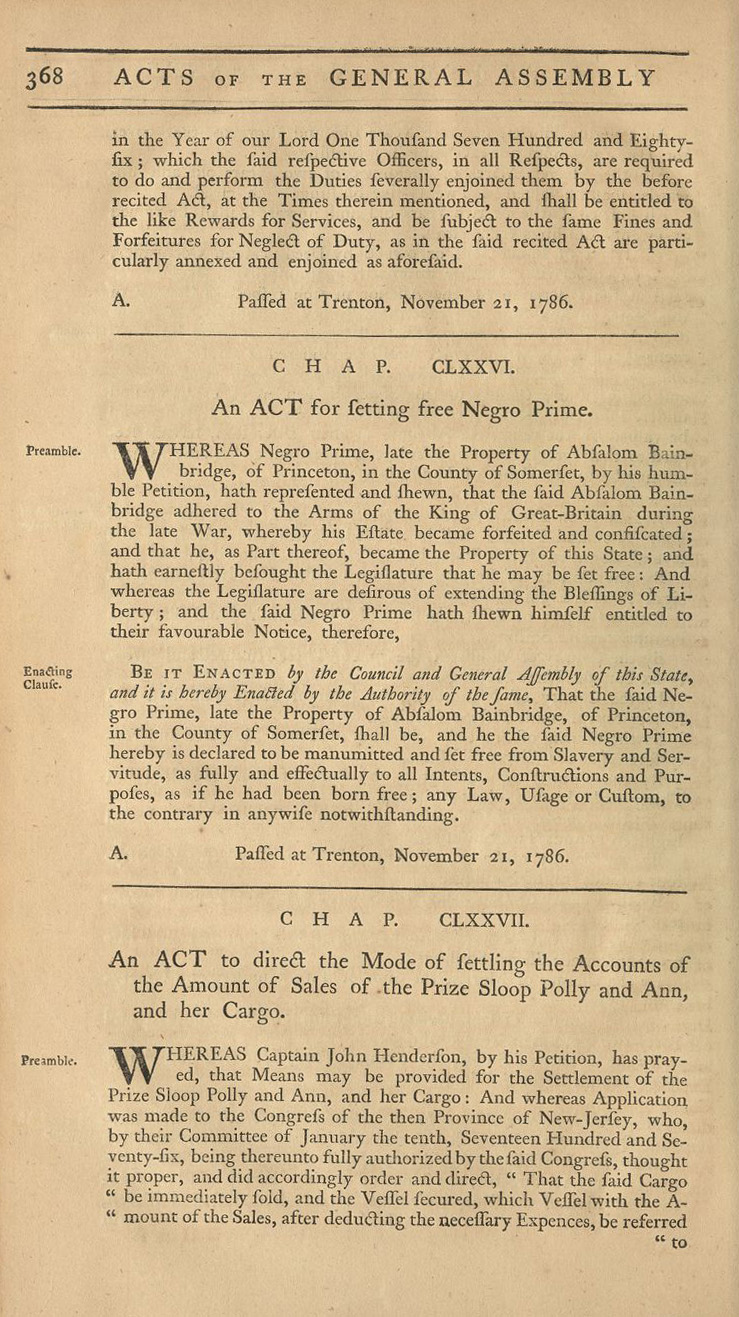
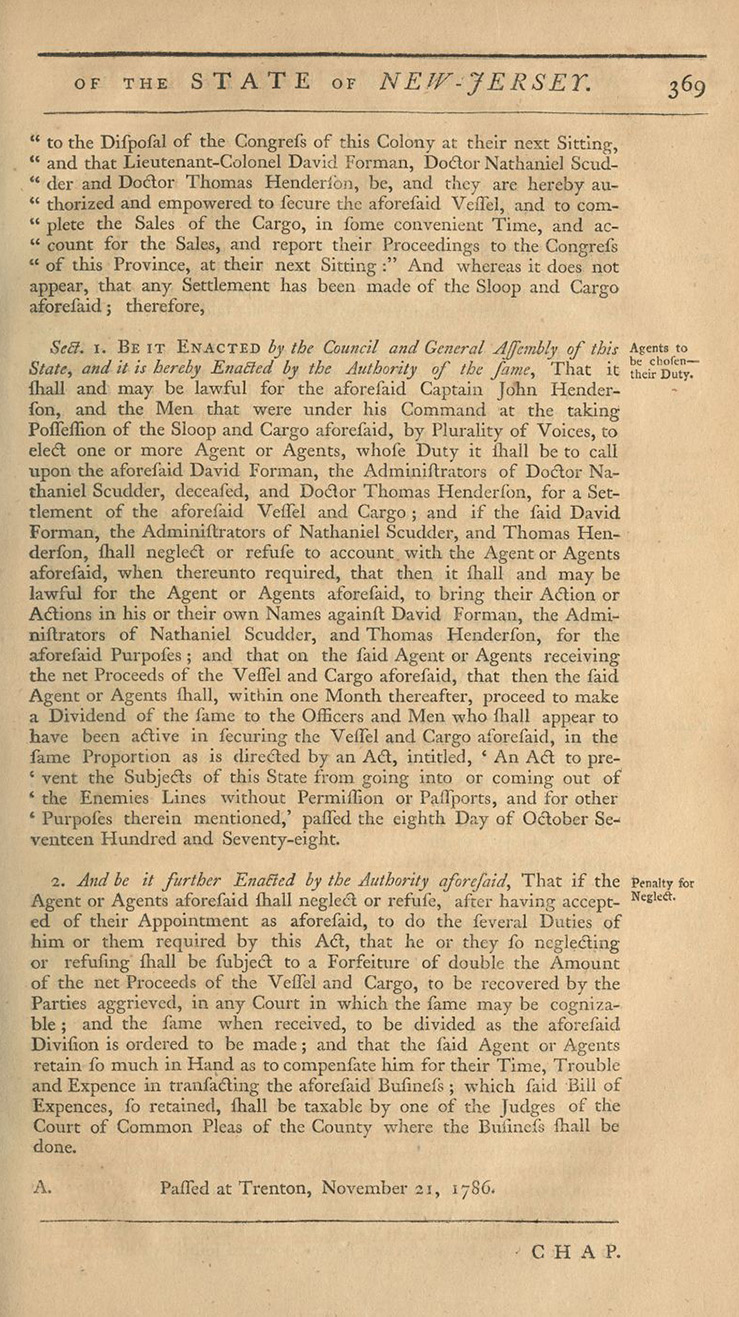
Trenton: Isaac Collins, Printer to the State, 1786
“The Fields of America,” Prime and his legal advocates argued, had “been dyed in the Blood of her Citizens” to “defend, secure, and perpetuate” liberty. Emphasizing Prime’s patriotic service, they petitioned the state for his freedom. In 1786, the legislature agreed, passing this law to manumit Prime—one of just three enslaved men freed by the state of New Jersey for their service to the revolutionary cause.

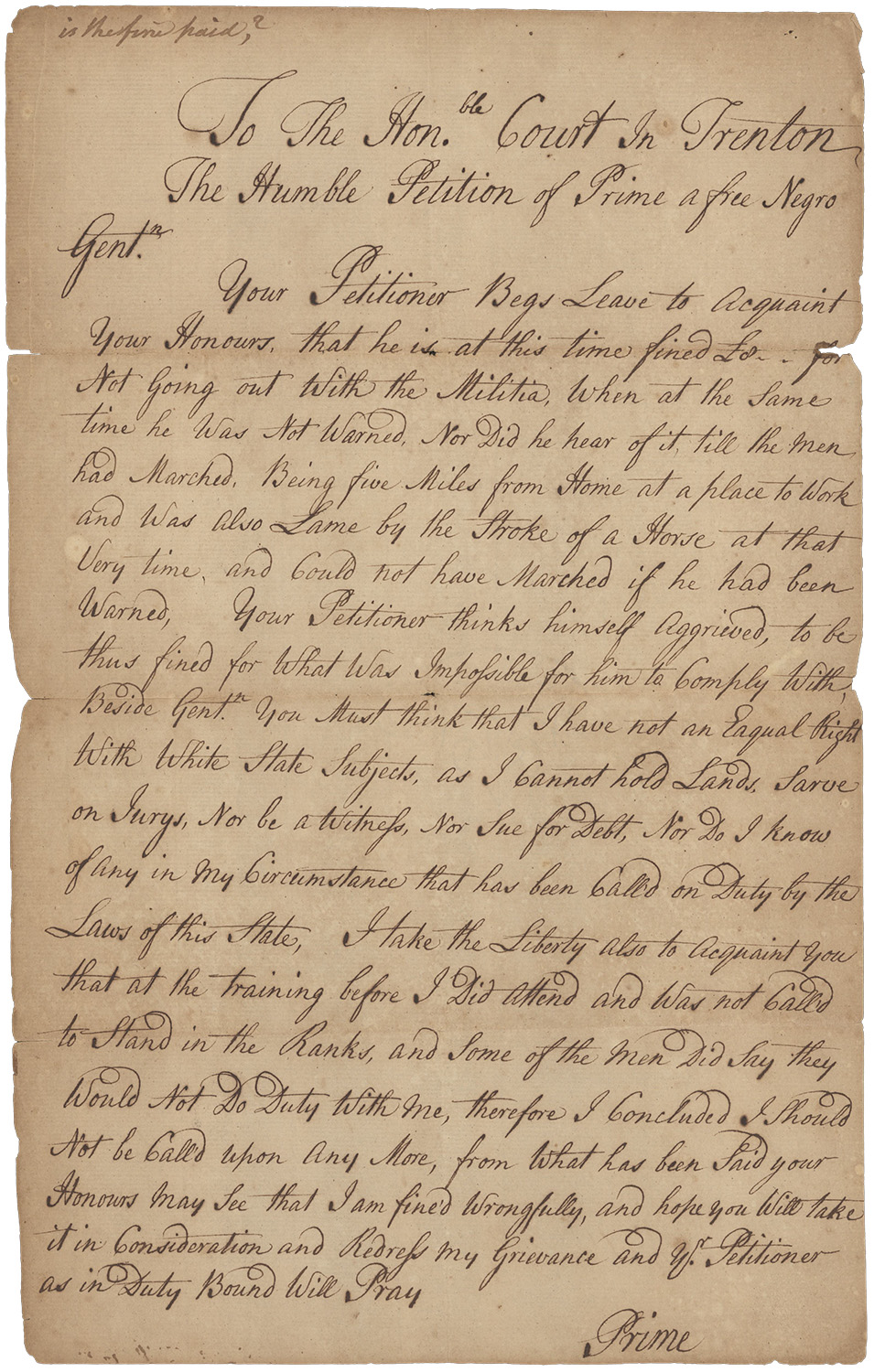
“Petition of Prime a free Negro Gentleman” to the “Honourable Court in Trenton,” circa 1780s
Prime (1755-?)
Loan courtesy of the New Jersey State Archives, Department of State
Though Prime’s legal status was secured, the meaning of citizenship remained undefined in the new republic, and the shape of Black freedom was deeply contested. In this petition, boldly protesting a fine for missed militia service, Prime described the challenges he faced as a free Black New Jerseyan in remarkably vivid terms: “I have not an Eaqual Right with White State Subjects, as I cannot hold Lands, Sarve on Jurys, Nor be a Witness, Nor sue for Debt.”