Coda

In the summer of 1787, Americans were still dealing with the destruction and tremendous costs of the War for Independence. In Princeton, much of the town and campus was still in shambles. College leaders were striving to revitalize the student body and raise funds to repair the structural damage to Nassau Hall.
In Philadelphia, meanwhile, 55 delegates gathered to fix the nation’s troubled structures of government. Charged with revising the Articles of Confederation, the 1787 Convention—which included nine Princeton graduates—instead designed a new national government from scratch, one strong enough to pay its debts and act on the world stage. Supporters argued that these reforms were necessary to preserve the republic, for wartime experience had made Congress’s failures painfully clear. But many others thought the Convention had betrayed the principles of the Declaration, replicating the kind of tyrannical state that patriots had fought eight long years to escape.
As contemporaries knew, the proposed Constitution was fragile and imperfect. Crucially, though, it included a process for future improvement. After vigorous debate, the Constitution was ratified in part because federalists promised to address skeptics’ concerns through a series of amendments protecting individual liberties. Now called the Bill of Rights, each of these first 10 amendments carries its own legacy of colonial resistance and the trials of war.

We, the People of the United States, In Order to Form a More Perfect Union, Establish Justice, Insure Domestic Tranquility, Provide for the Common Defence, Promote the General Welfare, and Secure the Blessings of Liberty to Ourselves and Our Posterity, Do Ordain and Establish This Constitution for the United States of America

Philadelphia: Printed by Dunlap & Claypoole, 1787
Bequest of William H. Scheide, Class of 1936
On September 17, 1787—the last day of the Convention—the delegates signed the final draft of the proposed Constitution. Shortly thereafter, an engrossed manuscript copy on vellum was made by Jacob Shallus, while John Dunlap and David Claypoole printed 500 copies for distribution to Convention delegates, members of Congress, state officials, and newspaper printers. This first official printing was heavily used and widely circulated during the ratification debates. As a result, it is exceedingly scarce today: only 14 copies are known to survive.
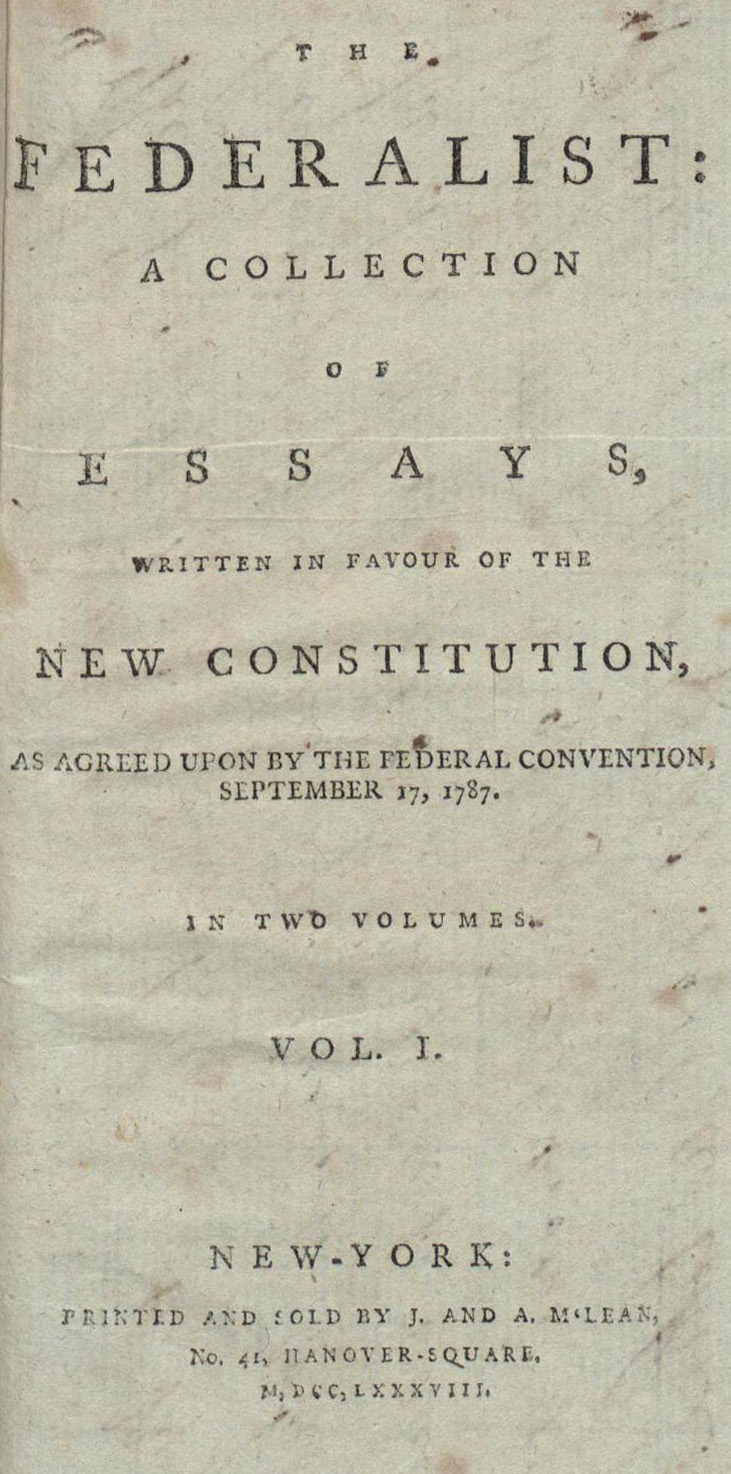
The Federalist: A Collection of Essays, Written In Favour of the New Constitution, As Agreed Upon by the Federal Convention, September 17, 1787, In Two Volumes
New-York: Printed and sold by J. and A. M’Lean, 1788
Gift of Sid Lapidus, Class of 1959
Over the long winter after the Constitution’s unveiling, debates raged over the document. No words reached further than those of Publius, the pen name of Alexander Hamilton, James Madison, and John Jay. In 85 essays, published in New York and known as the Federalist Papers, they championed a strong, unified government, where checks and balances would guard against tyranny. By July 1788, New York narrowly voted to approve the Constitution.
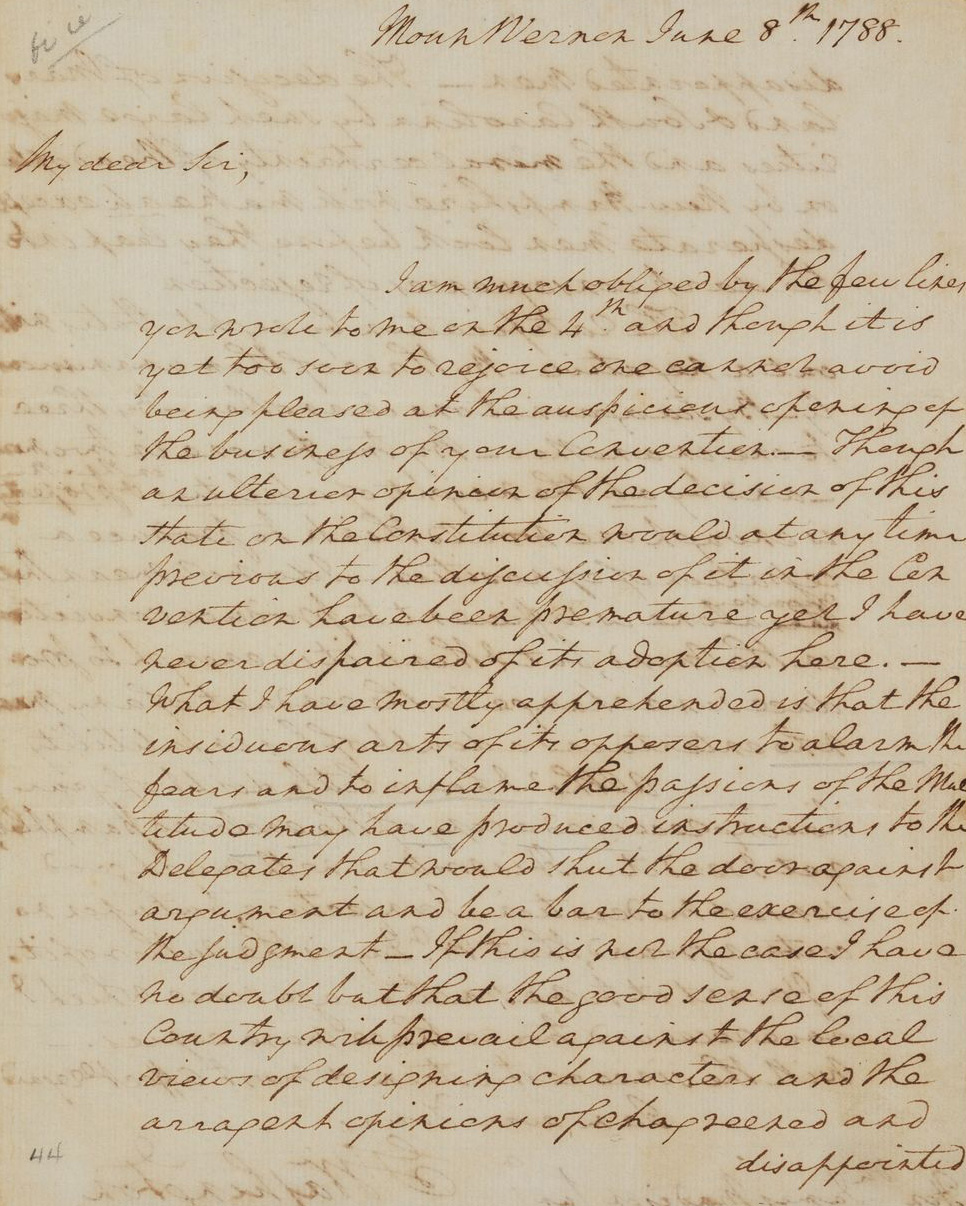
Letter from George Washington (1732–1799) to James Madison, Class of 1771, June 8, 1788
Bequest of Mrs. Gladys G. Straus, James Moore
Writing to James Madison, one of the Constitution’s primary authors, Washington cheered the progress of ratification. While commander of the Continental Army, Washington grew deeply frustrated with the state governments, and as a result he supported the draft constitution’s proposal for a stronger centralized government. As Virginia’s ratifying convention got underway, he was optimistic that the federalists would prevail over localism and “the insidious arts of [the Constitution’s] opposers to alarm the fears and to inflame the passions of the Multitude.”
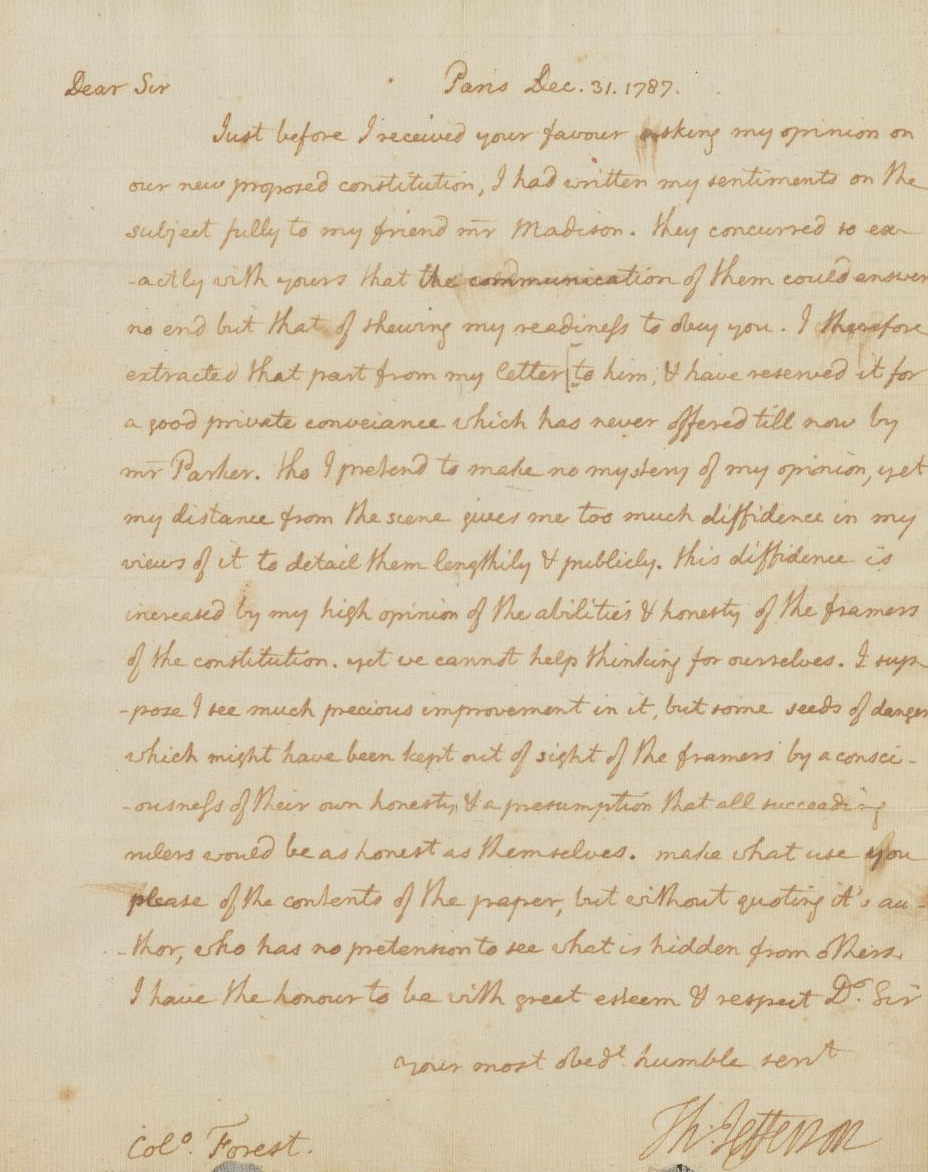
Letter from Thomas Jefferson (1743–1826) to Uriah Forrest, December 31, 1787
Bequest of Andre De Coppet, Class of 1915
Thomas Jefferson was abroad in Paris during the drafting of the U.S. Constitution. As the ratification debate began, he opined on the document in this letter to Maryland delegate Uriah Forrest. Jefferson trusted “the abilities & honesty of the framers.” Yet, he continued, “we cannot help thinking for ourselves.” Although he thought the Constitution an improvement over the Articles of Confederation, Jefferson also saw “seeds of danger” in its reliance on virtuous leadership—a risk the delegates might have missed by presuming “that all succeeding rulers would be as honest as themselves.”