Early to Mid-18th Century: The Rise of Color Printing
The complex process of full-color printing began in Japan in the latter half of the 18th century. It required the use of multiple woodblocks, including a “key block” that produced the foundational ink print and an additional separate block for each color. A newly-developed registration system assured that each sheet of paper was perfectly aligned on successive blocks. Full-color prints/books (using five or more colors) were called nishiki-e (brocade pictures 錦絵) because the rich colors resembled those in sumptuous silk brocades. Associated with Edo publishing, they were also known as Edo-e (Edo pictures 江戸絵) and azuma nishiki-e (eastern brocade pictures 東錦絵).
Color printing was very expensive and a financially risky investment for a publisher. It was therefore not the publisher alone but the wealthy sponsors of privately published books and prints that ultimately spurred its development. These sponsors, often members of elite poetry clubs, would pay for the first printing–a luxury edition of the book–to be given to members, and as gifts to friends and clients.

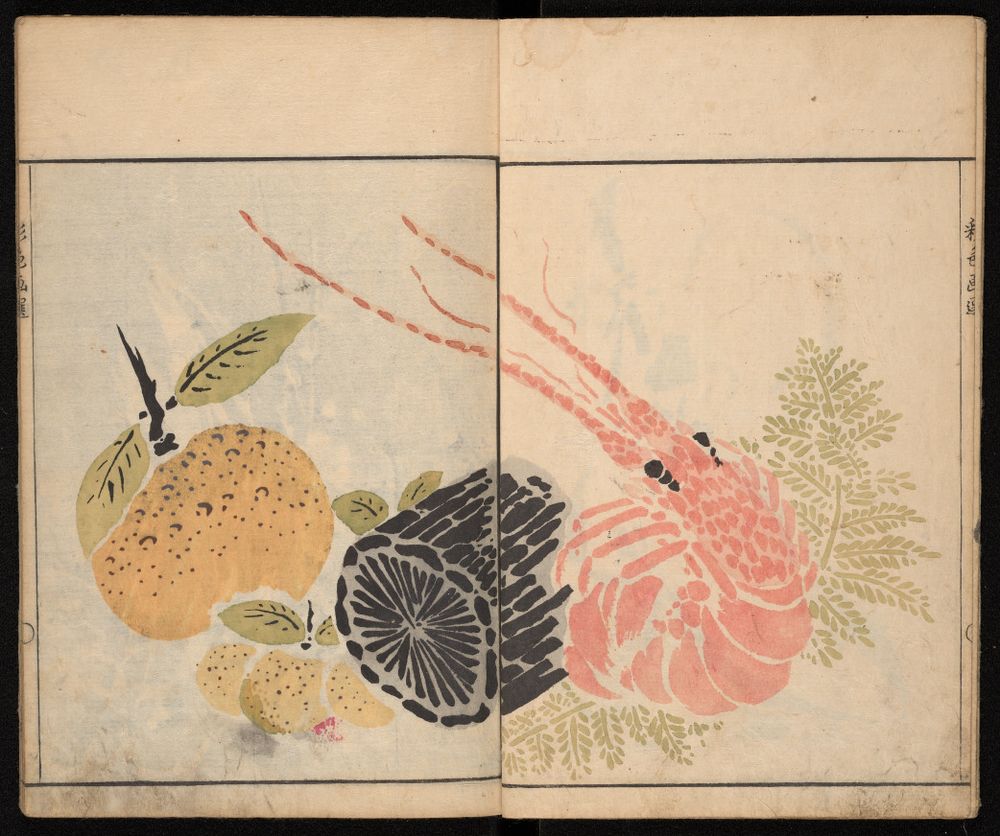
14. Saishiki gasen [A Selection of Colored Drawings] / 彩色画選, 1767
Kitao Tokinobu (Sekkōsai) (active 1744-1781)
Three volumes
Osaka: Shibukawa Daizō; Kyoto: Kōnami Shirōemon; Edo: Subaru Heisuke, Meiwa 4
北尾辰宣 (雪坑齋) (作画期 1744-1781)
三巻三冊
大阪: 澁川大蔵; 京都: 河南四即右衞門; 江戶: 須原平祐, 明和 4年
As publishing houses began to perfect color woodblock printing, artists continued to experiment with other methods to include color in their designs. Created on Chinese paper, the illustrations in this book were produced with some of the techniques employed in the decoration of textiles, like hand-painted stenciling and the blowing (atomizing) of color through stencils by means of a pipette. Gold, silver, and mica were also used to enhance some of these images.

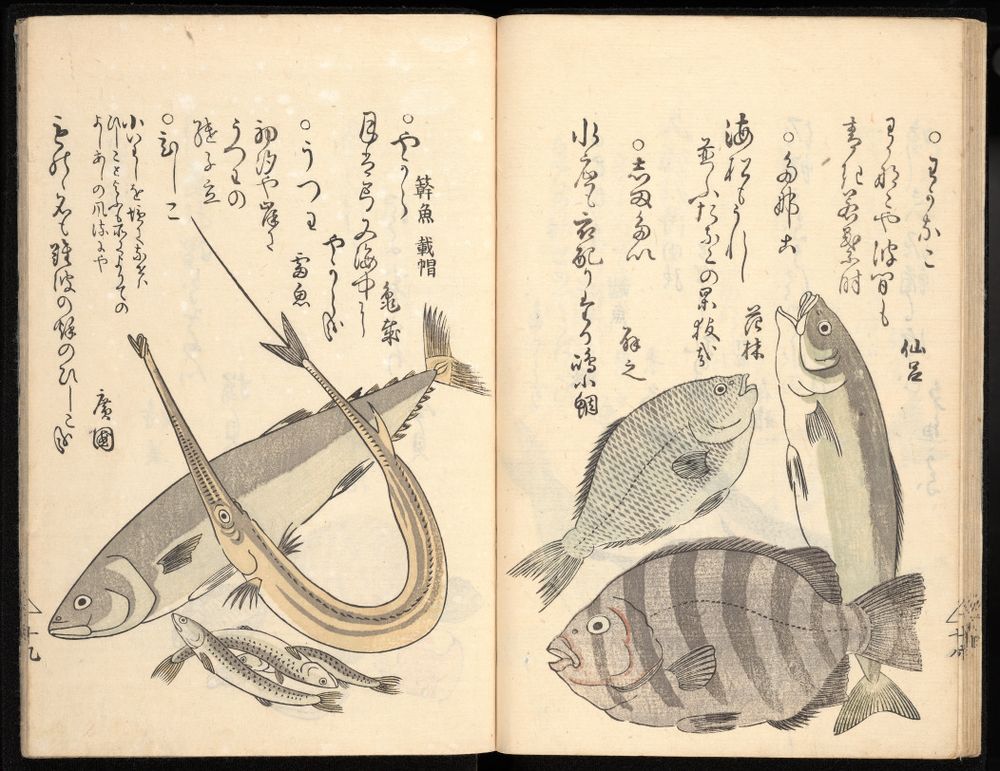
15. Umi no sachi [Bounty from the Sea] / 海能幸, 1778
Katsuma Ryūsui (1711-1796)
Two volumes
Edo: Maekawa Rokuzaemon, Hōreki 12/ Preface: An'ei 7
勝間龍水 (1711-1796)
二冊
江戶: 前川六左衞門求板, 宝暦12/ 序文: 安永 7年
This book celebrates “creatures that live beneath the sea” with whimsical natural forms that are carefully balanced with dynamically calligraphed poems. By the mid-18th century, publishers were experimenting with this kind of multiple-block color printing. The privately-printed first edition of this book (1762) actually predated the first full-color woodblock print and was extremely expensive to produce. Like the first printing, this later copy is also very large and exquisitely printed on soft, thick paper.

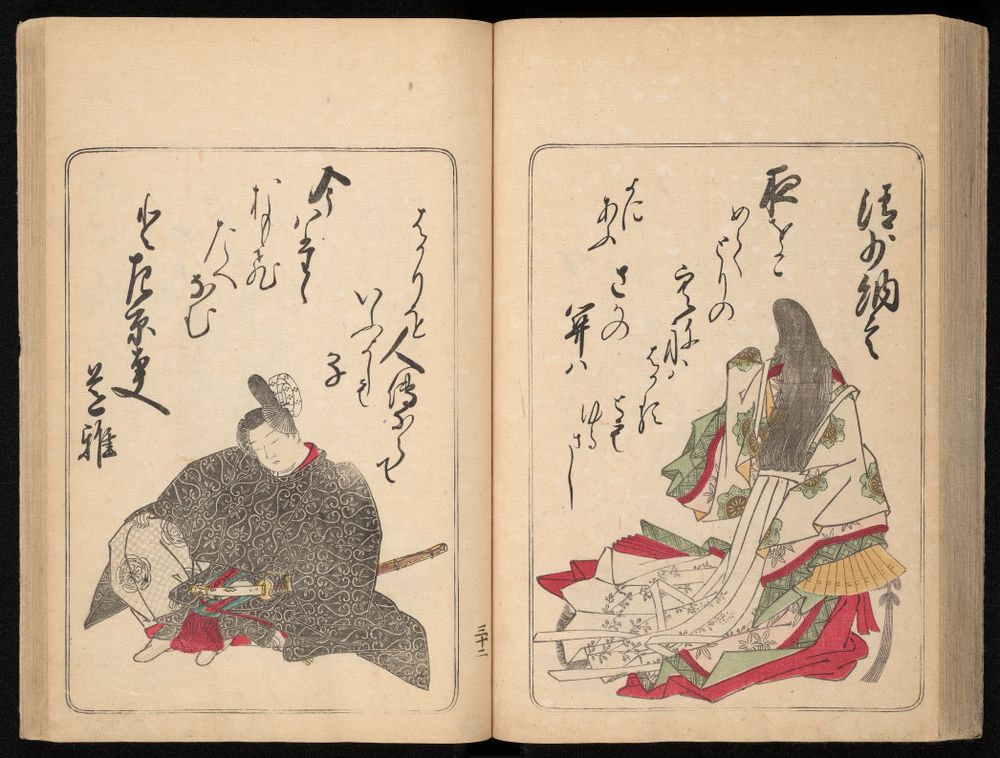
16. Nishiki hyakunin isshu azuma-ori [Eastern Brocade of One Hundred Poems by One Hundred Poets] / 錦百人一首あつま織, 1775
Katsukawa Shunshō (1726-1793)
One volume
Edo: Kariganeya Gisuke, An'ei 4
勝川春章 (1726-1793)
一冊
江戸: 鳫金屋儀助, 安永 4年
Continuing a new tradition of portraying the 100 legendary poets, whose works were compiled in the 12th century, this book is skillfully printed in color with the newly-developed multiple-woodblock technique. As the title suggests, illustrations like these were known as “brocade pictures” (nishiki-e) because they resembled colorful, embroidered silk fabric. Twenty of the hundred poets were women, like Takashina no Takako (Gidosanshi no Haha (Mother of the Honorary Grand Minister), who we see here on the right.

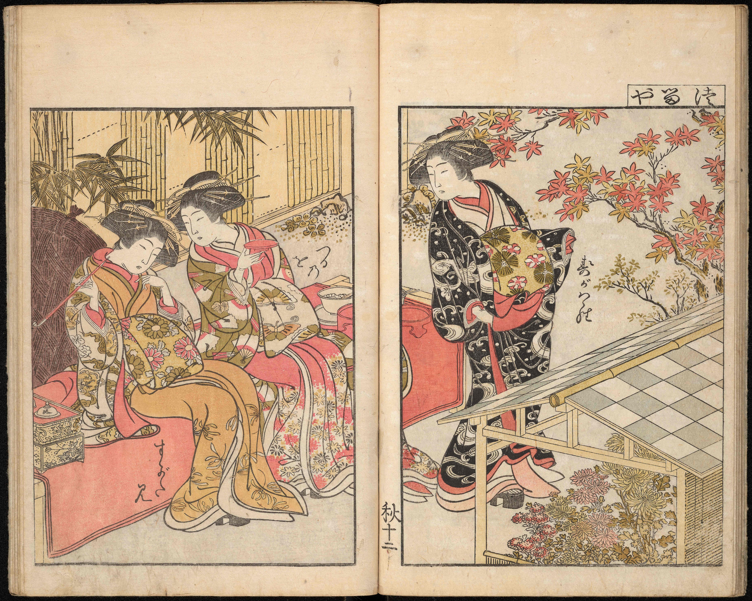
17. Seirō bijin awase sugata kagami [A Mirror of Beautiful Women of the Green Houses (Yoshiwara) Compared] / 青楼美人合姿鏡, 1776
Katsukawa Shunshō (1726-1793) and Kitao Shigemasa (1739-1820)
Three volumes
Edo: Kōshodō (Tsutaya Jūzaburō); Yamazaki Kinbē, An'ei 5
勝川春章 (1726-1793) と北尾重政 (1739-1820)
三巻三冊
江戸: 耕書堂 (蔦屋重三郎); 山崎金兵衛, 安永 5年
This book, a technical achievement in color printing, is a purported peek into the culturally-rich private lives of elegant and refined Yoshiwara courtesans. Identified by name beside their portraits, their cultural sophistication is further highlighted with their haikai poetry in the set’s third volume. (One from each of the 164 women is included.) Published by the legendary publisher, Tsutaya Jūzaburō, the son of a brothel owner, there was an air of authenticity to the subject matter–something much sought after by contemporary audiences.