Hishikawa Moronobu (?-1694)
Hishikawa Moronobu, often acknowledged as the “father of ukiyo-e,” was a painter and print designer. In the approximately 130 book titles attributed to him, he consolidated the styles found in contemporary paintings and illustrations to create his own. The motifs and compositional conventions we see in his book illustrations became models for the next 200 years of traditional Japanese printmaking.

![2 page spread illustration of the lost play, Imagawa shinobi-guruma [Imagawa’s Hidden Cart], showing portraits of the ancestors of contemporary kabuki actors, identified by family crests at the top of each page](/uploads/spotlight/attachment/file/8177/Kokon_yakusha_monogatari_16.jpg)
6. Kokon yakusha monogatari [Tales of Actors Past and Present] / 古今役者物語, 1678
Hishikawa Moronobu (? - 1694)
One volume
Edo: Hondonya kaiban, Enpō 6
菱川 師宣 (? - 1694)
一冊
江戶: 本問屋開板, 延宝 6年
The earliest known visual and textual record of the kabuki theatre, this book preserves valuable information about Japanese plays of the 17th century that would otherwise be lost. This illustration, for example, is the only documentation of the lost play, Imagawa shinobi-guruma [Imagawa’s Hidden Cart], first performed at the Ichimura-za Theatre in Edo in 1664. In this book, Moronobu established what later became the pictorial conventions for illustrating kabuki performances. Portraits of the ancestors of contemporary kabuki actors fill these pages, identified by family crests at the top of each page.

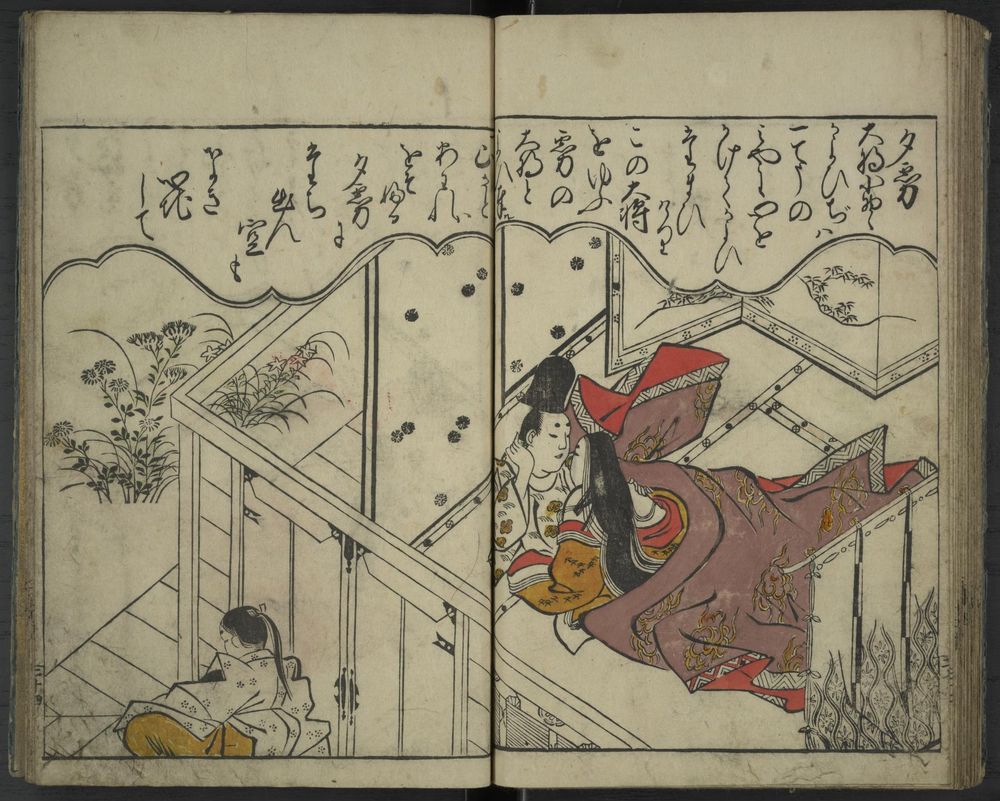
7. Genji kyasha makura [Genji's Elegant Pillow] / 源氏華奢枕, 1676
Hishikawa Moronobu (? - 1694)
One volume
Edo: Matsue Kaiban, Enpō 4
菱川 師宣 (? - 1694)
一冊
江戶: 松會開板, 延宝 4年
With this erotic adaptation of the famous 11th-century Japanese masterpiece, The Tale of Genji [Genji monogatari], Hishikawa Moronobu may have begun the ukiyo-e tradition of humorously reimagining classical literature in illustrated books published for the general public. Thirty of the 54 chapters are included, many with poems from the original text. Here, in Chapter 39 titled Yūgiri (Evening Mist 夕霧), Genji’s son, Yūgiri, visits his friend’s widow on a misty evening and pledges his love. This is the only known complete copy of the book still extant.

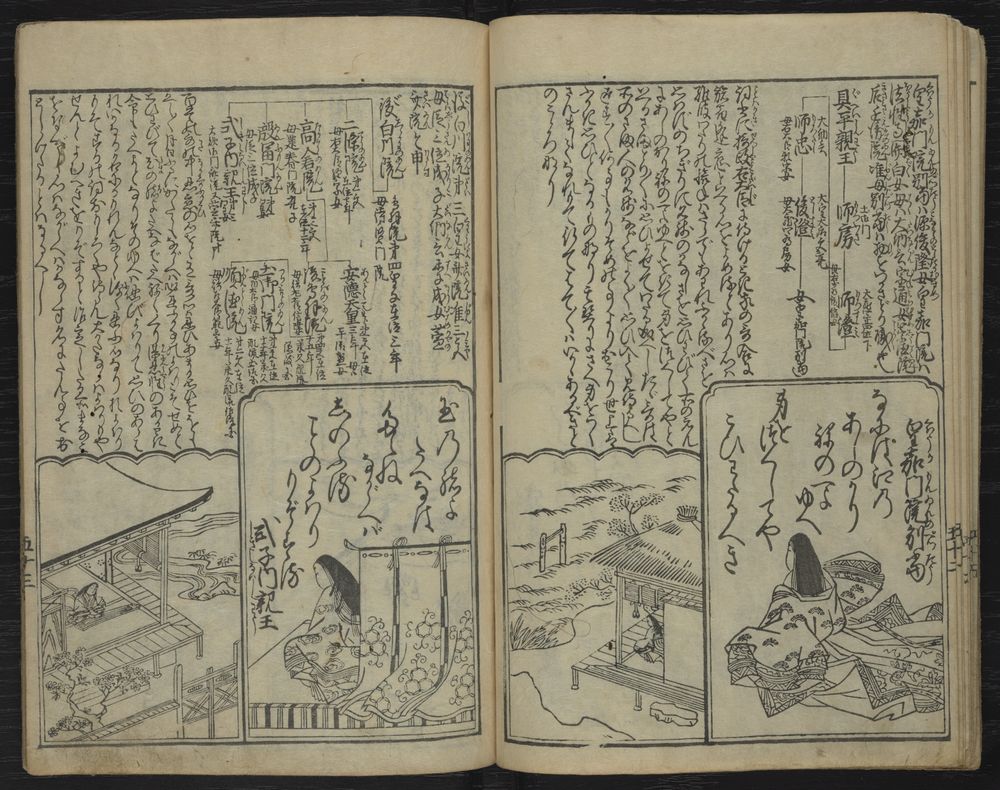
8. Hyakunin isshu zōsanshō [Commentary on the Images and Inscriptions from the One Hundred Poems by One Hundred Poets] / 百人一首像讚抄, 1678
Hishikawa Moronobu (? - 1694)
Three volumes
Edo: Urokogataya, Enpō 6
菱川 師宣 (? - 1694)
三冊
江戸: 鱗形屋, 延宝 6年
Images from One Hundred Poems by One Hundred Poets (a 12th century anthology) did not emerge until the early 17th century. This book is one of the earliest examples of the theme. Derived from the 12th century visual tradition of the Thirty-six Immortal Poets, each poet is surrounded by their name and a representative poem. Also included in these crowded compositions are illustrations of the poems, commentaries about them, and the poets’ biographies and family trees.