The Coming of the Americans and the End of Isolationism in Books
In the 1630s the Tokugawa government enacted a policy of isolationism (sakoku 鎖國) to close off the country to outside influences they felt detrimental to a peaceful nation. Trade with other nations was rigorously controlled and limited to China, Korea, and Holland (and Europe through the Dutch trading company).
In 1853, however, Americans, under the command of Commodore Matthew Perry, arrived in Japan with their “black ships” (kurofune 黒船) [#57] and demanded that the Japanese open their ports and sign trade agreements with the United States. A year later, when he returned for an answer, the government—already fractured by social unrest, famine, peasant uprisings, and Russian intervention in the north—relented, leading to worldwide trade and to an exchange of ideas and culture. Interest in Perry, his crew, America, and the American people led to a new array of themes to be exploited by publishers.

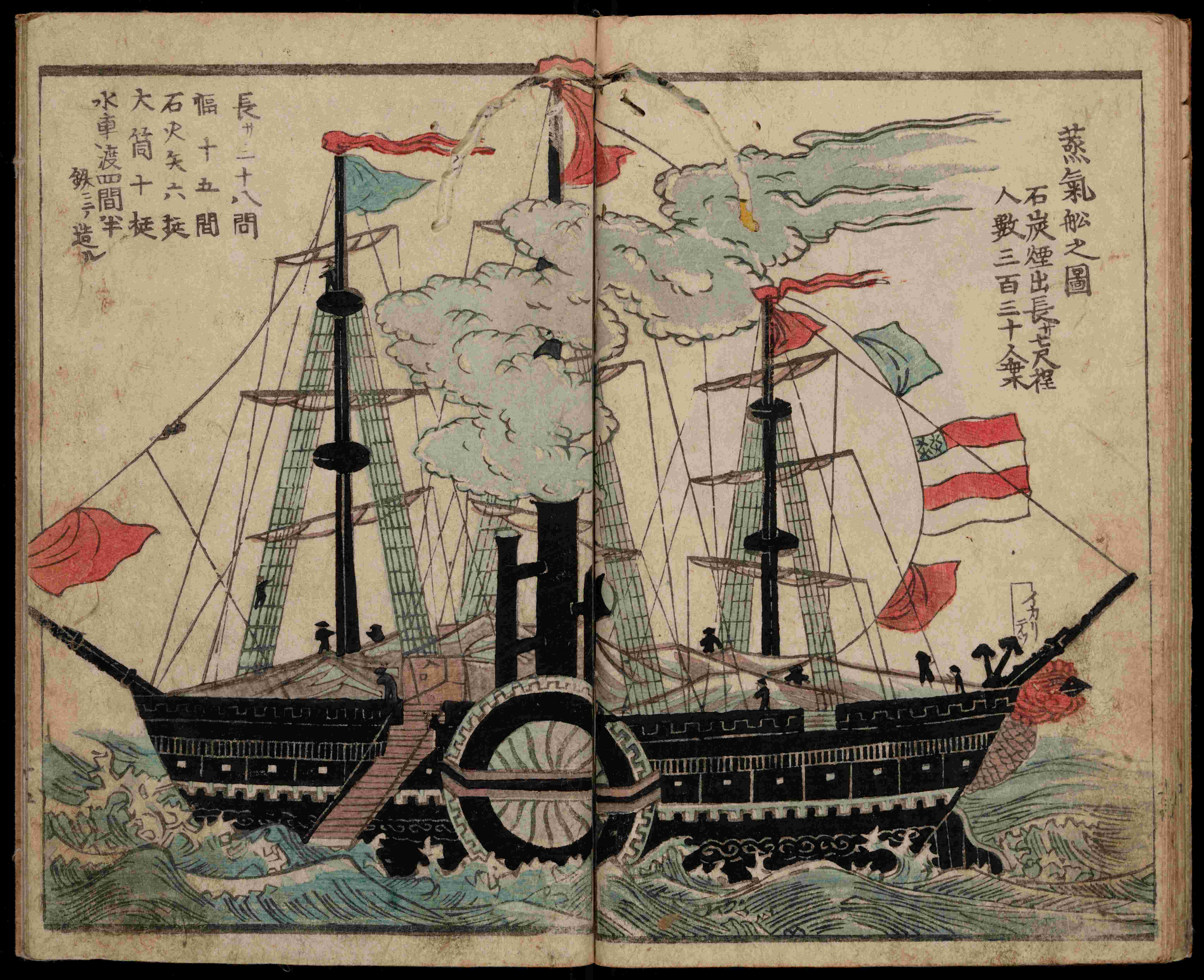
57. Ikoku ochiba kago [Fallen Leaves from a Foreign Country] / 異國落葉籠, 1854
Miki Kosai aka Utagawa Yoshimori (1830-1884)
One volume
[Tokyo]: [Ongakudō], Ansei 1
三木光齊 (歌川芳盛) (1830-1884)
一冊
[東京]: [隠學堂], 安政 1年

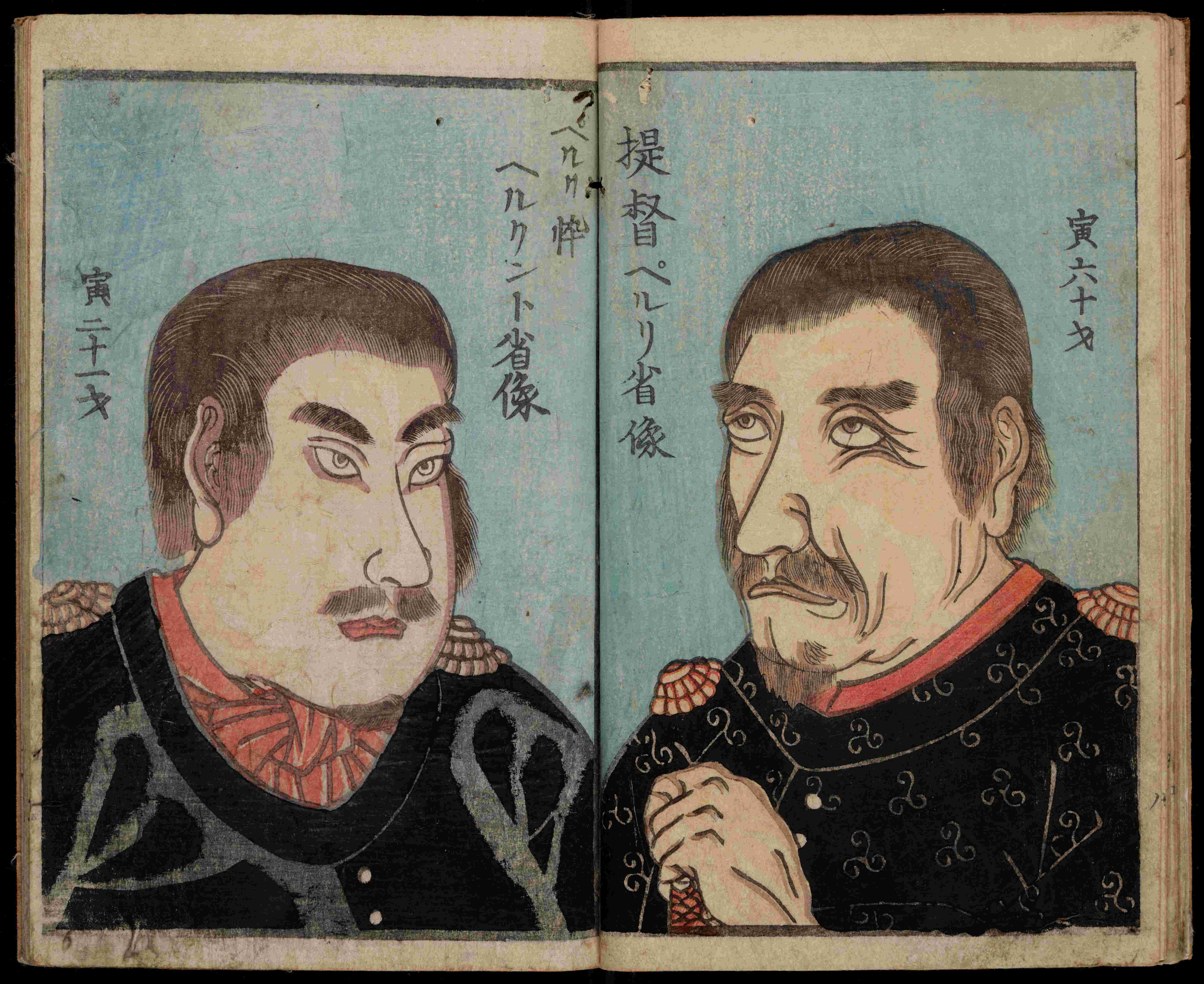
58. Ikoku ochiba kago [Fallen Leaves from a Foreign Country] / 異國落葉籠, 1854
Miki Kosai aka Utagawa Yoshimori (1830-1884)
One volume
[Tokyo]: [Ongakudō], Ansei 1
三木光齊 (歌川芳盛) (1830-1884)
一冊
[東京]: [隠學堂], 安政 1年
While there are many contemporaneously painted handscroll manuscripts detailing every aspect of Commodore Perry’s second trip to Japan, this appears to be the only book of the event published at the time. The illustrations, most likely copied from the scrolls, cover everything from a color map of North America to the gifts brought by the Americans—including a parrot and a steam locomotive. On the right, we see one of the more flattering portraits of Perry done by Japanese artists.

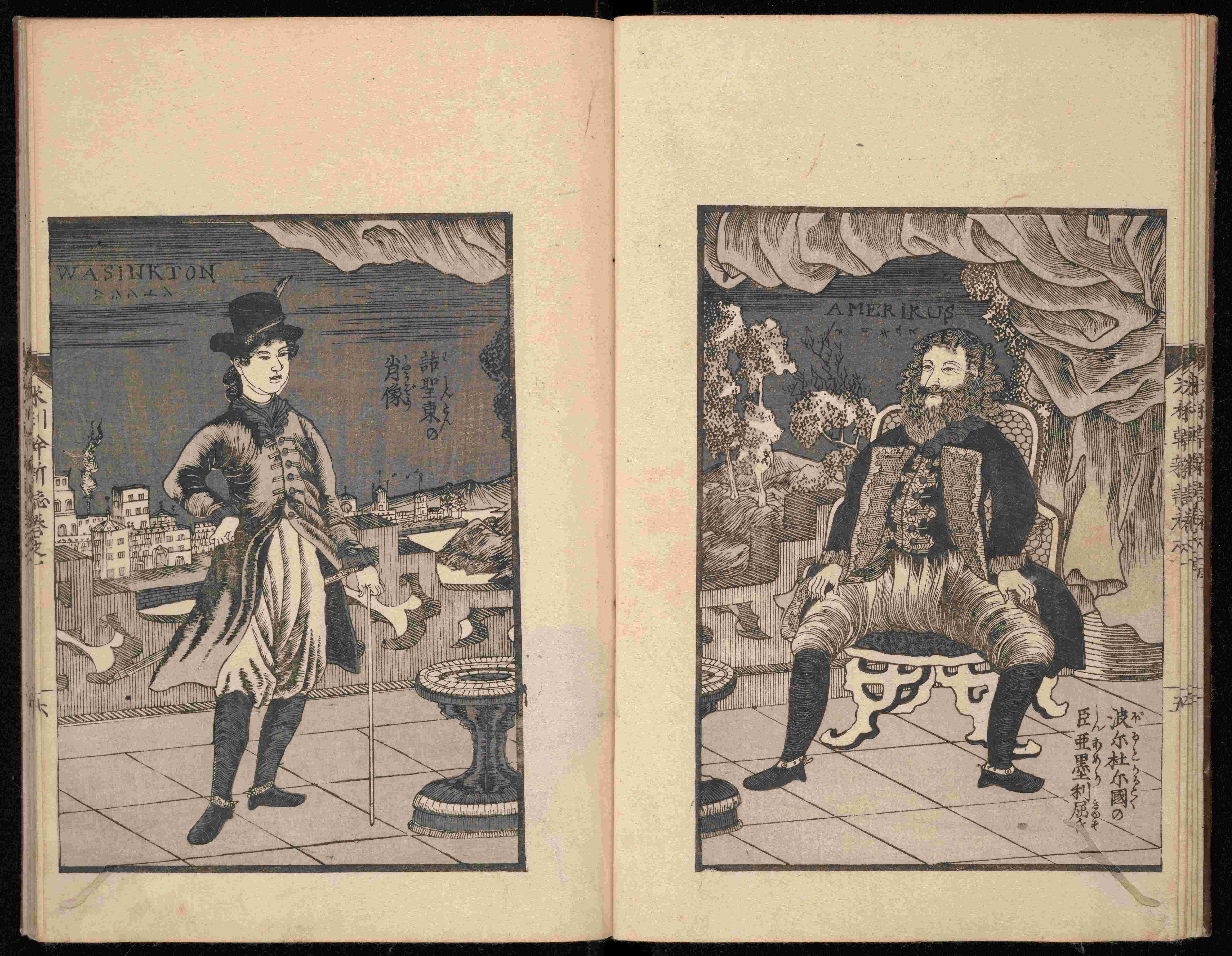
59. Meriken shinshi (New Account of America) / 米利幹新誌, 1853
Utagawa Sadahide (1807-1878/79); Author: Tsurumine Shigenobu (1788-1859)
Five volumes
[Japan]: Kasugarō, Kaiei 6
歌川貞秀 (1807-1878/79): 著者: 鶴峯戊申 (1788-1859)
五巻五冊
[日本]: 春日樓, 嘉永 6年
The news surrounding Admiral Perry led to intense curiosity among the Japanese about the Americas and the American people. While this book claims to give a full account of the Americas, much of the book is devoted to George Washington and Christopher Columbus. Canada is only briefly mentioned and the chapters on South America are often inaccurate and are illustrated with the racist images originally conceived by White European colonizers. Here we see the symbolic meeting of young George Washington and Italian explorer Amerigo Vespucci.

The Late 19th Century: A New Era
In 1868 the Tokugawa military government was overthrown, and full power was restored to the emperor for the first time in over 600 years. Japan quickly began a program of industrialization in an effort to compete with the world around them after so many years of isolation. This modernization, or what some called “Westernization,” was not embraced by everyone and was seen by many as a loss of Japanese culture.
The publishing of illustrated books and other materials clearly reflected this cultural divide. Established themes, produced with traditional techniques, now appeared alongside works that embodied Western ideals and were published with new printing processes. This, for the first time, changed the publishing dynamic to put the artist—not the publisher—in control.
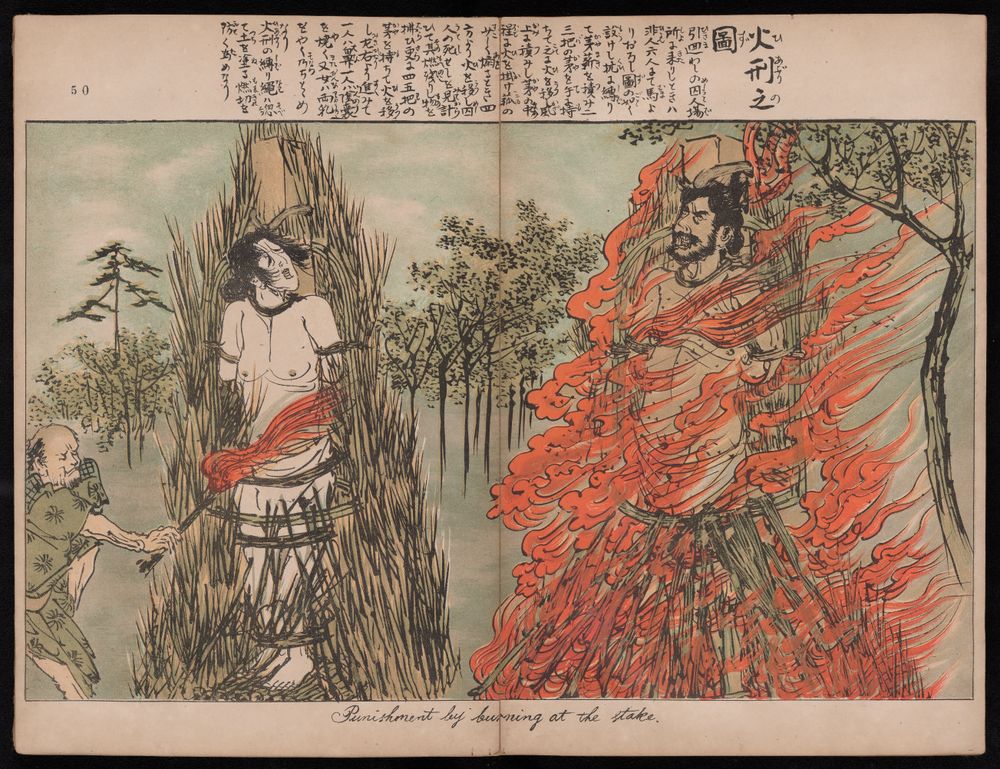
60. Tokugawa bakufu keiji zufu [Illustrated Guide to the Punishments of the Tokugawa Shogunate] / 德川幕府刑事圖譜, 1893
Fujita Shintarō (?)
One volume
Tokyo: Kanbe Naokichi, Meiji 26
藤田新太郎 (?)
一冊
東京: 神戶直吉, 明治 26年
Written in both Japanese and English, this “illustrated guide” was part of a propaganda campaign for Western audiences. It presents the revolutionary change—the modernization or “Westernization”—taking place with the fall of the Tokugawa government and restoration of the Meiji Emperor in 1868. The first part highlights alleged crimes that took place under Tokugawa rule, followed by graphic images of their brutal punishments. The second part pivots to illustrate modern Tokyo [#61], with public trials taking place in European-style courthouses followed by enlightened punishment in clean prisons.

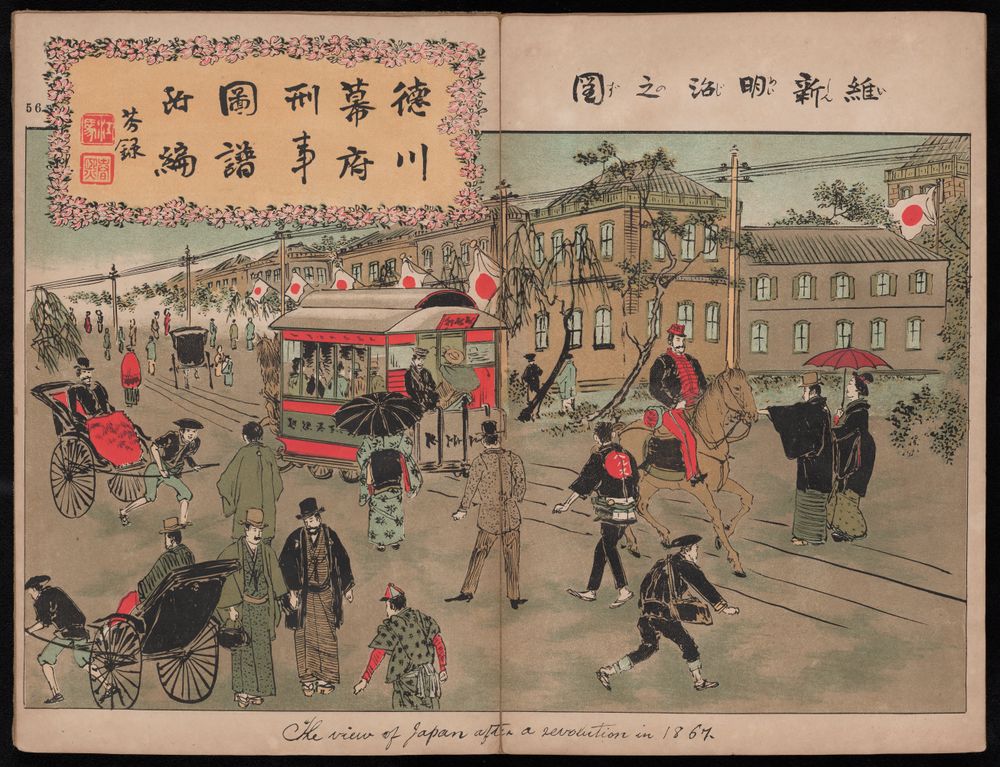
61. Tokugawa bakufu keiji zufu [Illustrated Guide to the Punishments of the Tokugawa Shogunate] / 德川幕府刑事圖譜, 1893
Fujita Shintarō (?)
One volume
Tokyo: Kanbe Naokichi, Meiji 26
藤田新太郎 (?)
一冊
東京: 神戶直吉, 明治 26年