The Commercial Publishing of Illustrated Books in the Mid-17th to Mid-18th Centuries
“Living only for the moment,
turning our full attention to the pleasures of the moon, the snow, the cherry blossoms and the maple leaves,
singing songs, drinking wine, and diverting ourselves in just floating, floating,
caring not a whit for the pauperism staring us in the face,
refusing to be disheartened,
like a gourd floating along with the river current,
this is what we call the floating world.”
--Asai Ryōi, Tales of the Floating World [Ukiyo monogatari], circa 1661
The publishing of a book typically began with the publisher, a savvy businessman who followed fashionable trends in urban Japan to determine what kinds of books would sell. During this period, books were printed with sumi ink, made from lampblack. Colors were hand-applied mineral pigments.
THE PROCESS:
- The publisher engaged the artists (designers, authors, calligraphers) to produce the content of his choosing.
- A copyist copied the designs onto thin sheets of paper which were pasted face down onto woodblocks by the block-cutter. After drying, the paper was moistened and rubbed to remove all but the inked layer, which became the template for carving.
- A printer then inked the block, laid the print paper over it, and rubbed the back with a padded disk (baren 馬連 ) to create a finished black & white print (sumizuri-e 墨摺絵).
- The most common binding was “bag-binding” or fukurotoji (袋綴じ). Each printed sheet was folded in half (with the printed side out) and bound into the book at its open end, forming a pouch-like page.
- The publisher then offered the book for sale or for rental through lending libraries.
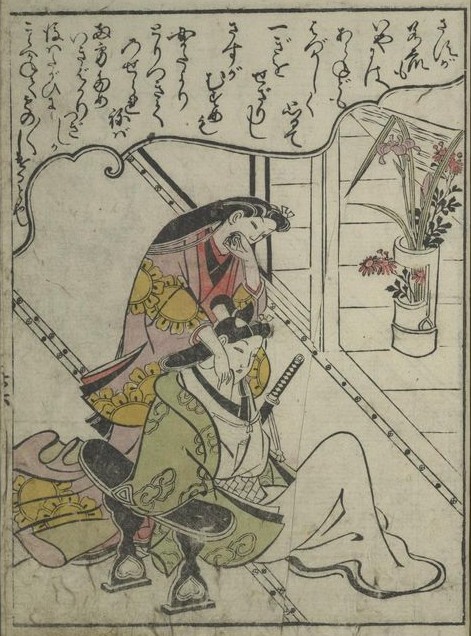
![Woodblock print of two lovers from Yoshiwara makura-e [Yoshiwara Pillow Pictures], page 8.](/uploads/spotlight/attachment/file/8310/Yoshiwara_makura-e_p8.jpg)
While artists from different workshops, or “schools of art”, designed the book illustrations in this exhibition, most of the examples dating from the 17th through 19th centuries would be defined as ukiyo-e.
Ukiyo (浮世), literally “floating world,” was an expression used from the late 17th century to describe life in urban centers, particularly in the capital city of Edo (present-day Tokyo) during the Edo period (1603-1868). A Buddhist term, it originally referred to the ephemerality of existence—but was now interpreted to mean “life is short—live for today!”
Ukiyo-e (浮世絵), “pictures of the floating world,” was a term first used around 1680 to describe images of pleasure-seeking that corresponded to this hedonistic mentality. These paintings, books, and prints focused on the government-licensed pleasure quarters and on the kabuki theatre—glamorous places where people could go to momentarily escape the Tokugawa shōgun’s strict societal control. Those who could not afford such excursions could also participate as “armchair travelers” with the purchase of woodblock-printed books like the ones in this exhibition.
The Yoshiwara (吉原) was the government-licensed pleasure quarters (yūkaku 遊郭) in Edo. Just before 1660 it was relocated to the outskirts of the city. Surrounded by a moat, the district was approximately 18 acres in size, with a single gated entrance. These pleasure districts in each of the major cities (Kyoto: Shimbara 嶋原; Osaka: Shinmachi 新町) were worlds unto themselves, with their own customs, codes of acceptable conduct, and slang. They had enormous influence over the evolution of mainstream popular culture.