Publishing the Natural World
Princeton University Library’s Marquand Library of Art & Archaeology has many notable examples of depictions of the natural world by some of the most famous Japanese artists of the time. The Library has been particularly fortunate in some cases to have acquired an alternate edition of an original printing, which allows further insight into the world of publishing.
It should also be noted that the artifacts in this section, like many in our collection, are rare because copies were often cut up so that these visually striking illustrations could be sold as individual prints for greater profit. They can be found labeled as “woodblock prints” with no acknowledgement of their original context in museums and libraries around the world.

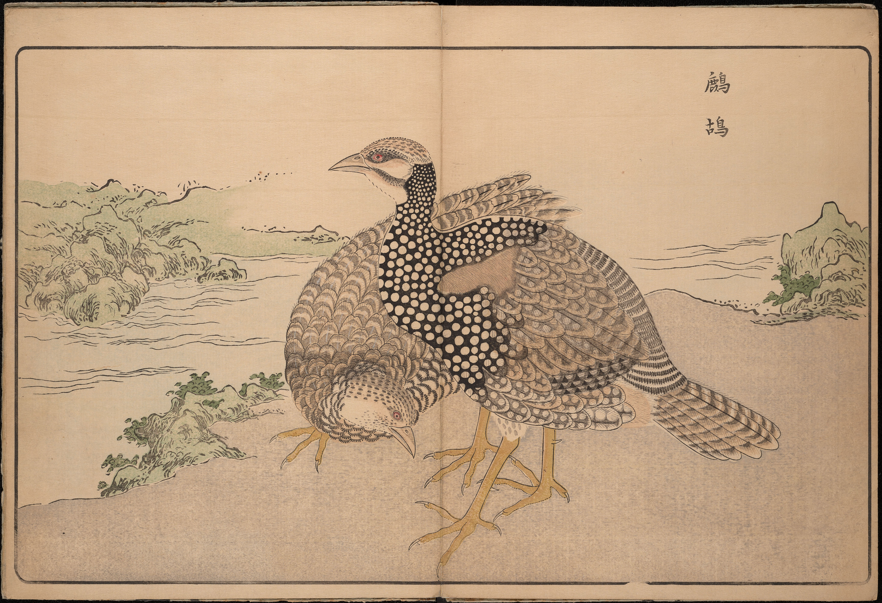
25. (Kaihaku) Raikin zui [A Compendium of Birds Brought from Overseas] / (海舶)来禽図彙, 1789
Kitao Masayoshi aka Kuwagata Keisai (1764-1824)
One volume
Tōto: Gungyokudō (Matsumoto Zenbē), Kansei 1
北尾政美 (鍬形惠斎) (1764-1824)
一帖
東都: 群玉堂 (松本善兵衛), 寛政 1年
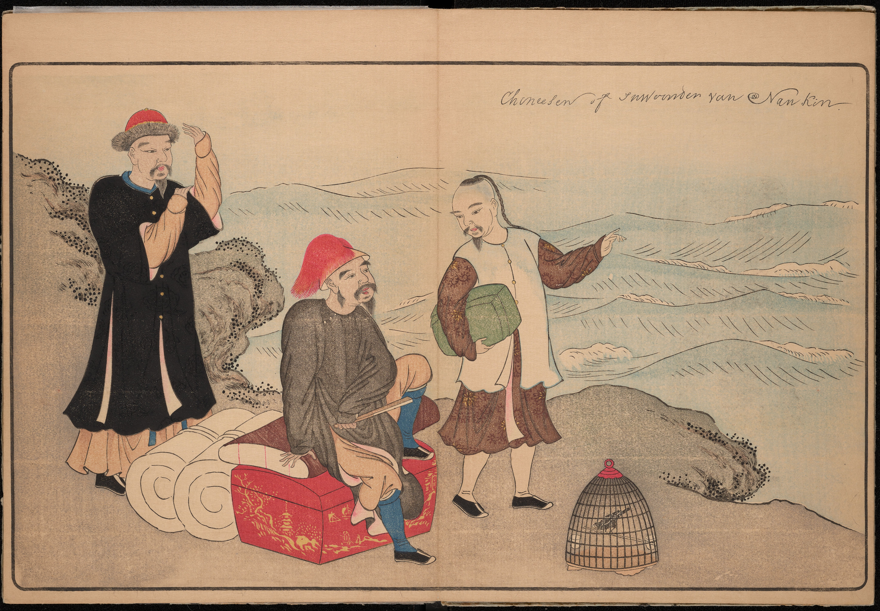
Exquisitely printed in rich colors, this book features images of exotic birds purportedly brought to Japan from China and Indonesia by foreign traders. To add authenticity to this premise, these foreigners appear in two illustrations at the beginning. This copy of the book is unique and has been identified as “a pre-first edition.” The illustration of the Francolin partridges (shako 鷓鴣) seen here does not appear in any of the handful of copies still extant. It has been replaced with the one pictured in #26.

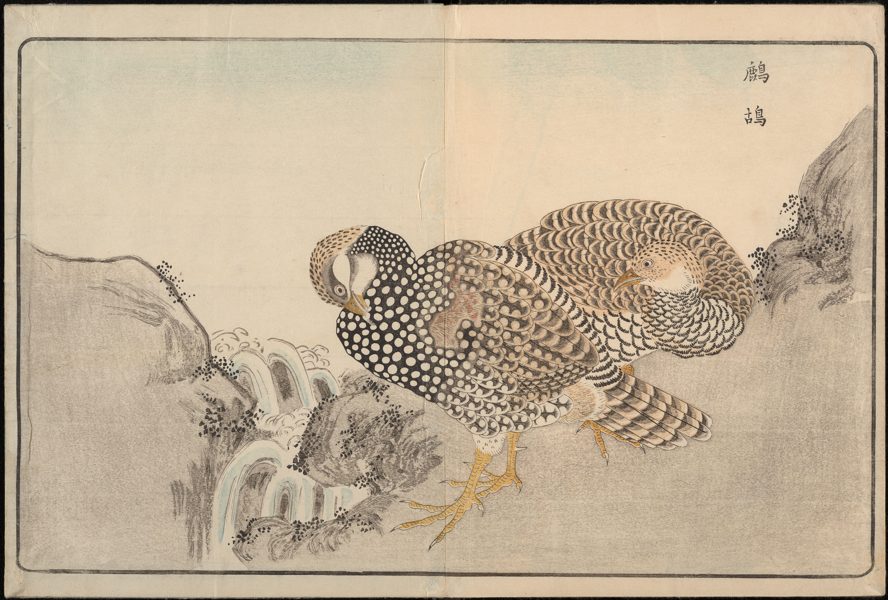
26. (Kaihaku) Raikin zui [A Compendium of Birds Brought from Overseas] / (海舶)来禽図彙, 1793
Kitao Masayoshi aka Kuwagata Keisai (1764-1824)
Two volumes
Tōto: Gungyokudō (Matsumoto Zenbē), Kansei 5
北尾政美 (鍬形惠斎) (1764-1824)
二帖
東都: 群玉堂 (松本善兵衛), 寛政 5年
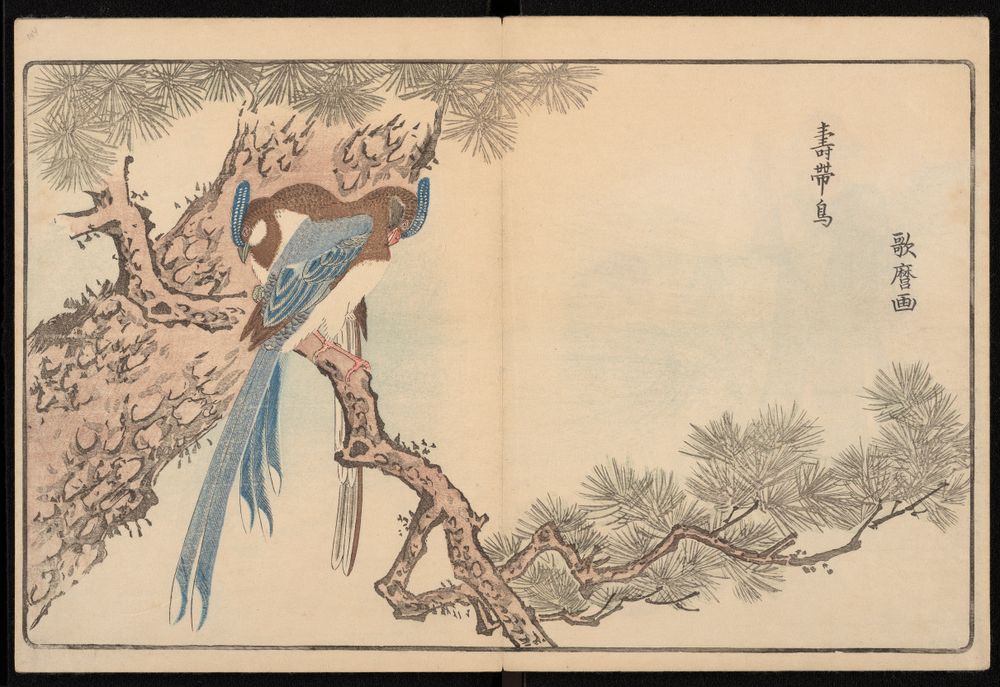
Between publication the 1789 [see #25] and 1793 editions, Kitagawa Utamaro’s blockbuster bird book, Myriad Birds: A Kyōka Poetry Competition was released. In what might have been an unscrupulous attempt to cash in on its success, the publisher of this later edition had woodblocks re-carved to make it seem as though it was also designed by Utamaro. His name now appears in the publishing information at the back of the book and his signature has been added to Masayoshi’s original image of the red-billed magpies (jutaichō).

27. Geishi [Treatise on Whales] / 鯨志, 1794
Nanki Josuiken (dates unknown)
One volume
Osaka: Kashimoto Kanbē, Kansei 6
南紀如水軒 (生没未詳)
一冊
大阪: 樫本勘兵衛, 寬政 6年
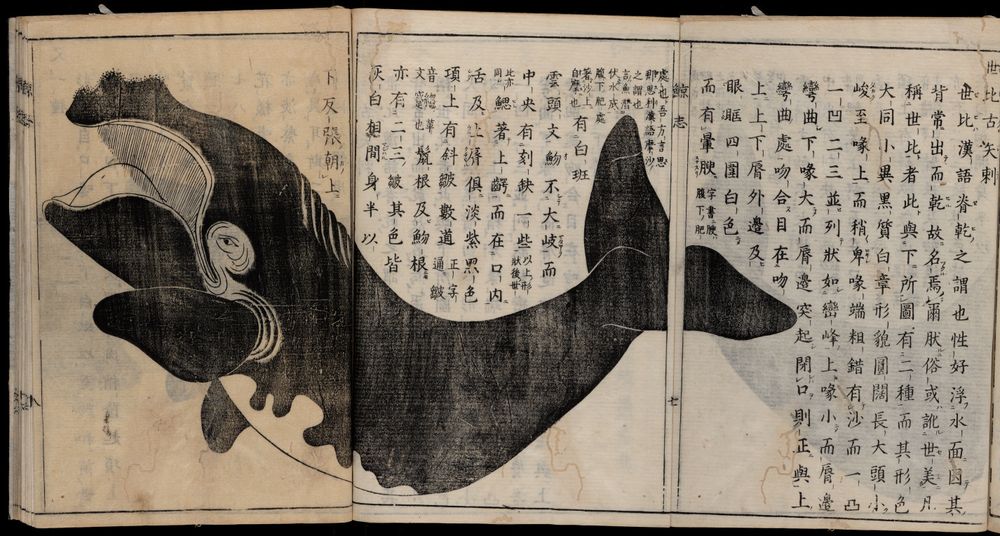
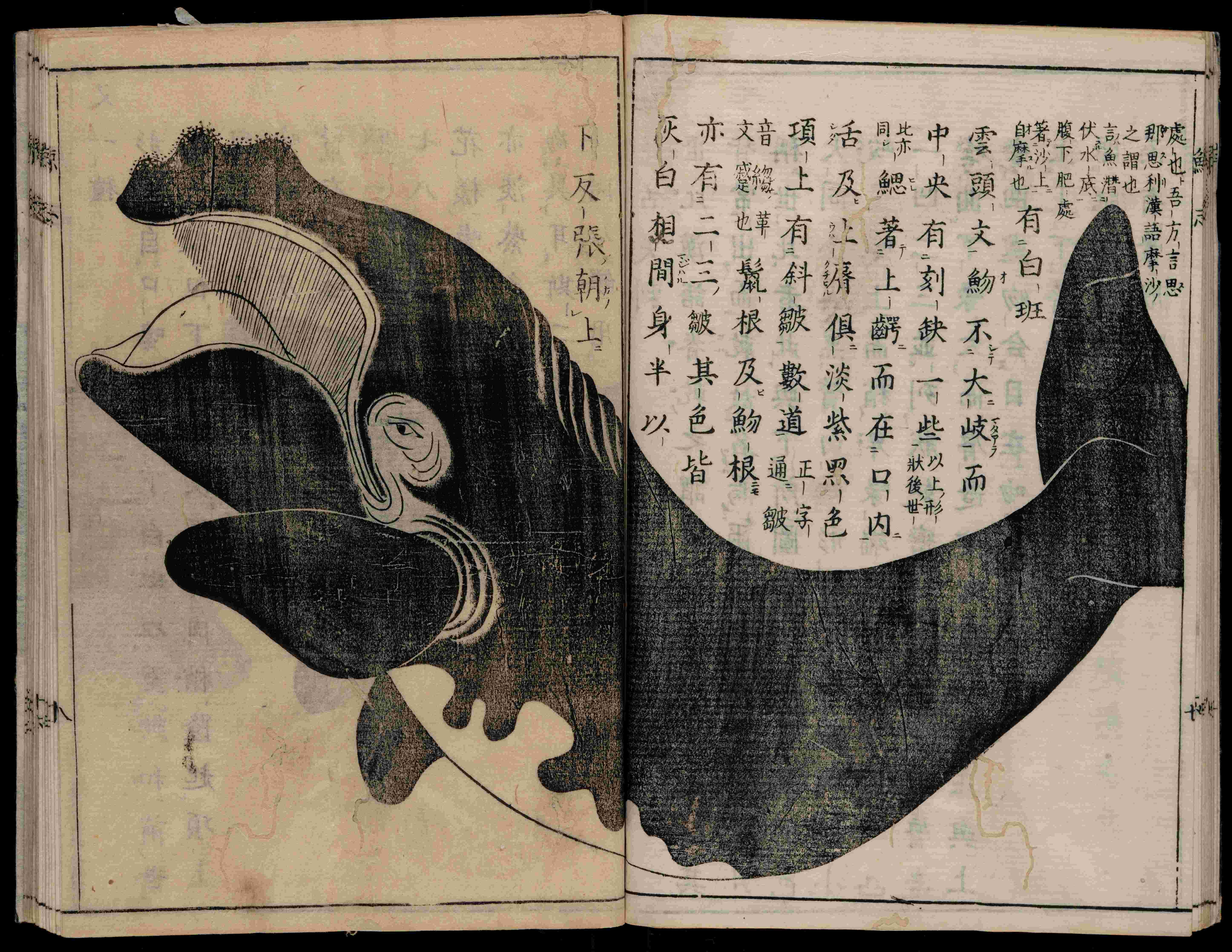
Published as a scientific text, comprehensively describing and illustrating the 14 species of whale known in Japan in the 18th century (some of which are now extinct), the engaging images in this book are presented like an illustrated narrative handscroll. The tips of tails on one page opening tempt the viewer to move forward to see the entire creature on the next. This format also emphasizes their enormous size. Significantly, this author may have been the first to posit that whales were not big fish, but mammals.

28. Ehon mushi erami [Picture Book: Selected Crawling Creatures] / 画本虫えらみ, 1788
Kitagawa Utamaro (1753?-1806); Compiler: Yadoya no meshimori (Ishikawa Masamochi)(1753-1830)
Two volumes bound as one
Edo: Kōshodō (Tsutaya Jūzaburō), Tenmei 8
喜多川歌麿 (1753?-1806); 撰者: 宿屋飯盛 (石川雅望)(1753-1830)
二編全一冊
江戶: 耕書堂 (蔦屋重三郎), 天明 8年
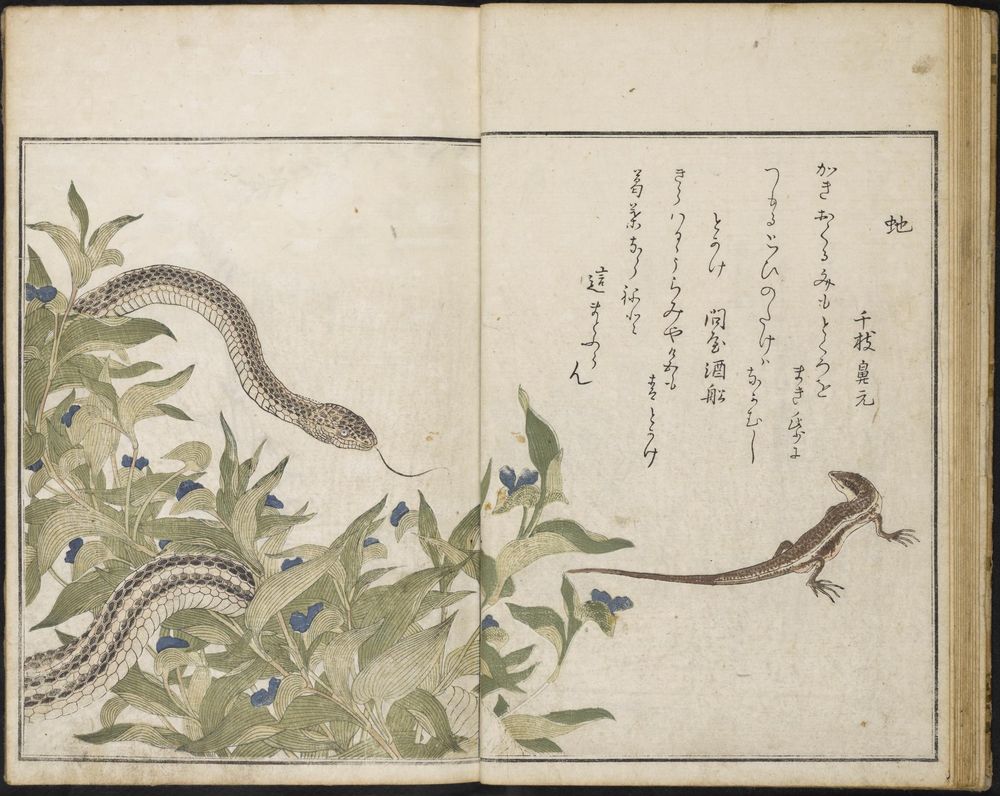
In this early collaboration between Kitagawa Utamaro and publisher Tsutaya Jūzaburō, pictures of insects, plants, and reptiles are paired with similarly themed and humorously risqué love poems. Selected by poet Yadoya no Meshimori, these poems were written by members of his elite poetry circle, which undoubtedly funded the publication of this book. In what appears to be a second printing, published just months after first at great expense, many of the bugs and reptiles (like the snake seen here) in this book glitter with the addition of crushed mica.

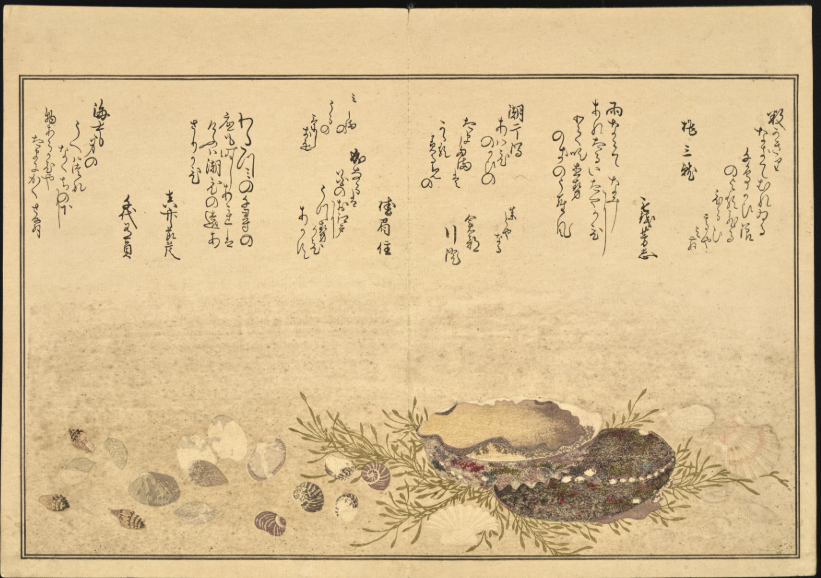
29. Shiohi no tsuto [Gifts from the Ebb Tide] / 潮干のつと, circa 1789 (First edition)
Kitagawa Utamaro (1753?-1806); Editor: Akera Kankō (1738-1798)
One volume
Edo: Kōshodō (Tsutaya Jūzaburō), circa Kansei 1
喜多川 歌麿 (1753?-1806); 編集者: 朱楽菅江 (1738-1798)
一帖
江戸: 耕書堂 (蔦屋 重三郎), 寛政 1年頃
A masterpiece of design and execution, this first edition copy incorporates many of the lavish techniques and processes available to the publishing industry at this time. Richly colored illustrations are embellished with gold and sprinkled with mica, metal filings, and mother-of-pearl. Some motifs are embossed in the thick soft paper. In this book, thirty-six poems, referencing The Thirty-six Poets, cleverly allude to the illustrations of shells and aquatic plants purportedly collected on a somewhat magical trip to the beach by inebriated members of the Yaegaki poetry circle.

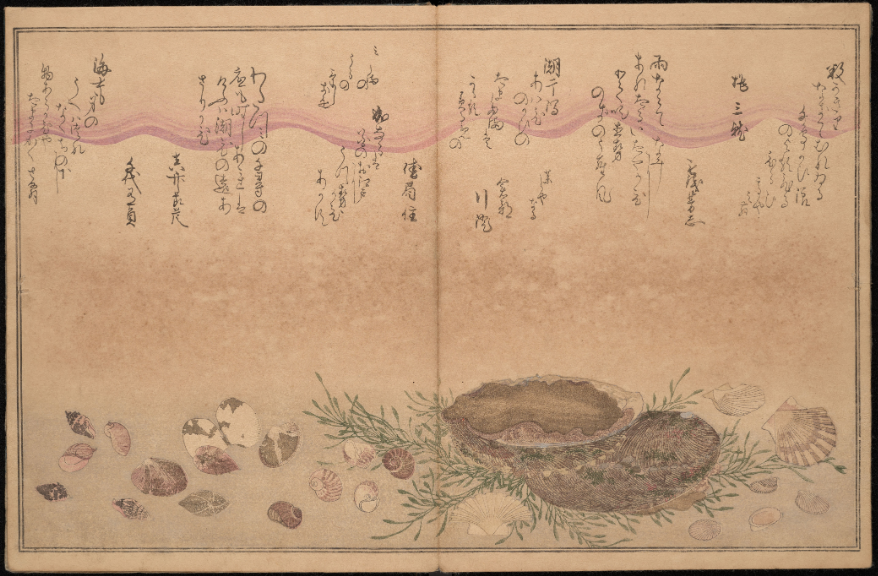
30. Shiohi no tsuto [Gifts from the Ebb Tide] / 潮干のつと, circa 1789 (Third edition)
Kitagawa Utamaro (1753?-1806); Editor: Akera Kankō (1738-1798)
One volume
Edo: Kōshōdō (Tsutaya Jūzaburō), circa Kansei 1
喜多川 歌麿 (1753?-1806); 編集者: 朱楽菅江 (1738-1798)
一帖
江戸: 耕書堂 (蔦屋 重三郎), 寛政 1年頃
This third edition of the book is remarkably different from the first [#29]. Most notable is the addition of a purplish wave that pulses through the poems at the top of the page—not seen in either the first or second printings. It hints that we are beneath the waves where the poets of the Yaegaki poetry circle collected their shells on an inebriated (and fanciful) trip to Shinagawa Bay. All three versions were expensively produced, suggesting that they were published for small elite audiences.