The 1940s and WWII
In the 1930s and early 1940s, the Japanese government maintained strict control over publishing. All media, including radio, newspapers, and films, was heavily censored. Posters were published to promote the idea of one’s civic responsibility and a government in control. Similarly, large-scale propagandistic paintings that focused on the nation’s sacrifice and the success of the war effort were displayed in exhibition halls for the public to see. They were painted in what was known as “Western style” (yōga 洋画) for a sense of “realism.” These same paintings became illustrations for books that were also part of this all-encompassing propaganda campaign.
Avant-garde Japanese art, like Surrealism and Abstractionism, was equated with Communism and suppressed through military coercion. Still, like Shimozato Yoshio’s photography book [#76], they continued to be privately published at great risk to the artists involved.

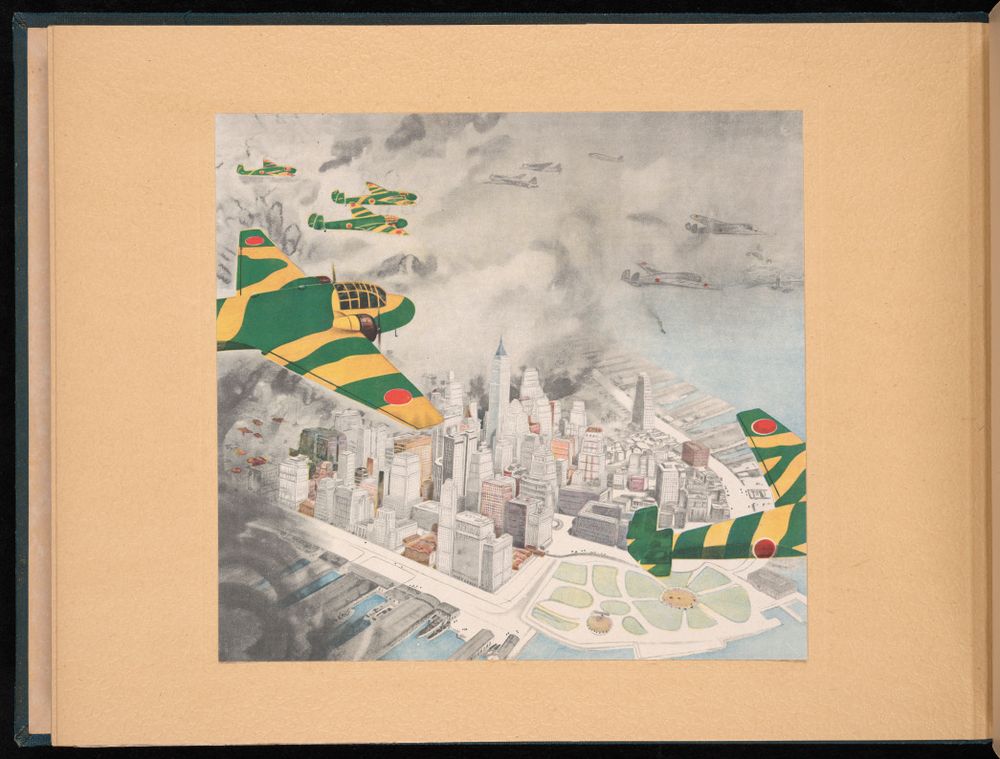
75. Dai Tōa Sensō kaigun bijutsu [Art of the Naval Campaigns of the Great East Asia War] / 大東亞戰爭海軍美術, 1943
Dai nihon kaiyō bijutsu kyōkai (Great Japan Air Defense Association)
One volume
Tokyo: Dai Nihon Kaiyō Bijutsu Kyōkai, Shōwa 18
大日本海洋美術協會
一冊
東京: 大日本海洋美術協會, 昭和 18年
With all media strictly controlled by the government, much of Japanese publishing during World War II was propaganda to bolster the war effort. By 1943, when the book was published (and things were not going well for the Japanese military), much of that propaganda focused on raising the morale of the public. This book, for example, highlighting the success of the Japanese navy almost two years after the bombing of Pearl Harbor, includes an aspirational image of Japanese planes just minutes from bombing New York City.


76. Mesemu zoku: chōgenjitsu shugi shashinshū [Genus Mesemu: Collection of Surrealist Photography] / メセム属: 超現實主義寫眞集, 1940
Shimozato Yoshio (1907-1981)
One volume
Nagoya-shi: Shimozato Yoshio, Shōwa 15
下鄉羊雄 (1907-1981)
一冊
名古屋市: 下鄉羊雄, 昭和 15年
Because surrealist images and erotica were banned during World War II, this book was privately published by the artist, a founder of the Nagoya Photo Avant-garde Club (Nagoya abangarudo kurabu 名古屋アバンガルドクラブ). The first half of the book is comprised of his abstract and erotic photographs of cacti—influenced by Salvador Dali’s comment that “Beauty should be edible, or not at all.” Photographs by other artists of the Nagoya group fill the last 10 pages of the book.

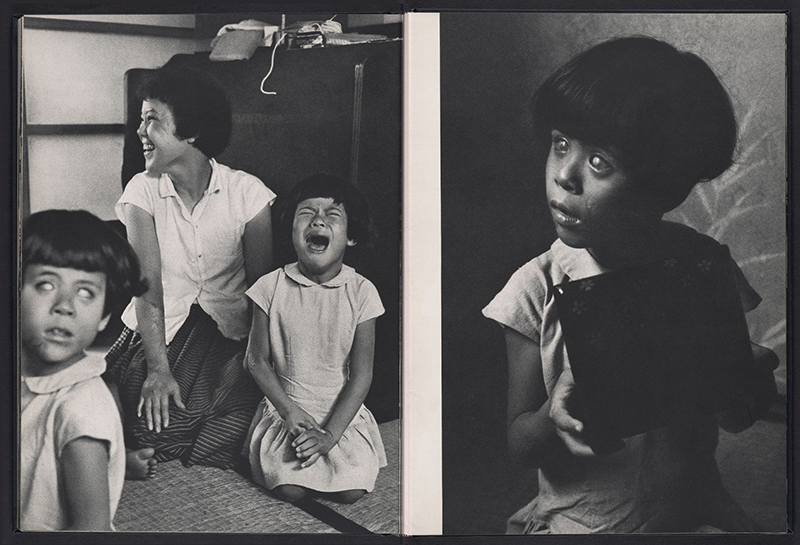
77. Hiroshima ヒロシマ, 1958
Domon Ken (1909-1990)
One volume
Tokyo: Kenkōsha, Shōwa 33
土門拳 (1909-1990)
一冊
東京: 研光社, 昭和 33年
Post World War II, 12 years after the atomic bombings of Hiroshima and Nagasaki, photographer Domon Ken produced this unflinching photobook about the ongoing devastation of the attacks on Japan and the after-effects of nuclear radiation. Though criticized by some for exploiting his subjects, this book was also praised for allowing Hiroshima’s living victims to speak. Believing his work to be a political act, he became the leading figure in the Photorealism movement that emerged in Japan after World War II.

78, 79, 80. Kokumin bōkū zufu (National Air Defense Maps) / 編著 国民防空図譜, 1941
Yagi Minoru (?), editor
35 lithographs (portfolio)
Tokyo: Dainihon Bōkū Hōkokukai, Shōwa 16
八木稔 (?)
石版画三十五枚 (ポートフォリオ)
東京: 大日本防空報国会, 昭和 16年
In September of 1940, Japan entered World War II and shortly afterward established a mandatory program of civil defense. Posters like these, color lithographs published in 1941, were printed with captivating graphic designs (what have been called “perversely pleasurable images”) to promote both military propaganda and public education. They succinctly imparted crucial but otherwise complicated information to a population that had been tasked with assigned roles in the aftermath of an attack and in the prevention of loss of life.
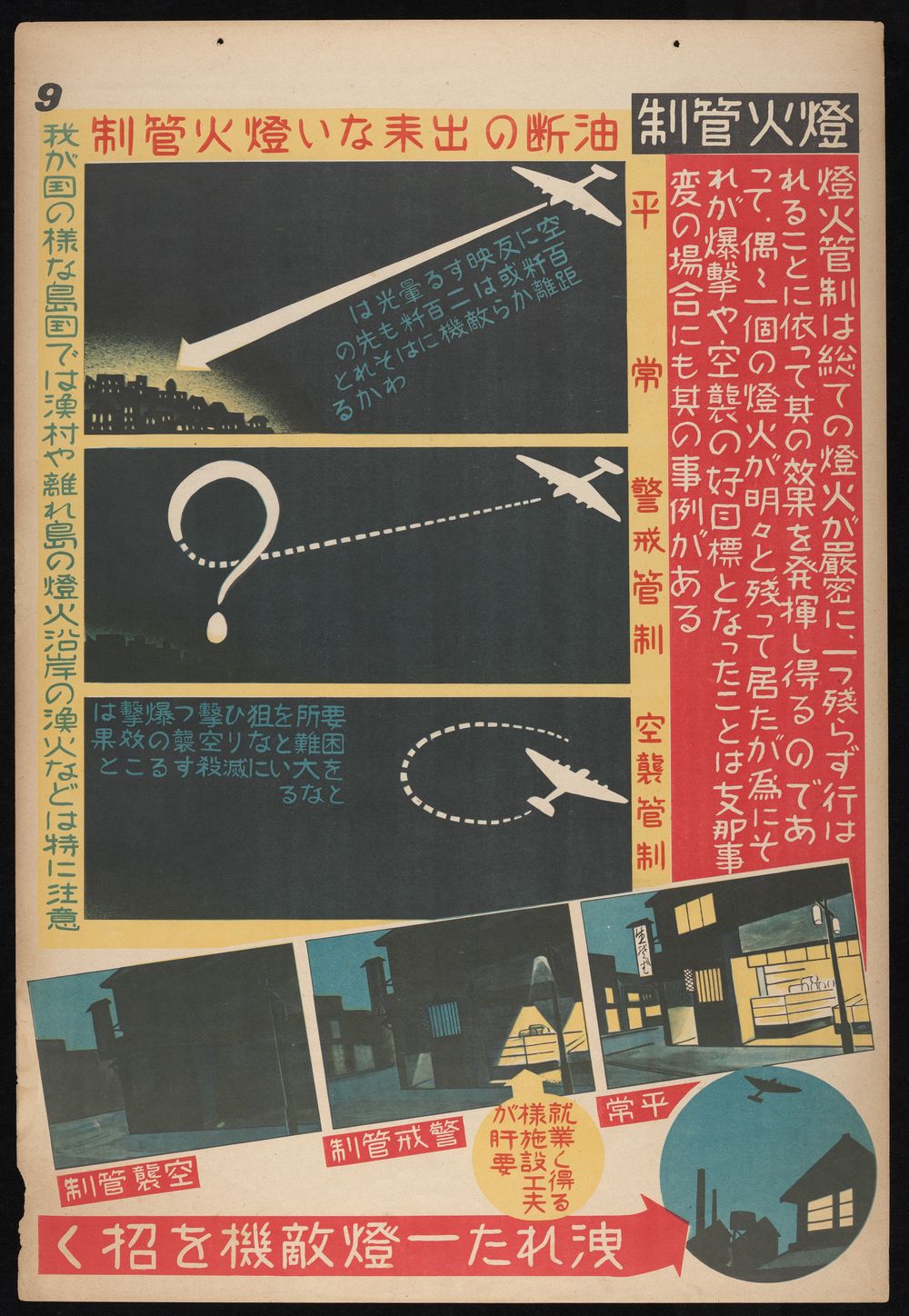
Tokakansei [Light Control (Without Targets it will be Difficult to Attack and Destroy) 燈火管制]
In this poster about the importance of blackouts, there is an enemy plane with an easy “lighted” target in the first panel. In the second panel there is a question mark as a plane arrives at the target but does not see anything (because residents complied with the blackout). In the third panel, the plane returns home with no harm done.
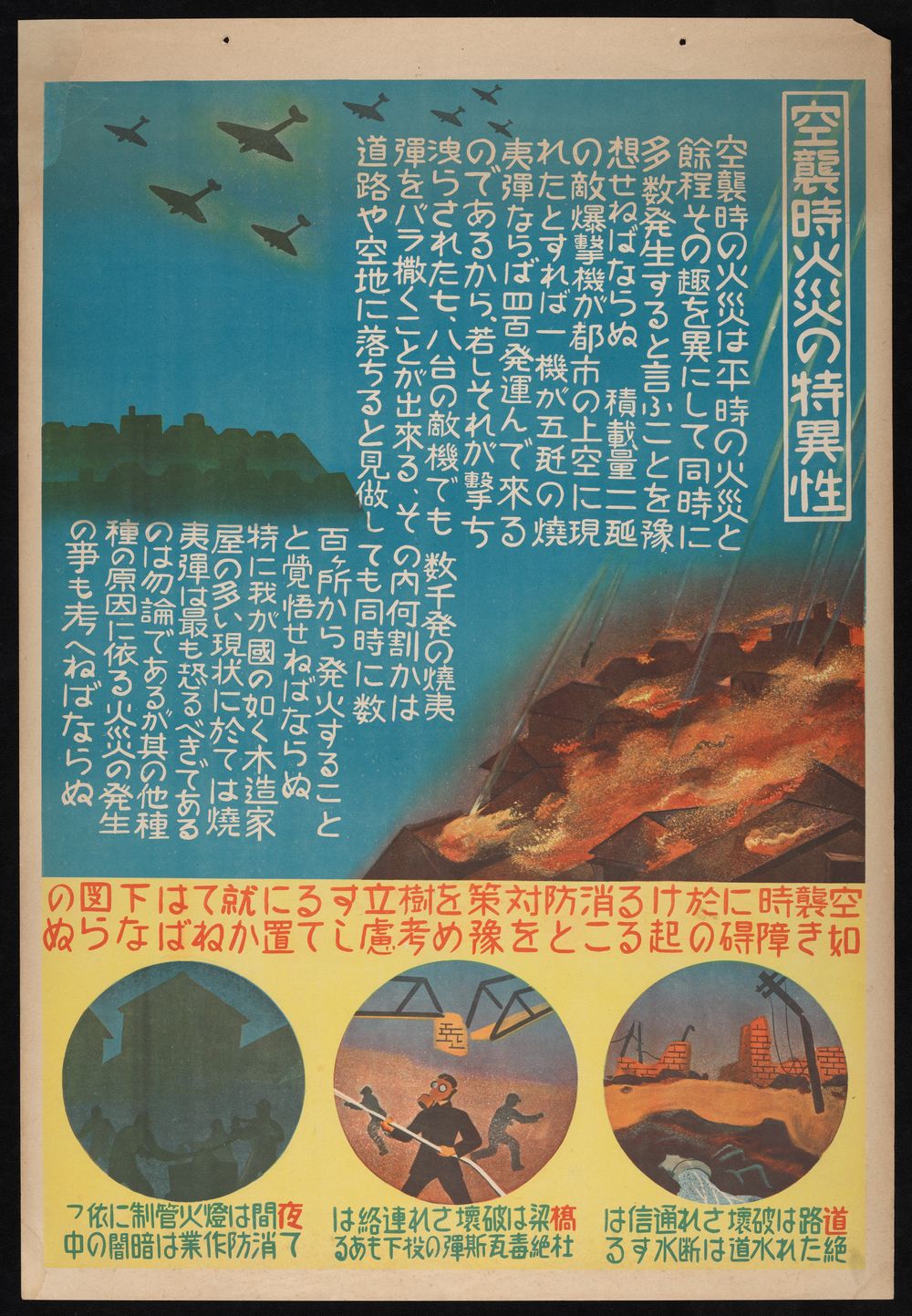
Kūshūji kazai no tokuisei [The Unique Nature of Fires During Air Raids 空襲時火災の特異性]
This poster warns that people must prepare for fires from incendiary bombs that, unlike a regular conflagration, could break out in hundreds of places at once. The public should also adhere to blackout warnings, beware of things like mangled bridges, poisonous air, road destruction, and a disruption in the water supply.
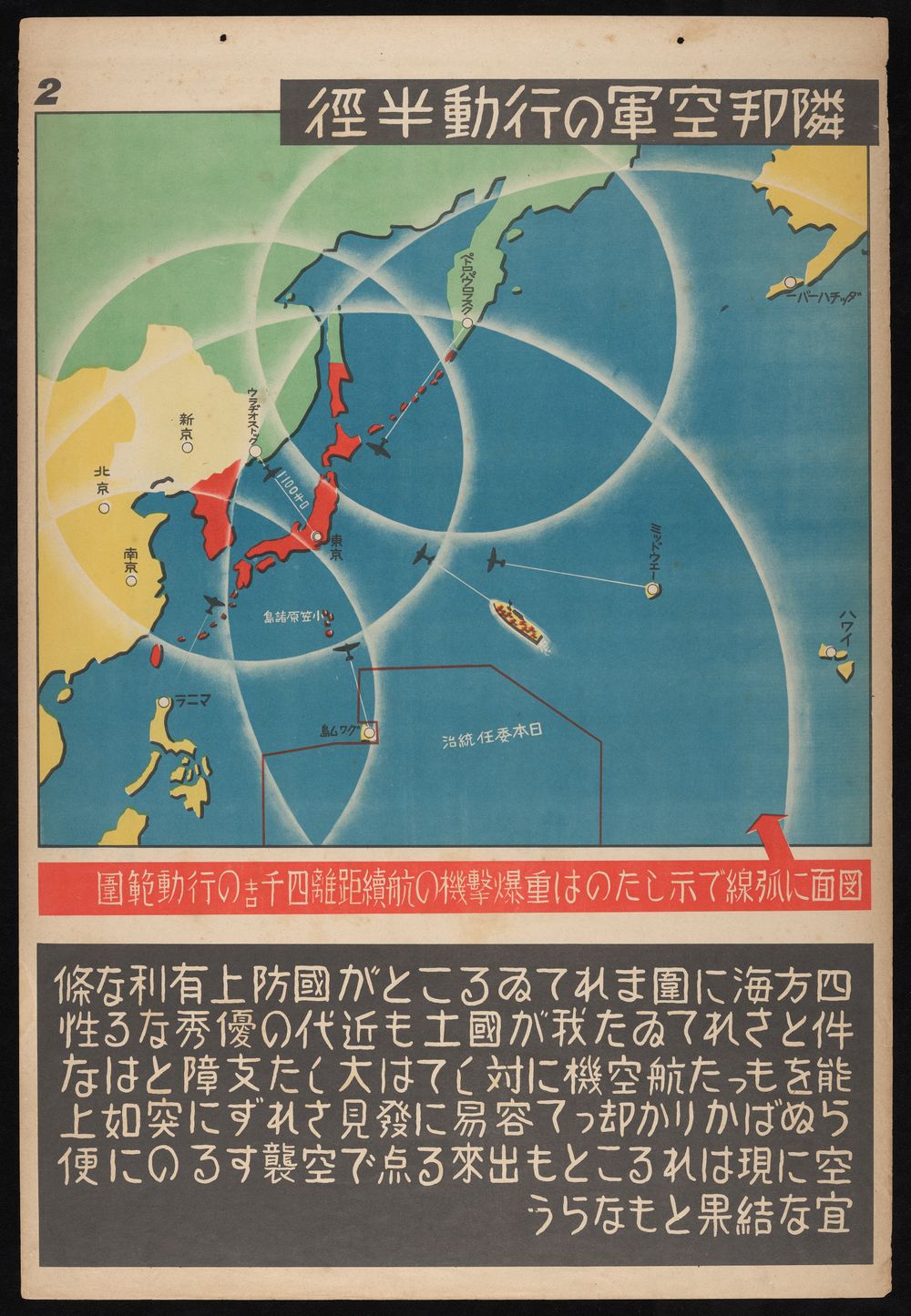
Tonari kuni sora no kodo hankei [Operational Radius of the Military Air Force in Action 隣邦空の行動半徑]
This poster assures the public that Japan is protected, not just by the sea on four sides, but also by strategic planning by the air force. Published in October of 1941, just two months before the bombing of Pearl Harbor, the islands of Hawai’i now seem conspicuous in the far right corner of this map.