Specialized Imaging

Throughout the Digital Princeton University Library (DPUL) exhibit, you can find several items photographed using specialized imaging methods at our Digital Imaging Studio in the Firestone Library. Our studio employs two advanced techniques to expand your viewing experience beyond standard photography.

Selene Photometric Stereo System
The Selene Photometric Stereo System (SPSS) is a high-resolution imaging system that captures detailed 3D surface textures and colors of flat objects. This helps to reveal features invisible to the human eye. Our studio uses this technology to document two objects: The Battle of Princeton (Sub-section: The Battles of Trenton & Princeton) by James Peale, and a Revenue Stamp (Sub-section: Resistance).
The Battle of Princeton glass-covered painting was difficult to photograph using traditional methods, but Selene allows us to produce a glare-free, ultra-high-resolution image. Similarly, the small, dark Revenue Stamp was captured in multiple sections and combined into a high-quality composite, which was also used to generate a 3D model.
On the left, a fragment of The Battle of Princeton painting; on the right, a revenue stamp. Slide the center divider to compare the two images.

3D Modeling with Photogrammetry
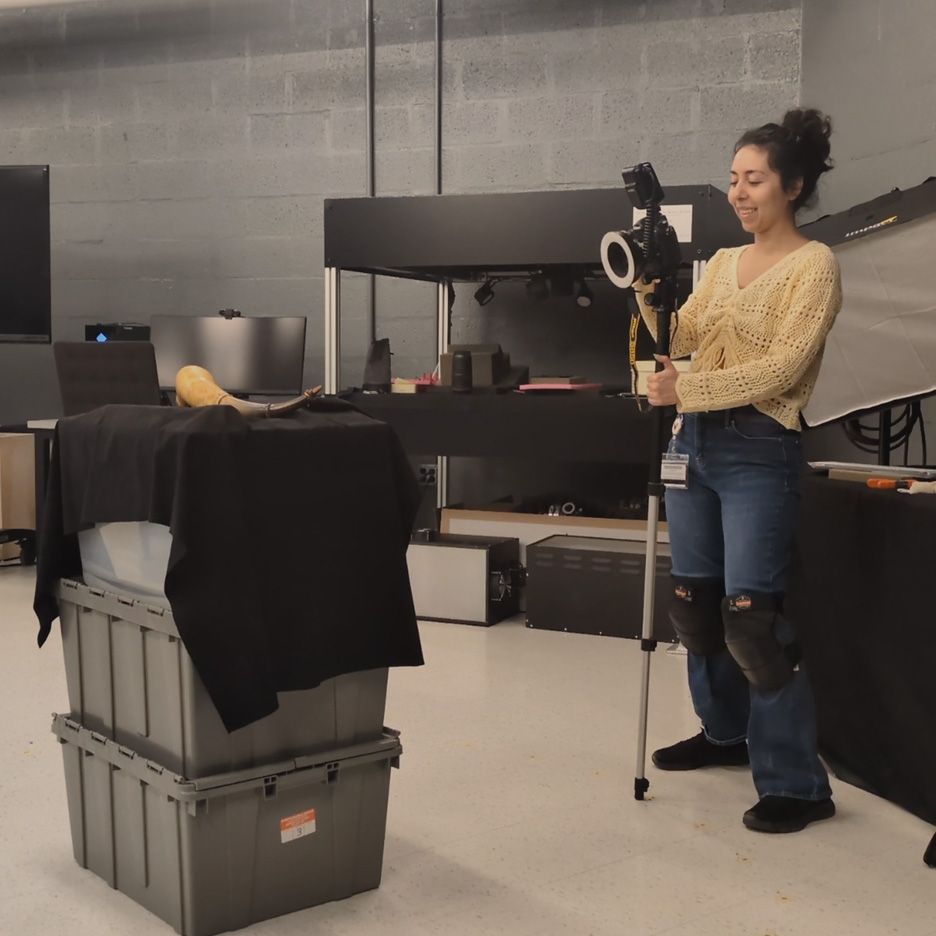
Photogrammetry is used to create accurate 3D models from overlapping 2D photographs taken from multiple angles. We focused on two objects from the exhibition: a Powder Horn (Sub-section: Seven Year War) featuring an intricately engraved map from New York to Canada, and the Libertas Americana medal (Sub-section: Congress at Princeton), a gilt bronze piece. These models provide a more engaging viewing experience, allowing close, multi-angle examination.
Photogrammetry is a time-intensive process that requires capturing objects from all angles, including both sides to record details on the top and bottom. We created six tiers of images (three per side: top, middle, bottom), with at least an 80% overlap between each shot.
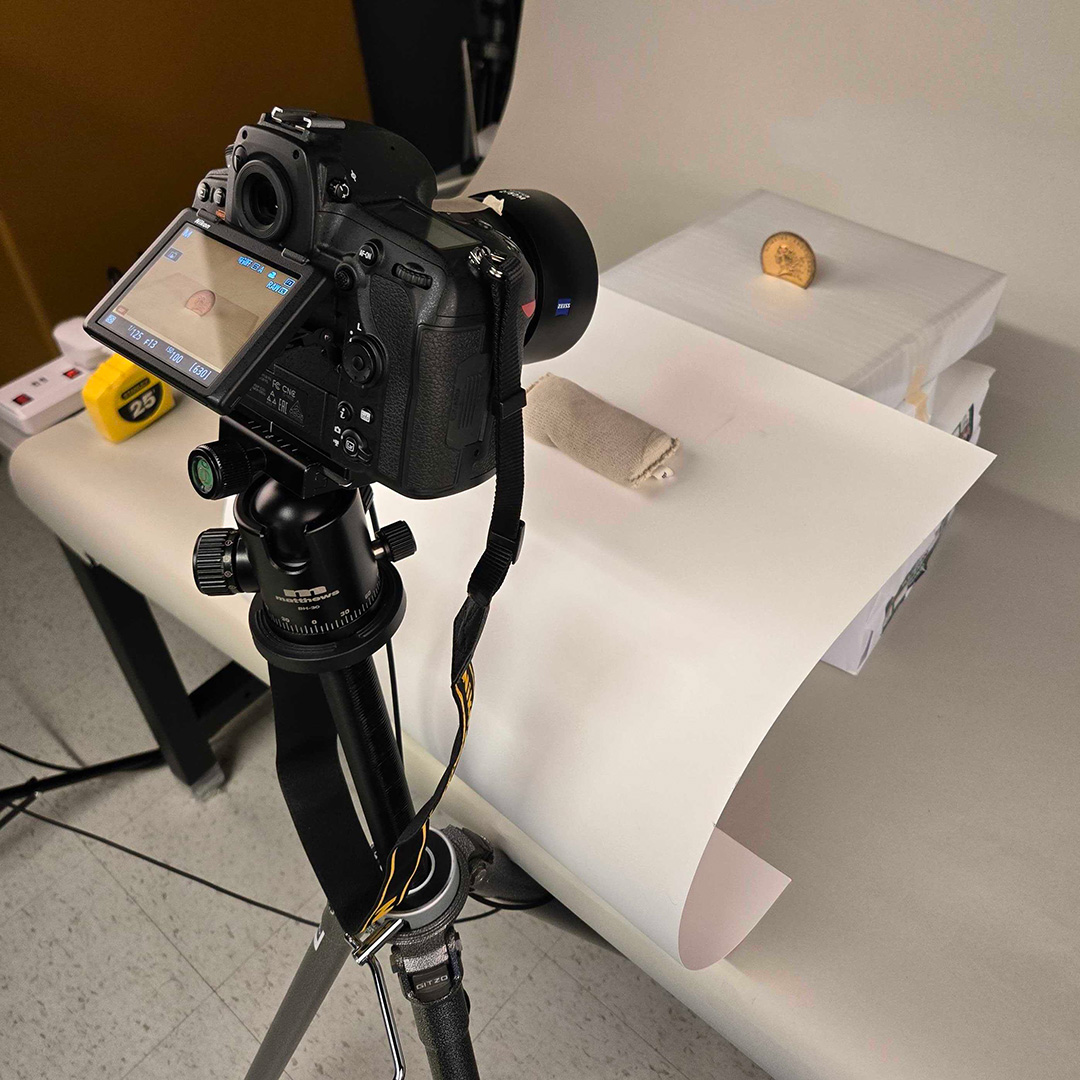
The camera must maintain a consistent focus and distance, achieved either by moving it incrementally around the object or by rotating the object itself. The approach depends on the object in question: the Powder Horn requires a multi-angle rotation, while the smaller medal is better suited to a rotating table.
In total, Digital Imaging Studio technicians captured approximately 216 images per object, maintaining consistent lighting and precise centering throughout. This workflow often involved multiple technicians managing the camera, positioning, and equipment, such as rotating tables, markers, and color calibration tools to ensure accurate color and scale.
After capture, the images were processed using Adobe Lightroom and then imported into Agisoft Metashape for 3D reconstruction.

You can view each model in detail in each corresponding sub-section.
- Revenue Stamp (Sub-section: Resistance)
- Powder Horn (Sub-section: Seven Years War)
- Libertas Americana medal (Sub-section: Congress at Princeton)

Learn more about specialized imaging at PUL.
