Présence africaine
By Paul-Louis Biondi, '24
Access all issues of this journal via JSTOR.

Like the Césaires, Senegalese Alioune Diop was part of the landscape formed by students from the colonies in Paris during the 1930s. Although he was not involved in L’Étudiant noir or its intellectual network in the 1930s, its impact resonated with him. Particularly influenced by négritude, Diop founded the journal Présence africaine in 1947. Published in both Paris and Dakar, the editor’s introduction asserts that “this review does not swear allegiance to any philosophical or political ideology” (Diop 1947, 7). Instead, Diop chose to publish African authors, works about Africa, and reviews of literary or artistic works about the “black world” (1947, 7). Positioned as a pan-Africanist, Francophone publication in a colonial time, Présence africaine found itself continually navigating its relationship with the metropole. Its contributors included a number of Negritude and surrealist intellectuals such as Aimé Césaire, Léopold Sédar Senghor, and Michel Leiris whose anti-colonial views were influential to the journal. While Présence africaine is not, strictly speaking a surrealist journal, its origins owe a lot to a generation of intellectuals and poets who aligned themselves with surrealism to articulate négritude and an anticolonial thought, while Diop, as mentioned above, was steeped into the anti-colonial surrealist culture developed in such publications as L’Etudiant noir. Présence africaine gives thus an idea of the surrealist legacy as it morphed and developed throughout the 20th century - the journal is still active today, with its 204th issue dated Spring 2023, and holds a great deal of historical and cultural significance as the only journal about Africa by Africans in France.
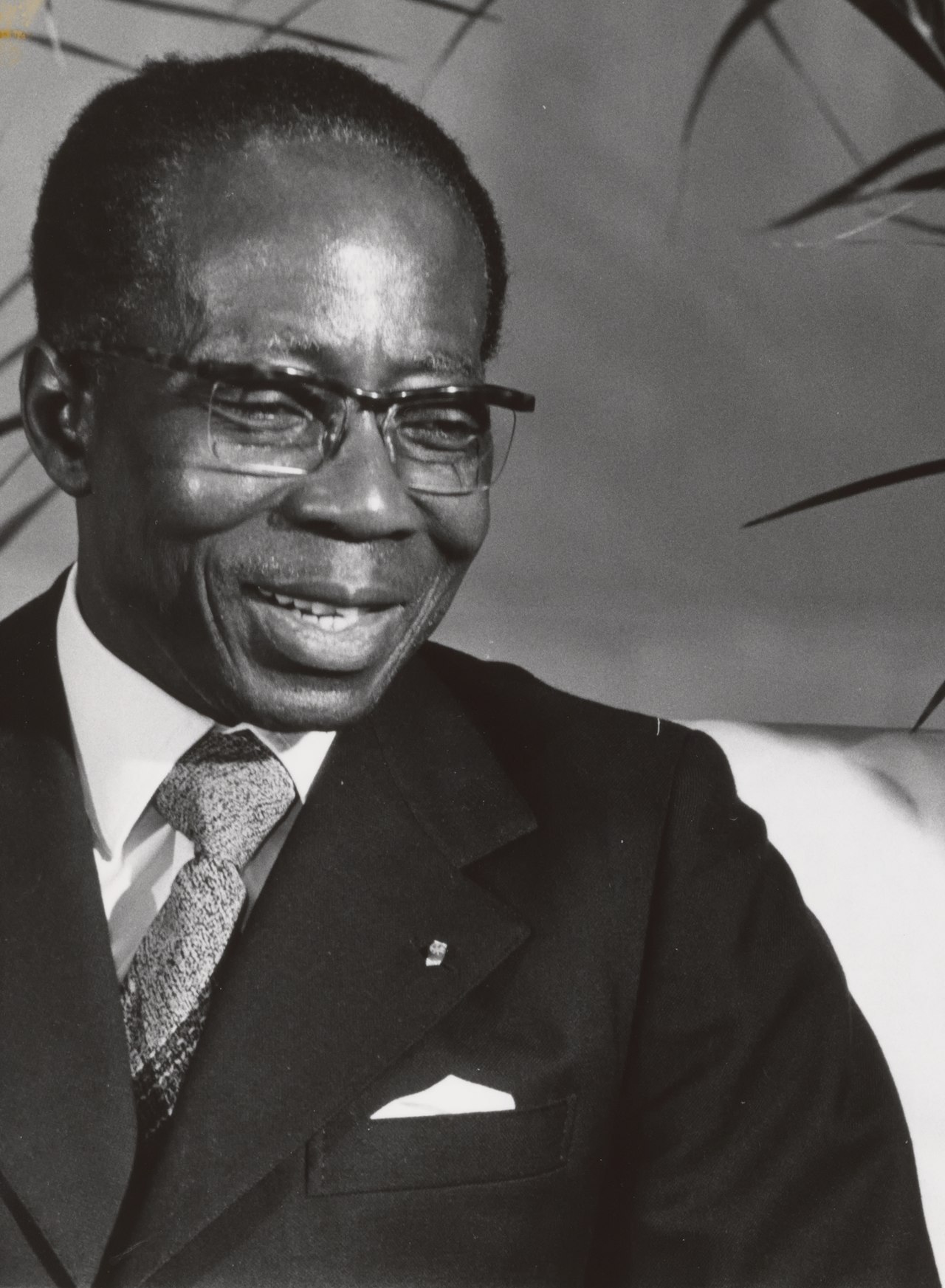
In 1941, Léopold Sédar Senghor and Alioune Diop formed a new group of black Francophone intellectuals living in occupied Paris that sought to discuss “black world problems” (Kesteloot 1974, 279). Diop recalls in his 1947 introduction to the first issue of Présence africaine how a new sentiment prevailed. This sentiment, he emphasizes, was one of “bouncing between two societies,” that left the group feeling the need to create a new way to think about their shared identities (Diop 1947, 8). However, the war and the Occupation made it impossible to publicize their ideas, leaving the project floating. In 1943, Diop took up this project once again and made the second move towards the formation of Présence africaine by placing an invitation for “African students to know their own civilization” in the Bulletin de l’etudiant d’outremer, a news bulletin published in Paris for Francophone students from the diaspora (Allouache 2017, 3). This was Diop’s primary interest and investment in Présence africaine, although, in its earlier issues, it often found itself weaving between Francophone assimilationist and pan-African politics.
After this initial call, it took Diop until 1946 to find enough support in order to get the publication off the ground. While he was not a part of the black student movements, he still managed to garner support from recognized literary giants of the Francophone literary world – Senghor, Jean-Paul Sartre, Albert Camus, André Gide, Michel Leiris, Aimé Césaire, and even Richard Wright (who had at that time become a rising star with Gallimard’s publications of his work in French) (Veron 2021, 304). According to Allouache, Diop even had obtained significant financial support from Albert Camus, who heavily contributed to the publication’s print and support costs (2017, 4). These literary figures begin to point to the complex navigation that Diop had to undertake within the intellectual landscape after the war: some of them were important surrealist and Negritude writers, while others were proponents of existentialism.
Not unlike Tropiques and L’Étudiant noir before it, Diop’s revue continued to necessitate a delicate balance between overt anti-colonial resistance and more discreet practices of literary production contending with Western traditions and non-Western ones. The journal provided a space for a newer, younger generation of black writers, while placing their work alongside more recognized figures like Césaire and Senghor. This format lent itself nicely to the innovation and continued evolution of pan-African and négritude literature alongside anti-colonial political movements in a way that either the one or the other could have done alone. As the journal kept evolving, it became a pre-eminent voice for African and diasporic literature and colonial critique, an approach which Diop developed quite intentionally.
This review does not swear allegiance to any philosophical or political ideology.
It wants to remain open to collaboration with any person acting in good faith… sensitive to our project of defining African originality and to its speedy introduction into the modern world.
Présence africaine is comprised of three fundamental parts.
The second, and in our eyes the most important, will be comprised of African texts (novels, news, poems, theater pieces, etc.). The first [part] will publish pan-African studies on African culture and civilization… Lastly, the final part will review literary or artistic works contending with the black world.
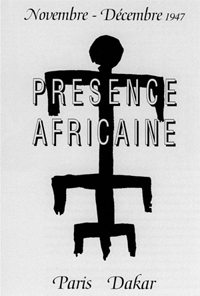
The goal of the publication was to define the African creative endeavor, to ensure its presence in the modern world, to foster African literary production in its many forms, to study African civilization from a pan-African perspective, and to analyze art that takes the black world as its subject. Diop created thus a vast lexical champ from which to choose, governed, at the same time, by a singular idea – the exploration and valuation of Africa and African civilization (in its many forms, including diasporic). It seems then that the refusal of one single philosophy or ideology, as announced in the first issue of the periodical, is not so much about the ideology itself but the ability to refuse and to rebel. In this manner, we may see Présence africaine working in a similar way as surrealism, in a continuous mode of revolt.
While the project of Présence africaine is not singular and oftentimes unsure of its footing, its investment in Africa does prove to be a unifying force for black, pan-African, and négritude writers after the Second World War. At a time when what Aimé Césaire calls the 'logical conclusion of colonialism' has scarred Europe and France and somehow also made them double-down on their own colonial projects, the journal provided a space to speak and reflect in a uniquely diasporic manner. That is not to say that the journal only published black Francophone writers, but it centered, unlike many journals before it, African and diasporic voices and fostered their development. In part because of this mission and in part because of Diop’s ability to reunite so many voices, it is in Présence africaine that some of the defining texts of 20th century black Francophone writers first appeared, such as Aimé Césaire’s Discourse on Colonialism.
Bibliography
Allouache, Ferroudja. “Naissance et résistance d’une revue: Présence Africaine.” Continents Manuscrits online: 1-13. https://journals.openedition.org/coma/950.
Diop, Alioune. “Niam n’goura ou les raisons d’être de Présence africaine.” Présence Africaine, no. 1 (1947): 7-14.
Kelly, Robin D.G. “A Poetics of Anticolonialism.” In Aimé Césaire, Discourse on Colonialism. New York: NYU Press, 2000.
Kesteloot, Lilyan. Black Writers in French: A Literary History of Negritude. Philadelphia:Temple University Press, 1974.
Véron, Kora. Aimé Césaire: Configurations. Paris: Éditions du Seuil, 2021.