Mandrágora
By Elizabeth Kunz '25
Access all issues of this journal via memoriachilena.

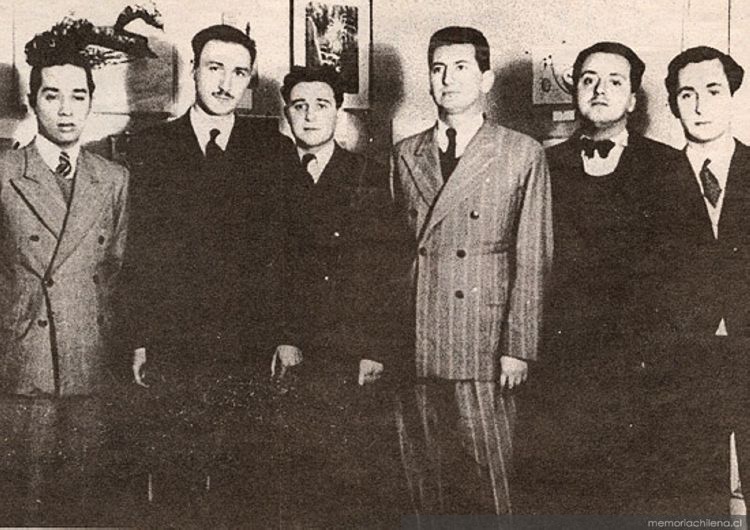
Mandrágora, Chile’s first and only surrealist periodical, was published intermittently from 1938 to 1943 in Santiago by a group of young poets: Braulio Arenas, Teófilo Cid and Enrique Gómez-Correa, who would later be joined by the poet, dancer and visual artist, Jorge Cácere. The group sought to use the written word to challenge Chile’s literary status quo, particularly the trends of social realism and the so-called humanization of art, which they viewed as inadequate in depicting the complexities of modern life. The main target of their derision was the Alianza de Intelectuales de Chile and its most prominent representative, Pablo Neruda. The Mandrágora group believed that, in maintaining ties to the Alianza, Neruda and his contemporaries relinquished their ethical and aesthetic independence as poets, rendering their poetry void of revolutionary potential.
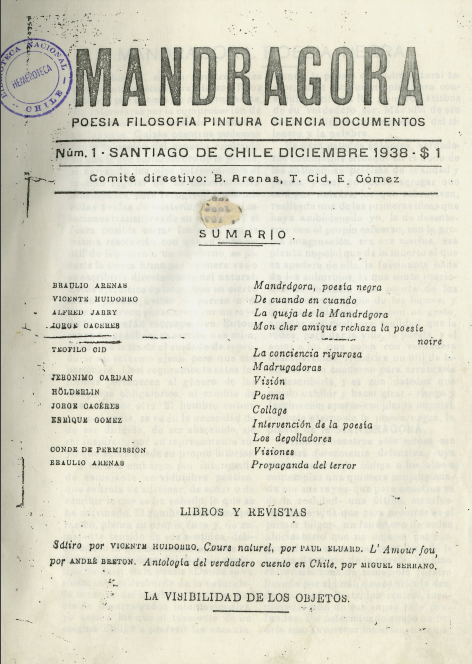
Printed and disseminated on a shoestring budget, Mandrágora was presented in a simple double-column newspaper format. Despite its full title (Mandrágora: poesía, filosophia, pintura, ciencia, documentos), all 7 issues contained only the written word (with the sole exception of the illustrated cover of the 7th issue). While the layout of Mandrágora changed from issue to issue (there was no standard font for the titles, a table of contents was included only in the first issue, and in the final issue the double-column newspaper format was abandoned all-together), there was no variation in its thematic contents. The first six issues included mostly prose manifestos and essays, surrealist poetry and prose, and translated works by international writers accompanied by reviews. The seventh and final issue diverged from this pattern in that it consisted only of Gómez-Correa’s lengthy essay “Testimonios de un poeta negro” (Testimonies of a black poet), written in the style of a poetic apologia.
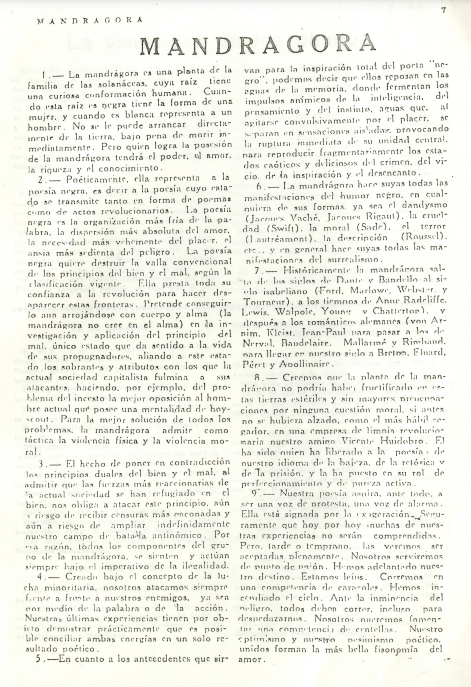
The surrealist orientation of the journal is most evident in the manifestos and pragmatic essays which seek to define Chilean surrealism. It is clear that the directors of Mandrágora sought to strike a balance between the national and international, balancing translated works of well-known French poets (Paul Éluard and André Breton) with those of emerging Chilean poets. While several of the essays develop the core poets’ vision of a uniquely Chilean brand of surrealism, it isn’t until the fourth issue that what may be considered a manifesto of Chilean surrealism appears. The nine-point manifesto (shown to the left) appears under the simple title of “Mandrágora'' with no specified author. The text outlines the group’s belief in the capacity of surrealist poetics – referred to by the group as la poesía negra (black poetry) – to critique the status quo and envision revolutionary futures.
La poesía negra - Imagery of the Occult in Mandrágora
While early French periodicals were the group's primary inspiration for the production of Mandrágora, the evident influence of the group’s collective obsession with German romanticism sets it apart thematically from other early surrealist periodicals. As university students in the provincial town of Talca, Arenas’s older brother provided the group with a reading list that would profoundly influence the group’s particular brand of surrealist poetry, “la poesía negra", including the likes of Goethe, Achim von Arnim, Nietzche, Baudelaire, Rimbaud, and Blake, among others. The poets of Mandrágora drew from this deep well of literary influences the poetic imagery of the occult, which, stretching beyond romanticism to the earlier esoteric ideas it incorporated, grafted the esoteric literary themes of the past onto the modern avant-garde poetics of surrealism to create a unique vision of revolutionary poetry.
Mandrágora deployed the romantic themes of the profane, the sinister, and the occult in order to emphasize the surrealist vision of poetry as a radical tool capable of unsettling the illusions of reality by eliminating the line between moral and immoral, conscious and unconscious, real and unreal. Within the context of Mandrágora, poesía negra refers to blackness only with regard to romantic tropes of the irrational, the immoral, and the grotesque. In the essay-manifesto "Yo hablo desde Mandrágora" (I speak from Mandrágora), Gómez-Correa declares that, “the poeta negro (black poet) will be permitted to commit every sort of act – even the most abominable according to laws and established morality; from performing ‘black masses’ to parricide, passing through incest – on the sole condition that they serve to promote his poetic instinct".
The poets of the Mandrágora took these themes from romanticism and applied them to the surrealist concept of a total poetry which encompassed all aspects of life. The term poesía negra was not a style of poetry but rather a way of living which demanded the integration of life and poetry in pursuit of a complete upheaval of the literary, social, and political status quo. It is described in the Mandrágora manifesto of issue 4 as “poetry which is transmitted so much in the form of poems as in revolutionary acts'' that “seeks to destroy the conventional boundary between the principles of good and evil according to our current understanding”. In eliminating these conventional boundaries, poesía negra allows the poet to access the hidden “other side” of reality, the subconscious. The poets of Mandrágora refer to the subconscious exclusively through imagery of the occult, depicting themselves and other practitioners of poesía negra as mystics, oracles, seers, or conjurers who, by delving into the depths of the human psyche through the written word, achieve clairvoyance. This theme of the occult is established most clearly from the periodical title itself, which invokes the mythical connotations of its namesake, the mandrake plant. In adopting the mandrake as the periodical’s central image, “the group looked back in time beyond surrealism to Mediterranean myth and folklore, to medieval superstitions and beliefs, and in particular to nineteenth-century Europe”. Within the context of European esoteric tradition, “the symbolic value of the mandrake lies in its visual similarity to humans, along with its narcotic, soporific, and aphrodisiac qualities, all of which caused the root to be traditionally associated with the cult of Aphrodite, with witchcraft, and with magic”(Nicholson 2023, 9). According to medieval legend, if one were to pull the mandrake root from the earth, the root, inhabited by a demon, would begin to scream and cry, killing anyone who heard it. But, as is explained in issue 4 of Mandrágora, “whoever does achieve the possession of a mandrake root will have power, love, riches, and knowledge”.
The First issue of Mandrágora begins with an essay written by Braulio Arenas, "Mandrágora, poesía negra". Calling forth the image of the mandrake, he declares that the purpose of his writing is:
“to unearth by my own effort, with my own imagination, that sea bird, the nuptial plant that brings death to the one who seizes hold of it, the fascinating fairy of the slums, the one who sings children’s songs at the door of brothels and at the foot of the gallows, and who nevertheless known how, with a single gesture to push aside the mediocre reality that surrounds her, in order to give life, poetry, and love to those who take up a spade or a notebook with true frenetic desperation, in order to tear it out or to describe it, and I turn round my hands to show you all – risk and fascination aside – that nuptial plant, eternal symbol of poesía negra, the plant called the Mandrágora”.
Here Arenas depicts writing as the pursuit of knowledge through the exercise of the human imagination. From the process of imagining the mythical image of the mandrake, Arenas is granted the gift of true knowledge, and it is therefore the very act of writing which allows him to cross the threshold to the mystic “other side” of reality, as would a psychic or seer. Arenas describes this task of the poet in direct visionary terms: “But there the poet works, besieged by ice and fire – with his primordial instinct, with his supernatural and aphrodisiac visions. So many centuries of frozen work have given him direction and clairvoyance”. Arenas shows that the purpose and power of poetry is to give sight to the reader by giving shape to the unknown through language. This belief in language, particularly in forms of non-rational expression such as prophecy, verbal delirium, and it’s surrealist manifestation, automatic writing, can be seen as a continuous thread running from ancient esoteric thought through romanticism and into surrealism. Furthermore, the depiction of poesía negra as a surrealist descent into the unknown echoes the romantic idea of the occult as that which is hidden, kept secret, potentially sinister. In "Intervención de la poesía", also featured in the first issue, Gómez-Correa suggests that such insight allows for a revelation of the self, but also holds the power to poison, contaminate, or even destroy if not wielded correctly: “But I warn those first attempting the unbridled game of the word, those being initiated into the mystery of the word, those who are amateur in its use, of the dangers it brings. At the slightest misstep it turns into a noose around the neck, and then all is lost”. Despite these embellished descriptions of clairvoyance, the poets of Mandrágora refer to elements of the occult in exclusively metaphorical terms. The metaphor of the written word as an esoteric practice serves to demonstrate that “crossing the threshold into nonrational states depends not on supernatural forces but simply on the full affirmation of subjective experience” The role of the poet is therefore akin to that of a seer or fortune-teller in that they are granted the ability to delve into the depths of the human psyche and bring back an uncanny image impossible in its absurdity which nevertheless reveals a fundamental truth of human existence.
Revolutionary Acts
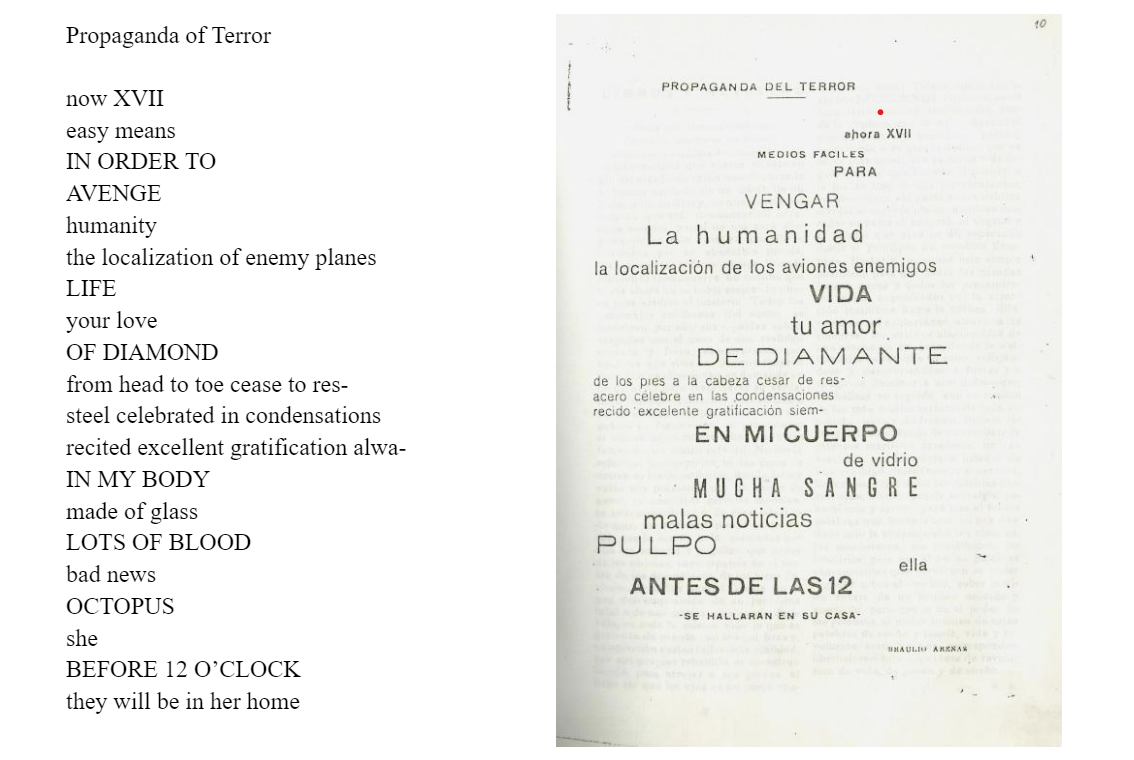
The poets of Mandrágora saw poetry and acts of protest as one and the same, as existing constantly in tandem. In the Mandrágora manifesto which appears in issue 4, the group defines la poesía negra as “the poetic state which is transmitted so much in poems as in revolutionary acts”. Each poem was an act of insurgence, radical in its ability to challenge the status quo and to imagine a completely unexpected reality. The poets of Mandrágora thus conceived themselves as rebels and pariahs, tasked with creating a new social and political order utterly contradictory to capitalism, the Christian religion, and the glare of rational thought. They depicted themselves as utterly alone, describing themselves as surrounded on all sides by opposition as if on a battlefield, besieged by the “bitter censure” of their opponents, causing the members of Mandrágora to “always feel and act under the imperative of illegality”.
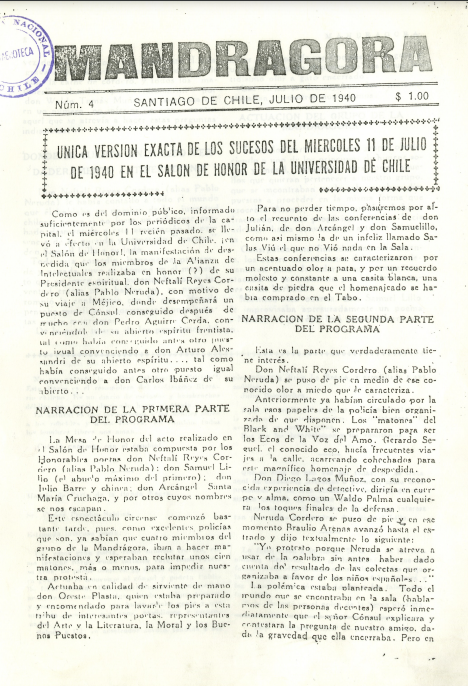
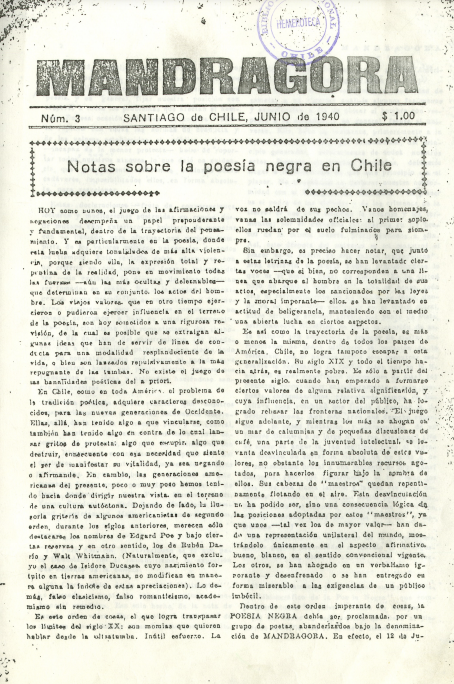
In "Notas sobre la poesía negra en Chile", featured at the start of the third issue, Gómez-Correa addresses the social and political challenges facing Chile’s youth at the start of the 1940s. In the international context, Chile was impacted by the dissolution of the bourgeoisie in the interwar period and, with the rise of Stalinist, Francoist and Nazi-fascist politics, what seemed like a complete and possibly permanent breakdown of European cultural institutions. Meanwhile, Chile’s primarily agricultural economy was rapidly industrializing, which led to a mass migration to Santiago from the countryside and provincial cities. The rapidly changing, increasingly bohemian capital city offered success and poverty in equal measure, the urban landscape marked by stark images of both opportunity and destitution. At the same time, expanding access to education made it possible for the middle class to play a very dynamic intellectual role. The parameters of modern life had been irrevocably redefined, and Chile’s youth was searching for a new vision of the future.
Gómez-Correa’s answer for Chile’s youth in "Notas sobre la poesía negra en Chile" is not a social program or a certain political affiliation, but rather the very practice of poetry. He begins by explaining that, for el poeta negro, there can be no solution to the radical new landscape of modern life short of total social revolution: “He will therefore be in favor of any act that implies the breakdown of the basic principles of the present society, until we arrive at the total collapse of the existing institutional system. This is why we are against the bourgeois, against facism – to the extent that it serves to protect those institutions eternalized by the capitalist regime – against family, against laws, against religion, against morality and against petty revolutionaries''. Gómez-Correa then explains that poetry, “being the sudden and total expression of reality”, is itself a revolutionary act. In revealing the truth beyond our limited purview of reality and the falsehoods upon which society stands, poetry sets in motion the complete demolition of its pillars. The Mandrágora group claimed that poetry acted in tandem with revolutionary acts, that their group, being “created under the concept of the minority struggle of the minority”, always attacks their enemies “face to face, whether it be through the written word or through direct action”. However, despite their advocating for all manner of violent, shocking revolutionary acts, the poets of Mandrágora protested the status quo almost exclusively through the written word. The sole example of collective direct action by the group is described in issue 4 of Mandrágora under the title of “The only exact version of the events of Wednesday, July 11, 1940 in the Hall of Honor at the University of Chile''. The text details in length the group’s disruption of a ceremony celebrating Pablo Neruda, during which they caused minor chaos by asking a set of ridiculous questions after Neruda’s acceptance speech. The poets’ excessive self-congratulation for the disruption of the event demonstrates that their grandiose praise of violent, profane acts of revolution were largely metaphorical in nature. The poets of Mandrágora used tropes of violence and profanity similarly to how they used imagery of the occult, entirely metaphorically.
The Legacy of Mandrágora
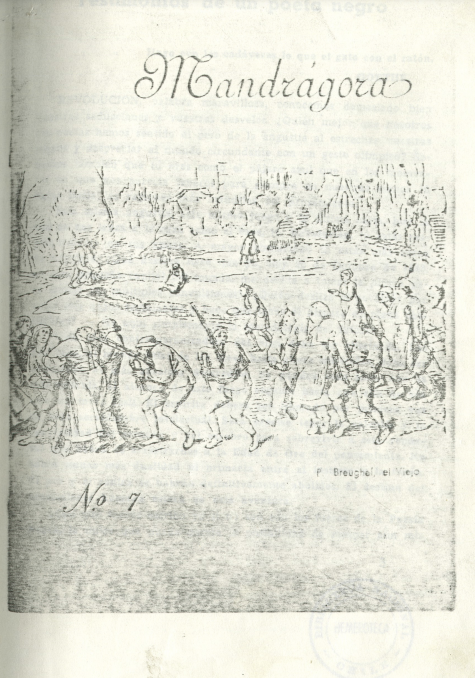
Issue 7, which may be considered the farewell issue of Mandrágora, sharply departs from the format of the preceding issues. Rather than featuring a collection of prose, poetry, and essays by various authors, it includes only one piece, "Testimonios de un poeta negro", a lengthy essay written by Gómez-Correa. The essay is addressed to “revolution, a wonderful word”, to which Gómez-Correa muses, “What fate makes me, today, October 20, 1943, in this small capital of the world, decide to take up the pen to write down your many convulsions? Who slips the revolver through my trembling fingers and makes me fire the shot in the middle of my eyes?”. In what reads almost as a eulogy of Mandrágora, Gómez-Correa implores his readers to continue to practice poesía negra in pursuit of the total upheaval of the current social order:
“Any contemporaneous idea of the good must be eliminated. The doctrines, the whole world of ideas hitherto known, must be dragged into utter disrepute. Every idea, even the dearest, will be placed within the reach of this blinding fire until it is but a mere fossil. The spirit must be freed for the first time from all intellectual servitude. It will take courage and generosity of heart and brain to survive this gale that will drag us into the Golden Age of thought. There will no longer be duality or primacy between instinct and reason. The pros and cons will have been definitively abolished. The fate of human thought will be in this adventure”.
In this text, Gómez-Correa professes his fate in the power of poetry beyond the scope of Mandrágora, trusting that a great revolution of the written word has begun and will bring to fruition the “Golden Age of thought”. Gómez-Correa then, in insisting upon the building momentum of poesía negra, reaffirms the legacy of the Mandrágora periodical. “Behind those convulsive pages that have meant the appearance of Mandrágora, I know that there are countless young people who work in silence and who will one day shout out loud thanks to poesía negra. Lo negro [the black] will invade politics, history, science, philosophy, sociology, law, fashion, etc., producing the most beautiful collages of thought”. Gómez-Correa, prophesizing the ultimate fruition of their creative and revolutionary energies, then implores these young readers, bearers of Mandrágora’s legacy, to continue practicing poesía negra: “It will then be necessary to demand of every poeta negro that he should at least have the courage to be ready to leap at any moment from a second floor. I feel possessed by enthusiasm. Every poeta negro, at the hour of signal, will know how to shout definitively: THE HISTORY OF POESIA NEGRA IS THE STORY OF MY LIFE”.
After its seventh and final issue, Mandrágora was to be replaced by Leit Motiv (1942) which, similar to the periodicals succeeding Argentina’s Letra y Linea, featured surrealists writers alongside other avant-garde poetics. Within its short lifetime, Leit Motiv “represented an innovative and artistically diversified alternative to the largely esoteric-romantic orientation of Mandrágora”. The periodical had a markedly more sophisticated layout than that of its predecessor and expanded its focus beyond poetry to also include the visual arts. Despite these contrasts, Leit Motiv and Mandrágora shared an unwavering commitment to undermining the moral and political order of the era, their revolutionary energies contributing to the momentum of the vanguardia literaria latinoamericana.
Bibliography
Nicholson, Melanie. “From German Romanticism to Surrealism: The Modern Esoteric Tradition in Chile’s Mandrágora.” Dada surrealism. 24, no. 1 (2023).
Noriega, Julio E. “La Mandrágora En Chile: Profecías Poéticas y Revelaciones Del Género Negro.” Revista Iberoamericana 60 (1994): 751–60. https://doi.org/10.5195/reviberoamer.1994.6433.
Nicholson, Melanie. Surrealism in Latin American Literature: Searching for Breton’s Ghost. New York, NY: Palgrave Macmillan, 2013.
Apablaza, Claudia. “La Mandrágora.” Essay. In Manifestos Vanguardistas Latinoamericanos, 199–208. Madrid, España : Ediciones Barataria, 2011.