Arsenal
By Annie Xiong '25
Access all issues of this journal via JSTOR.
Arsenal: Surrealist Subversion
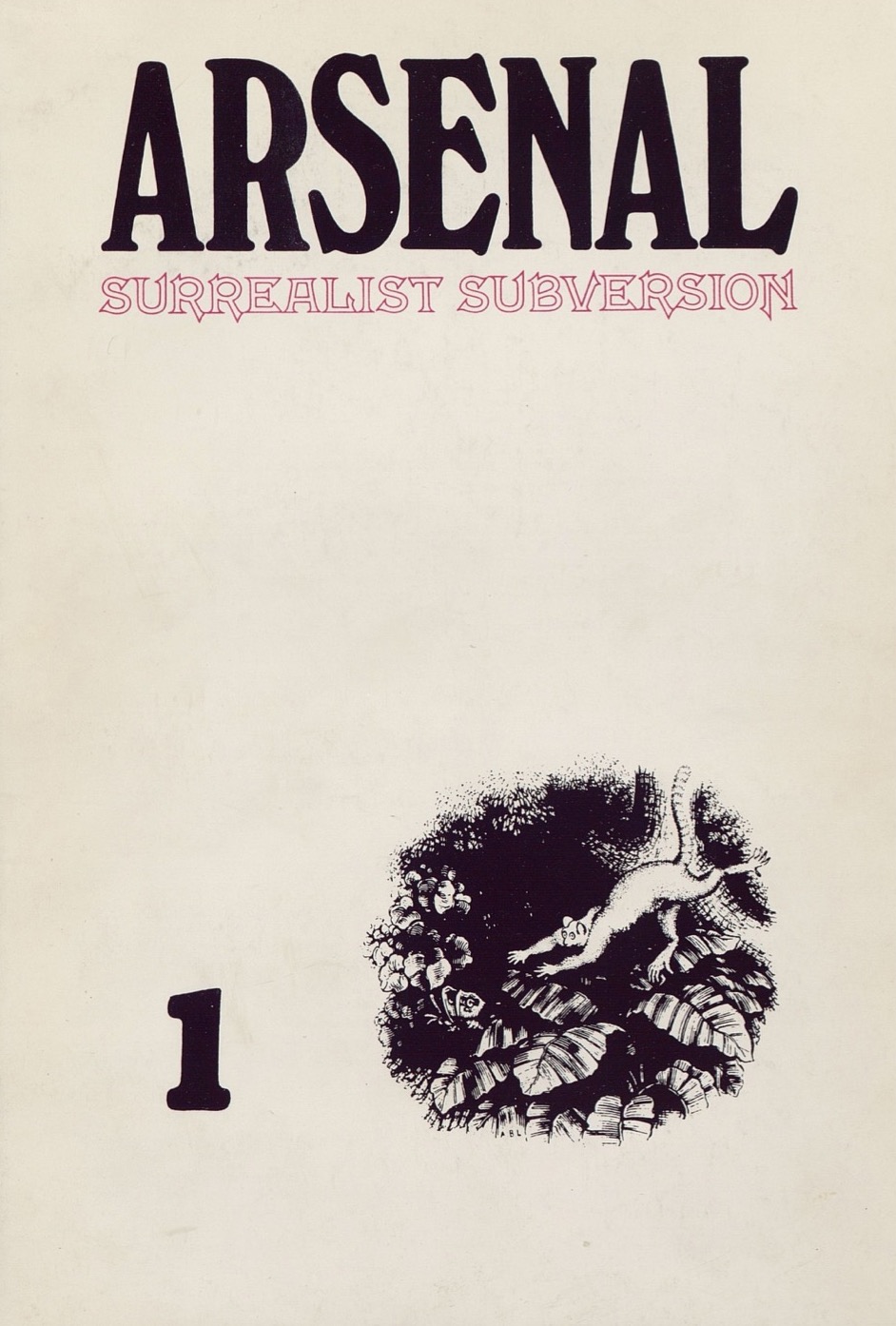
Arsenal: Surrealist Subversion was a Chicago-based surrealist magazine that published four issues in the years 1970, 1973, 1976, and 1989. Franklin Rosemont acted as the editor-in-chief, but the editorial board included members of the larger Chicago surrealist group, such as Jean-Jacques Jack Dauben, Paul Garon, Joseph Jablonski, Philip Lamantia, and Penelope Rosemont (Arsenal 3: Surrealist Subversion 1976). Arsenal was a mammoth production: each issue averaged around 60 pages and the 1976 issue contained a staggering 112 pages (Arsenal 3: Surrealist Subversion 1976).
The title of the magazine, Arsenal, was inspired by Arson/An Ardent Review, a London-based surrealist periodical published by Toni del Renzio. Abigail Susik also believes the name could have been derived from Nicolas Calas’s book Foyers d’incendie (Flashpoint, 1938), which “included lines about the explosiveness of art as sarcastically exemplified by the use of the Parthenon as an arsenal” (Susik 2021, 192). Calas's exact quote was, “The Parthenon proves it: Art is a powder magazine.” The word "magazine" thus changes its meaning - from periodical to an explosive powder keg. Members of the Chicago group hailed from radical backgrounds: Franklin Rosemont was born to labor activist parents and first read about surrealism by spending time at the Art Institute of Chicago after dropping out of high school (Industrial Workers of the World 2009). He then attended Roosevelt University, where he met other members of the proto-group, including Penelope, who grew up in Lake Villa but moved to Chicago because she was fascinated by the city after reading Chicago: City on the Make by Nelson Algren (Rosemont 2022, 199). Although Franklin Rosemont had envisioned a surrealist periodical as early as 1962, Arsenal was not his first publication (Susik 2021, 187). Joining the Industrial Workers of the World (IWW), an organization advocating for industrial unionism, Rosemont and friends devoted their energy to The Rebel Worker in the early 60s (Susik 2021, 187). Running for seven issues between 1964-1966, The Rebel Worker, though not a surrealist magazine per se, was crucial to the production of Arsenal as it informed the pro-worker ideology that would become central to the Chicago surrealist group. Franklin Rosemont became more closely associated with surrealism after his meeting in Mexico with Leonora Carrington, who put him in contact with the New York surrealists such as Nicolas Calas, Claude Tarnaud, and EF Granell, as well as with André Breton in Paris. The Rosemonts subsequently traveled to Paris in 1965, where they met André Breton and attended meetings with the larger Paris group (Rosemont 2022, 200). After Breton’s death in 1966, Franklin Rosemont also began editing André Breton and the First Principles of Surrealism, the first collection of Breton's works in English, bringing Parisian surrealist ideas to a wider English-speaking audience (Industrial Workers of the World 2009).
The Chicago surrealist group and their publications such as Arsenal were extremely intersectional since their inception, incorporating various schools of thought. They were largely influenced by the Frankfurt School philosopher Herbert Marcuse. In his 1955 book Eros and Civilization: A Philosophical Inquiry into Freud, Marcuse discusses concepts such as “the pleasure principle,” “the performance principle,” “surplus repression,” and “negative thinking” through a Marxist and Freudian lens. Marcuse believed that the “surplus value of production over the basic quality of human life itself … leads to an extremely limited experience of gratification through regimented leisure, in which ‘man exists only part-time, during the working days, as an instrument of alienated performance’”(Susik 2021, 185). The Chicago surrealist group mobilized Marcuse’s argument to organize resistance activities such as strikes and protests as a way to regain what the 1924 Manifesto of Surrealism called “true life.” Additionally, the Chicagoans were also influenced by the Black Power movement, viewing wage labor and systemic racism as intersectional systems of oppression (Susik 2021, 185).
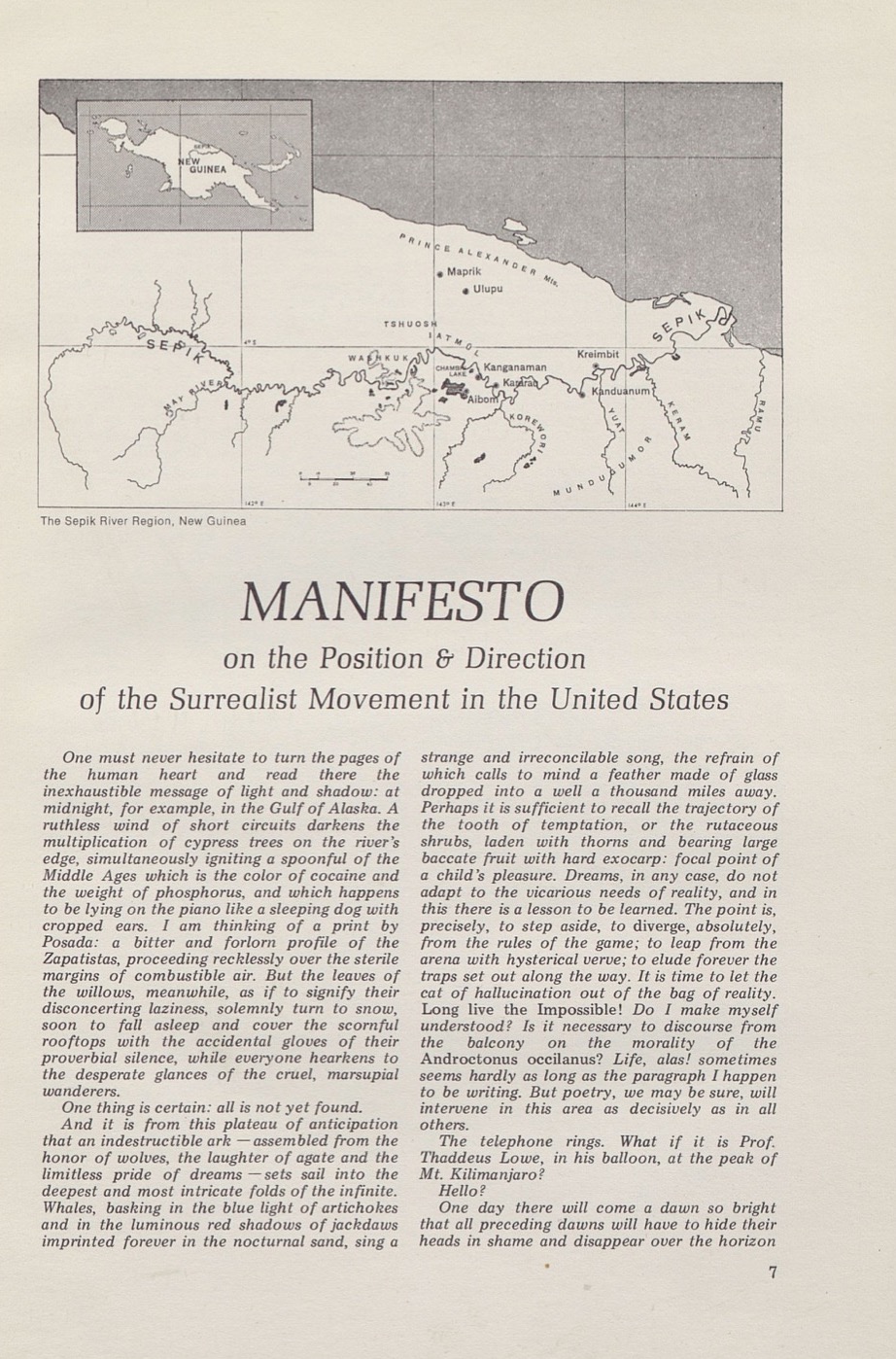
These themes and influences were extremely prominent in the writings and artworks in Arsenal: Surrealist Subversion. As early as 1970, Franklin Rosemont had already articulated the central role of activism and revolution for the Chicago surrealist Group. In Manifesto: On the Position & Direction of Surrealist Movement in the United States, Rosemont declares revolt as a necessary component: “Revolt alone came to us as the bearer of real truths. Revolt: pure, enraged, bursting into flames, restoring us to a sense of truly liveable destiny. Revolt: always the surest of criteria” (Arsenal 1: Surrealist Subversion 1970). Emphasizing a certain dynamism and political engagement, Rosemont directly indicates “the street” as a place where revolt can take place. This manifesto, therefore, has a strong speech act element, asking the reader to take action and take to the streets. The group’s identification with Marxism is also highlighted: “it is a matter of principle for us always to insist unreservedly on the unimpeachable integrity of the teachings of Marx, Engels, Lenin, etc” (Arsenal 1: Surrealist Subversion 1970). Rosemont strongly criticizes the “experts,” such as scholars, critics, and professors, who argue that surrealism is “artistic,” “non-political,” and “harmless,” by demanding that the emancipation of the unconscious cannot exist without the emancipation of the social and political orders (Arsenal 1: Surrealist Subversion 1970).
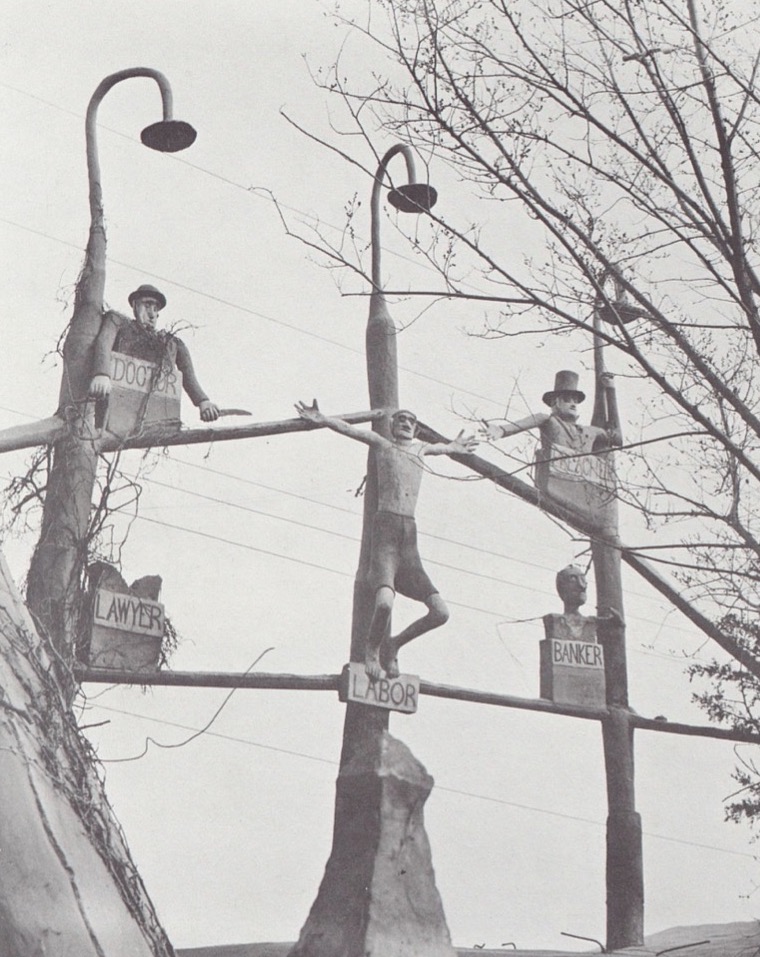
This pro-worker, Marxist message is also apparent visually. The June 1973 issue of Arsenal features a series of photographs by SP Dinsmoor titled The Garden of Eden. A veteran of the American Civil War, Dinsmoor built a garden out of cement next to his cabin in Lucas, Kansas. Labor Crucified depicts one of the installations in his garden: mannequin busts labeled “doctor,” “lawyer,” “preacher,” and “banker” are tied on lampposts as tall as the trees. In the middle of the four busts stands a full-size mannequin with its arms stretched out and tied to the intersection of two poles, resembling the crucifixion of Jesus Christ. This dummy is labeled “labor.” In the text that accompanies the image, Dinsmoor writes, “The Preacher is saying to this poor fellow crucified, ‘Never mind your suffering here on earth, my friend, never mind your suffering here, secure home in heaven for A-l-l E-t-e-r-n-i-t-y and you’ll be alright’” (Arsenal 2: Surrealist Subversion 1973). In this photograph, Dinsmoor first compares the experience of the wage laborer to that of Jesus’s crucifixion, one that is akin to punishment and suffering. This is consistent with the political positions of the Chicago group, but also with surrealism’s predilection for outsider art, art created by practitioners beyond the art institution, as Dinsmoor was.
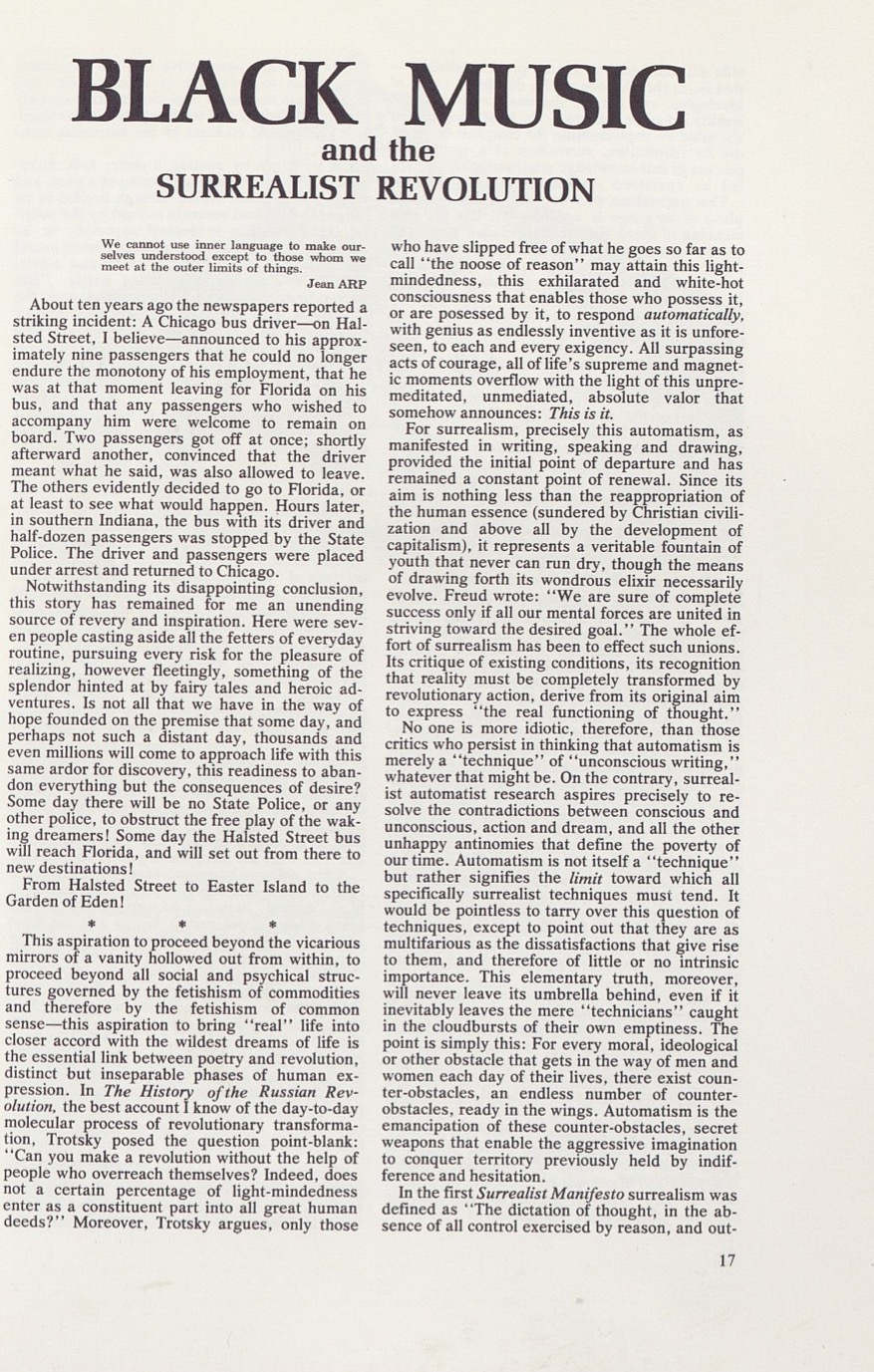
Arsenal was also interested in the intersection between surrealism and the Black liberation movement, with Chicago being a hotbed for protests and black activism in the 60s and 70s. The city, for example, saw the Chicago Freedom Movement, which was led by Martin Luther King Jr. In his essay Black Music and the Surrealist Revolution, Franklin Rosemont makes a compelling argument for jazz music as a surrealist and revolutionary practice. He first objects the idea that surrealists were “hostile or indifferent to music” by pointing to instances in Breton’s work that mention musicality. In Soluble Fish, for example, Breton writes, “the lure of dreams stimulates the music of my head,” and in Introduction to the Discourse on the Paucity of Reality, he also describes “the mysterious wind of jazz” (Arsenal 3: Surrealist Subversion 1976). Rosemont continues by arguing that jazz music is particularly important because of “its elaboration of protest, its unrelenting revolutionary will” (Arsenal 3: Surrealist Subversion 1976). Seeing surrealism as a movement that is revolutionary and radical, Rosemont points to similarities between jazz and other surrealist practices. He also invokes arguments by other musicians such as Cecil Taylor, who see “collective improvisation practices in jazz” as a musical equivalent of “the written or drawn ‘exquisite corpses’” (Arsenal 3: Surrealist Subversion 1976). Drawing comparisons between conventions in jazz music and surrealist play, Rosemont’s writing is an example of how the Chicago surrealist group incorporates artistic practices that flourished in America. Moreover, jazz and its liberating power is identified as distinctly Black music, highlighting the role of surrealism in the larger Black liberation movement.
Bibliography
Arsenal 1: Surrealist Subversion. October 1, 1970. Reveal Digital.
Arsenal 2: Surrealist Subversion. July 1, 1973. Reveal Digital.
Arsenal 3: Surrealist Subversion. April 1, 1976. Reveal Digital.
Calas, Nicolas. Foyers d’incendie. Paris: Les Éditions Denoël, 1938.
Industrial Workers of the World. “Fellow Worker Franklin Rosemont 1943-2009,” April 18, 2009. https://archive.iww.org/node/4678/.
Susik, Abigail. “Direct Action Surrealism in Chicago.” In Surrealist Sabotage and the War on Work. Manchester: Manchester University Press, 2021.
University of Michigan Special Collections Research Center. “Franklin and Penelope Rosemont Papers, 1950-2012 (Majority within 1960-2009).” Accessed March 21, 2024. https://findingaids.lib.umich.edu/catalog/umich-scl-rosemont#background.