La Revue du monde noir
By Noelle Kim '25
Access the scans of this periodical via Gallica Periodicals.
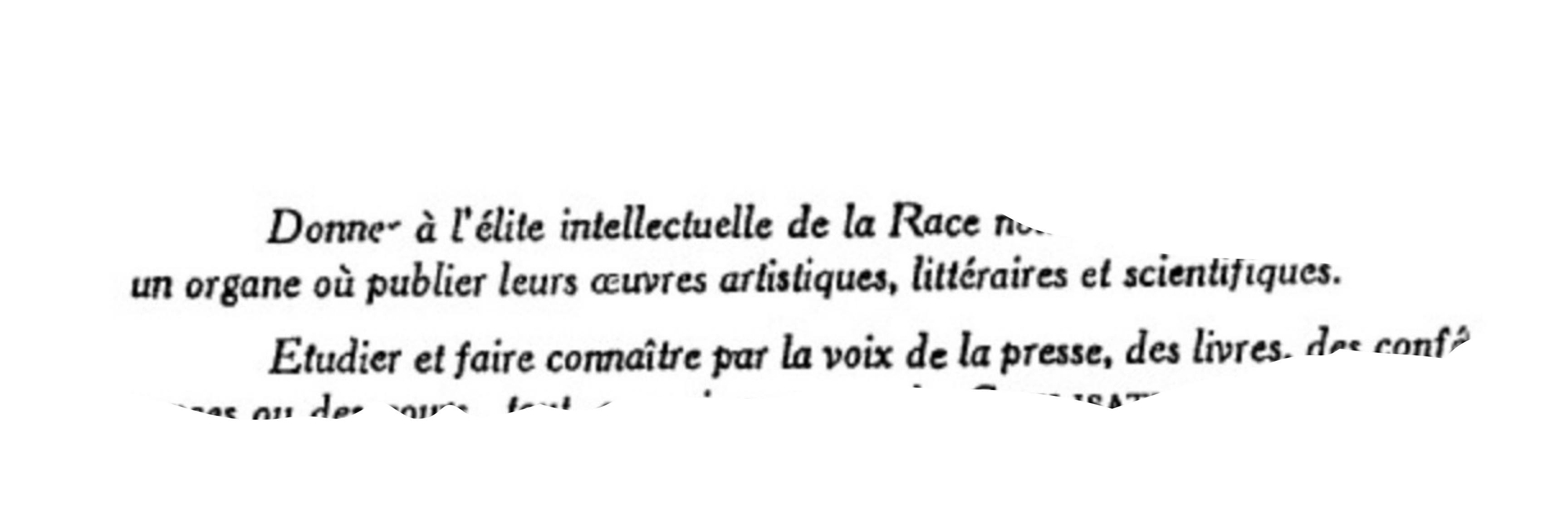
La Revue du monde noir was a bilingual (French and English) periodical mainly created and edited in Paris in 1931 by Paulette Nardal of Martinique and Dr. Léo Sejous of Haiti, whom Nardal credits with the original idea after noticing a lack of community across the African diaspora (Edwards 2003). The bilingual aspect can be attributed to Nardal who studied English literature at the Sorbonne, allowing her to do many of the English translations (Church 2013). The publication released six issues over the course of six months before being discontinued after growing political controversy caused a significant loss of funds (Lewis 1999). Although La Revue du monde noir primarily finds its roots in movements like the Harlem Renaissance and Negritude (these were two movements that centered on reimagining the African diaspora and reviving its culture) rather than in surrealism itself, a great number of its contributors were surrealists or adjacent to the movement. Moreover, as the Harlem Renaissance and the Negritude movements progressed, their relationships to surrealism became more entangled as prominent figures like Aimé Césaire (co-founder of Negritude) drew upon surrealist ideas. La Revue also had connections to the surrealist movement through its influence on subsequent surrealist publications. For example, Étienne Léro – a French surrealist writer who lived in Martinique –was featured several times in La Revue and wrote the story titled "Evelyn". Furthermore, as Brent Hayes Edwards claims in ‘The Ethnics of Surrealism’, the importance of La Revue in the creation of the Martinican surrealist publication Légitime Défense, which also materialized in Paris just several months after the Revue was terminated, cannot be overstated. Several signatories of Légitime Défense, including Etienne Léro, René Ménil, and Jules-Marcel Monnerot, were contributing authors of La Revue (Cole 2010). Ménil also went on to be a key contributor to the surrealist literary magazine Tropiques, published in Martinique and co-founded by Césaire and his wife Suzanne Césaire (Cole 2010).
Paulette and her sister Jeanne Nardal hosted their famous Salon de Clamart in Paris – an intellectual hub for authors and artists of all disciplines to discuss issues concerning racial equality for the African diaspora (Edwards 2003). It was through the Clamart Salon that the Nardal sisters encountered Aimé Césaire, Léopold Sédar Senghor, and Léon-Gontran Damas – the trio that would later be famously known as les Trois Pères of the Negritude movement (Sheffield 2018). The three also had ties to the surrealist movement, although to different extents. Furthermore, the Clamart Salon became the space of encounter between the intellectuals of the Negritude movement and those of the Harlem Renaissance, who would meet at the salon to talk about their ideas (Sheffield 2018). Although La Revue was deemed to be an apolitical publication by its creators, it was ultimately shut down precisely due to the political challenges it brought forth. Some scholars speculate that this apolitical label was deliberately chosen to avoid censure by authorities rather than as a true reflection of the group’s ideals (Lewis 1999). The politics of the magazine were complicated and not one-dimensional, and Nardal’s position on the Colonial Exhibition of 1931 is a characteristic example of this complexity and polyphony. Whereas surrealists aligned themselves starkly against this exhibition – which celebrated France’s colonial powers and success – in concordance with their anti-colonial stance, Nardal actually wrote an article in La Revue that explicitly praised the event for placing a spotlight on the intellectual standing of black women. Nardal found that the role of women was overshadowed when it came to her mission with La Revue (Lewis 1999). This serves as a reminder that La Revue du monde noir did not strive to be a surrealist publication itself, although its history and many of its contributors were closely entangled with the movement.
In terms of how La Revue was structured, like most periodicals, each issue begins with the sommaire to provide a quick glance at its contents and the issue’s contributing authors. It is also a purely literary publication and does not feature any artwork. Every text is presented in two columns: the left-hand column in French and the right-hand one in English. After all the text entries, there is a “Our next issue” section which informs the readers of the contents of the next issue. The periodical concludes with the ‘Question Corner’, otherwise known as an ‘Enquête’, which poses several questions to the readers who are expected to send in their responses.
One highlight of La Revue is a two-part story titled “Evelyn” by the surrealist poet Etienne Léro published in issue No. 2 - the second half was featured in the following issue as the "Epilogue". The narrative follows the unrequited love story of a man named André who fantasizes over a woman named Evelyn before finding the courage to pursue her in reality. Some scholars believe that this text seemingly alludes to the lack of recognition of the role of the black diaspora by French society (Williams 1993). In this analogy, André represents the Francophone black diaspora while Evelyn, who does not notice initially notice André's presence, represents French society. Meanwhile, the dream-like fantasizing over Evelyn showcases hints of Léro’s attachment to surrealism.
For us, I should have liked that same pleasing affinity as exists between the reader and the characters in the novels, that vague relationship, remote and delightful, in which are blended equal parts of fiction and reality… But, abruptly, I was awakened from my dream by a storm of applause and the noise of shuffling feet.
As the story develops, and as shown in the excerpt above, the reader might notice how the Evelyn of André’s imagination blurs into the actual portrayal of Evelyn in reality. This unification of unconscious desire and reality reflects the “whole purpose behind Surrealism’s treatment of physical reality… to project… a refreshing feeling of unity in which the inner existence of consciousness and outer reality are no longer in conflict” (Matthew 1977, 185). Léro’s contribution here thus serves as a great example of the intersection between surrealist influences and La Revue’s goal of rethinking what it meant to be Black and African in Paris at the time.
Another interesting feature in the third issue of La Revue is Renée Ménil’s “Magic Island” – an essay which responds to the book The Magic Island by the explorer W.B. Seabrook on his travels to Haiti and his encounter with Voodoo. Here, Ménil praises Seabrook’s detailed descriptions of Haitian voodoo and even writes that “it is not surprising that Seabrook should have acquired such a deep insight in the life of the magic island” for the following reasons (Ménil 1931, 28).
Like a man who, in his sleep, does not defend himself against any dream, he stores up the images, complete or broken, builds them into a whole with loving care, without concerning himself with the silly laughter of the civilized man who is awake… We are at the borderline where the imagination outlines reality and gives it substance.
This quote demonstrates the influence of surrealism in Ménil’s writing. The reference to a suspension of judgment through the unconscious mind is almost reminiscent of surrealist automatism and is what Ménil attributes to Seabrook’s ability to genuinely appreciate the Voodoo culture he encounters in Haiti and capture those images in his writing. Additionally, it suggests the utility of the imagination (which might be extended as an understanding of the unconscious) in framing our perception of reality – another possible remnant of Ménil’s surrealist ties. Concerning La Revue’s ties to Negritude, this essay offers a glimpse of how the group wanted to reimagine the postcolonial world. Evidently, remnants of exoticization of the ‘Other’ still prevailed. In the midst of these views that previous colonies remained inferior in terms of their culture, which also often fell victim to fetishization, Ménil brings to attention an account that finally seems to serve justice to the functioning of Haitian voodoo in their culture.
Overall, although La Revue was not itself a surrealist publication, it certainly held many connections to the movement through individual writers. La Revue managed to bring together scholars from across the Black and African-American diaspora and largely contributed to the growing movement of Negritude, which would fully emerge later in the 1940s.
Bibliography
Bertin-Élisabeth, Cécile. “Les Nardal : Textes, co-textes, contextes.” Fédérer Langues, Altérités, Marginalités, Médias, Éthique, no. 1 (October 5, 2021). https://doi.org/10.25965/flamme.89.
Church, Emily Musil. “IN SEARCH OF SEVEN SISTERS: A Biography of the Nardal Sisters of Martinique.” Callaloo 36, no. 2 (2013): 375–90.
Cole, Lori. “Légitime Défense. From Communism to Surrealism to Caribbean Self-Definition.” Journal of Surrealism and the Americas 4, no. 1 (2010).
Edwards, Brent Hayes. “Feminism and L’Internasionalisme Noir: Paulette Nardal.” In The Practice of Diaspora. Harvard University Pres, 2003.
Farebrother, Rachel, and Miriam Thaggert. “Introduction: Revising a Renaissance.” In A History of the Harlem Renaissance, edited by Miriam Thaggert and Rachel Farebrother, 1–18. Cambridge: Cambridge University Press, 2021. https://doi.org/10.1017/9781108656313.001.
Francis, Terri. “Introduction: The No-Theory Chant of Afrosurrealism.” Black Camera 5, no. 1 (2013): 95–112.
Léro, Étienne. “Evelyn.” La Revue Du Monde Noir, no. 2 (1931): 35–42.
Lewis, Shireen K. “Gendering Négritude: Paulette Nardal and the Birth of Modern Black Francophone Literature.” Romance Languages Annual 11 (1999).
Mencé-Caster, Corinne. “Paulette Nardal ou le jeu du féminisme au prisme du genre grammatical.” Fédérer Langues, Altérités, Marginalités, Médias, Éthique, no. 1 (October 5, 2021). https://doi.org/10.25965/flamme.98.
Ménil, Renée. “Magic Island.” La Revue Du Monde Noir, no. 3 (1931): 26–32.
Sheffield, Emily C. “The Unsung Mothers of Négritude: An Examination of the Efforts of Women Behind the Movement.” Global Africana Review 2 (2018).
Williams, Carla Denise. “When the Pen Becomes a Sword: Race and Class Consciousness in the Literature of the West Indian Writers Jacques Romain, Etienne Lero, Gilbert Gratiant.” Clark Atlanta University, 1993.