Le Surréalisme au service de la révolution
By Noelle Kim '25
Access the scans of the periodical via Princeton University Library.

Between 1930 and 1933, the surrealist group in Paris released six issues of the periodical Le Surréalisme au service de la révolution. This periodical followed the publication of André Breton’s Second Manifesto of Surrealism (1929), which appeared in the final issue of the previous periodical of the movement, La Révolution surréaliste (1924 to 1929). In this second manifesto, Breton notably denounces many other surrealists, including Antonin Artaud and Philippe Soupault, whom he believed no longer aligned with the movement’s theoretical agenda (Breton 1972). As a result, the position of the surrealist movement was redefined yet again. The influence of this rebranding can be seen in the shift towards political radicalism and bold cultural statements. The first issue of Le Surréalisme au service de la révolution, for example, makes no attempt at concealing the surrealists’ turbulent connections to the Communist Party through its main focus on the Russian Futurist poet Vladimir Mayakovsky, who had committed suicide a few months earlier and had an unstable relationship with the Soviet state, despite supporting the Bolshevik ideology (Donkin 2017). Overall, Le Surréalisme au service de la révolution guides the reader through the surrealist group’s newfound political and cultural direction while remaining true to the movement’s principles and aesthetics through its use and formatting of texts and photography.
Although Le Surréalisme au service de la révolution featured many different authors and artists, some of the most frequent collaborators included André Breton, Louis Aragon, Paul Éluard, and Marcel Duchamp. Salvador Dalí, a surrealist artist hailing from Spain, also made frequent appearances in Le Surréalisme au service de la revolution and served as a central figure in orienting the contents of the periodical. He officially joined the French surrealists in 1929 during his travels to Paris and through introductions by Luis Buñuel (Museo Nacional Centro de Arte). Aside from the named few, the periodical featured many other authors, which highlights the surrealist movement’s dedication to collective work.
The contents of the six issues of Le Surréalisme au service de la révolution roughly followed the same general structure. Each issue would open with any relevant advertisements that would highlight surrealist artists’ works. In fact, the final issue opened with an ad for the periodical Minotaure (1933 to 1939), which was to follow Le Surréalisme au service de la révolution. Following these advertisements would generally be the sommaire to give the reader an overview of the issue’s contents. The main body of the periodical was composed of the texts which would range from poems to manifestos, as well as "cadavres exquis" – collaborative forms of automatic writing and drawing. Most illustrations would be found at the end of the periodical (with the exception of the first issue) as if to serve as a final reflection space for the points made earlier in the texts. Aside from this general outline, there was no distinctive format that dictated how texts would be arranged on the page. A page could be a mélange of illustrations and text or have several different types of texts all on one page (see below). Contributors were also not confined to a specific font style or size. For example, following a multi-authored essay titled “Belgrade, 23 Décembre 1930” in the periodical’s third issue, the authors choose to include a typewritten passage that appears edited by hand. These are just a few examples of the periodical’s inventive format and constantly changing layout, which is reflective of the unconstrained surrealist aesthetic that does not adhere to formulas. Overall, the lack of a strict design layout also speaks to the malleability of the publication, as the form would change to suit the subject matter presented.
![Le Surréalisme au service de la révolution. [selected pages]](https://iiif-cloud.princeton.edu/iiif/2/02%2Fb5%2Fe4%2F02b5e48b1d044f589639625184f5431c%2Fintermediate_file/full/!400,400/0/default.jpg)
![Le Surréalisme au service de la révolution. [selected pages]](https://iiif-cloud.princeton.edu/iiif/2/47%2F46%2F49%2F4746491e00fb41b9a362510a138585ed%2Fintermediate_file/full/!400,400/0/default.jpg)
![Le Surréalisme au service de la révolution. [selected pages]](https://iiif-cloud.princeton.edu/iiif/2/03%2Fce%2Fa9%2F03cea90bad634c9abcde20e5ddd863fe%2Fintermediate_file/full/!400,400/0/default.jpg)
The first issue of Le Surréalisme au service de la révolution makes several references to Dalí and Buñuel’s film L’Age d’Or, which took an explicit stance against the morals of the bourgeoisie in the form of satire. The film, which is widely considered as a landmark of surrealist cinema, was ferociously attacked by the Patriots’ League and the Anti-Jewish League – both extreme right and para-fascist political groups – who claimed that it was “a Bolshevik endeavor to corrupt the French” (Richards 2008, 23). Shortly afterwards, French authorities banned the film from public showing despite initial approval (Richards 2008). Although the first issue of Le Surréalisme au service de la revolution was published a few months prior to the film’s public release, photographs from the politically controversial film highlights precisely the surrealist group’s explicit political shift since Breton’s second manifesto.
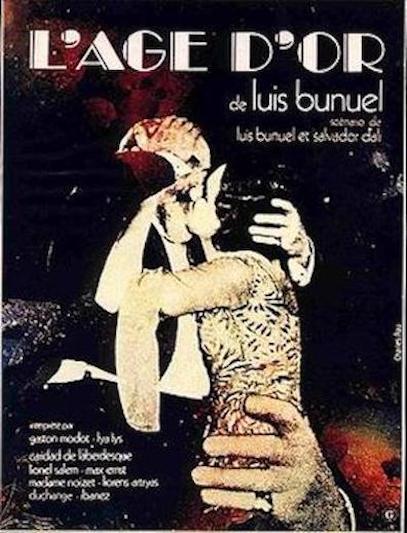
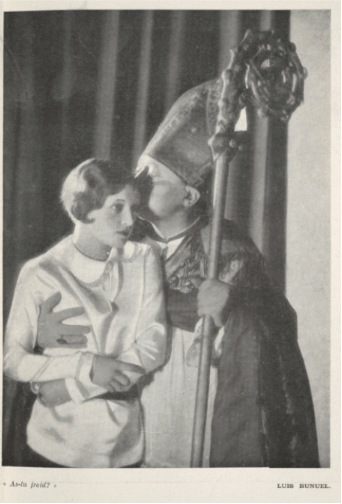
Four stills from the film can be found in the middle of the publication unaccompanied by any text, excluding the captions. Generally, the formatting and use of photography in Le Surréalisme au service de la révolution contrasts with its predecessor, La Révolution surréaliste as most illustrations would be found at the end of the periodical in their own section. Some scholars speculate that putting all the illustrations at the end rather than scattered throughout the periodical was a result of financial constraints (Donkin 2017). J. H. Matthews, however, claims that designating an entirely separate section for photographs had the intention to highlight the importance of photography in the magazine (Donkin 2017).
Regardless of the true intention behind the presentation of photography, photographs published in the periodical pose a challenge to existing cultural and political paradigms. In the Second Manifesto of Surrealism, Breton writes that “everything remains to be done, every means must be worth trying, in order to lay waste to ideas of family, country, religion” (Breton 1929, 128). Taking the provocation of this statement into consideration, one might note the significance of the four chosen stills from L’Age d’Or, which portray a woman in potentially offensive poses according to current moral and religious values. The first of these stills, as shown above, depicts a woman standing in an intimate position with a man who appears to be the Pope. The following stills, displayed in descending order, depict the same woman in various positions: the woman with her fist in her mouth in blasphemy; the woman kissing a shoe with a caption that reads, “Ah! quelle joie d’avoir assassiné nos enfants!” (Ah! What joy to have murdered our children!); finally, the same woman lying down in a trance-like state.
![Le Surréalisme au service de la révolution. [selected pages]](https://iiif-cloud.princeton.edu/iiif/2/b9%2F5b%2F83%2Fb95b836207624c5d912616da61723782%2Fintermediate_file/full/!400,400/0/default.jpg)
![Le Surréalisme au service de la révolution. [selected pages]](https://iiif-cloud.princeton.edu/iiif/2/45%2F96%2F90%2F45969020b8954c23ae3fd8b4c2a4f45d%2Fintermediate_file/full/!400,400/0/default.jpg)
![Le Surréalisme au service de la révolution. [selected pages]](https://iiif-cloud.princeton.edu/iiif/2/5d%2F63%2F73%2F5d63738c8b65456e9bf9461603086b86%2Fintermediate_file/full/!400,400/0/default.jpg)
Everything remains to be done, every means must be worth trying, in order to lay waste to ideas of family, country, religions"
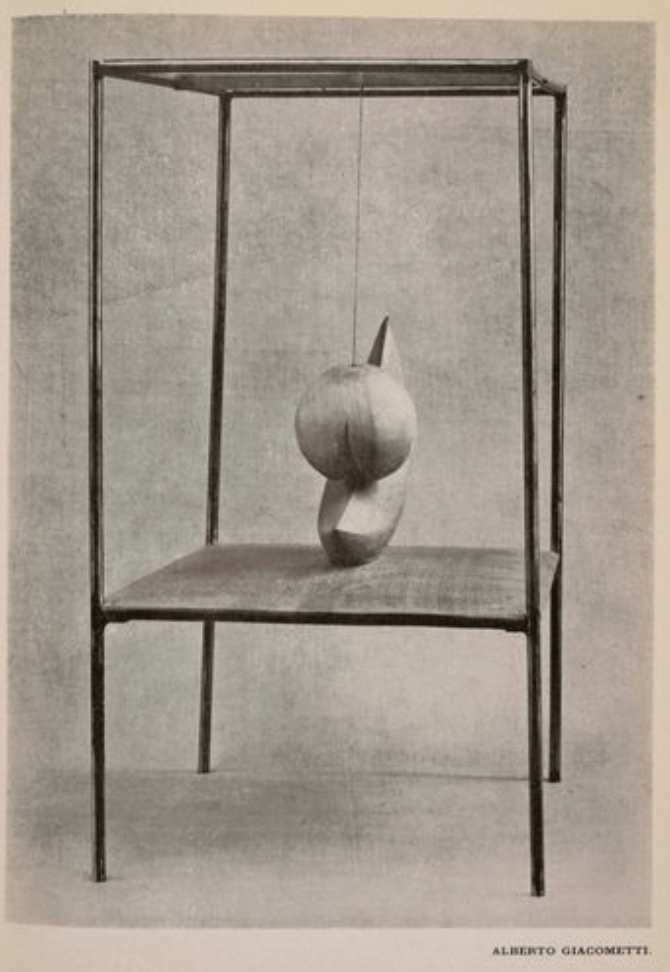
A key article that was published in Le Surréalisme au service de la révolution was a text written by Dalí entitled “L’objet à fonctionnement symbolique”. This article, which appears in the periodical’s third issue, was foundational for the theory and practice of the surrealist object, following dream-like objects (les objets oniriques) first suggested by Breton. Dalì theorizes the surrealist object – a small construction, often composed by everyday items reorganized in a novel fashion in a kind of assemblage – by imbuing it with a new function, that of evoking unconscious desire. The following page features several illustrations drawn by Alberto Giacometti titled “Objets mobiles et muets” and includes a sketch of the famous Suspended Ball, Giacometti’s sculpture which was the first one to be characterized as an “object with a symbolic function.” It is no surprise, then, that the majority of photographs appearing at the end of this issue showcase other examples of “objects with a symbolic function”, including a photograph of the actual sculpture of the Suspended Ball shown to the right.
As seen above, the sculpture contains two objects with clear sexual connotations. On their own, each object (the sphere-like object and the banana-shaped object) would have a neutral meaning. However, by putting them together, Giacometti displaces the strictly aesthetic value of the original items: the two objects seem to almost touch in an impossible copulation which appears as a mediation between the artist’s fantasies and the viewer’s reaction to her own unconscious desires the sculpture provokes. Similarly, the "Surrealist Objects" found below repurpose everyday objects and reconfigure them with one another to communicate a personal message of the artist to the viewer.
![Le Surréalisme au service de la révolution. [selected pages]](https://iiif-cloud.princeton.edu/iiif/2/4d%2F1b%2F0a%2F4d1b0aecf5b74b56847522000fb30912%2Fintermediate_file/full/!400,400/0/default.jpg)
![Le Surréalisme au service de la révolution. [selected pages]](https://iiif-cloud.princeton.edu/iiif/2/a6%2F14%2F86%2Fa614865138fd46da81ecdf741a1fc61d%2Fintermediate_file/full/!400,400/0/default.jpg)
![Le Surréalisme au service de la révolution. [selected pages]](https://iiif-cloud.princeton.edu/iiif/2/2a%2F7c%2Fd3%2F2a7cd374b3524c319750023bb79c75c2%2Fintermediate_file/full/!400,400/0/default.jpg)
Although Le Surréalisme au service de la révolution may now sometimes be overshadowed by its succeeding and preceding periodicals (Minotaure and La Révolution surréaliste respectively), it is undeniably significant in the surrealist group’s political shift following Breton’s Second Manifesto. Through its six issues, the publication explicitly delineates its new political and cultural stance, especially in reference to the Communist Party, while still contributing to surrealist theory and practice by reinforcing new and existing concepts of surrealism, as Dalí’s does in his essay on “Objets à fonctionnement symbolique”. These concepts were further supported through the systematic inclusion of visual arts (photography, sculptures, paintings) in each issue.
Bibliography
Breton, André. “Second Manifesto of Surrealism (1929).” In Manifestoes of Surrealism. Ann Arbor: The University of Michigan Press, 1972.
Donkin, Hazel. “André Breton and Vladimir Mayakovsky: Poeticizing Politics and Politicizing Poetry.” Dada/Surrealism 21 (July 17, 2017): 1–19. https://doi.org/10.17077/0084-9537.1319.
Richards, Rashna Wadia. “Unsynched:The Contrapuntal Sounds of Luis Buñuel’s ‘L’Age d’Or.’” Film Criticism 33, no. 2 (2008): 23–43.