La Révolution surréaliste
By Pia Bhatia '25
Access the scans of this periodical via Princeton University Library.
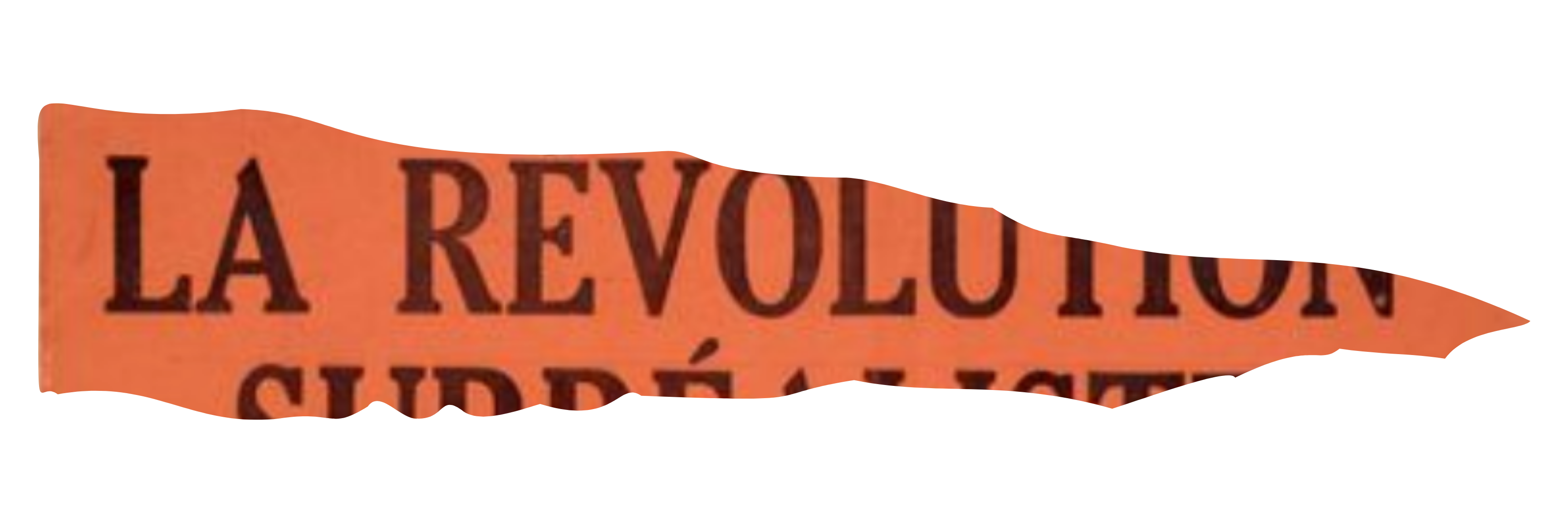
La Révolution surréaliste was the first official periodical of the surrealist movement, its inaugural issue was published on October 11th, 1924 in Paris, a few days before the release of the “Manifesto of surrealism,” and its last issue in 1929 featured the “Second manifesto of surrealism.” The periodical consolidated thus surrealism during its first years, bookending its existence between the two foundational manifestos of André Breton.
“Pure psychic automatism by which it is intended to express, either verbally or in writing, the true function of thought. Thought dictated in the absence of all control exerted by reason, and outside all aesthetic or moral preoccupations.”
Prior to La Révolution surréaliste and the manifesto, the soon to be surrealists were a group that was still in a Dada or post-Dada mode. Much of the internal dissent within this amorphous movement was caused by its efforts to self-define. Only two weeks before the release of La Révolution surréaliste, the Franco-German poet Yvann Goll, then considered the leader of a rival faction, released his own surrealist manifesto in Paris. It was modeled after La Nature (1873-1972), a French scientific review that was considered conservative, though this appeared to be more than an aesthetic choice. On the one hand, the magazine adopted a “pseudo-scientific” tone that could be seen as satirical: pages were packed with text in a sober manner mimicking a strict scientific journal, though the content of the work itself was incendiary. On the other hand, the choice to frame the periodical as a scientific magazine reflects the way the surrealists paid particular attention to method and strove for objectivity, in a quasi-scientific way - as witnessed by the pseudo-dictionary definition of surrealism in the Manifesto mentioned above.
The periodical contained many subversive treatments of various topics, ranging from sexuality to violence. In the second issue, an article was titled Is Suicide a Solution? The third issue contained a series of children’s dreams, such as the one below:
Lazare (11 years old): One day I dreamed that a dog came looking for me to kill rats. I took a wooden shoe and slammed it on the rat, which was killed. The dog then took the rat and buried it in the ground and placed yellow flowers and faded roses on it, which he watered with his pee-pee.
![La Révolution surréaliste. [selected pages]](https://iiif-cloud.princeton.edu/iiif/2/c5%2F4e%2Fa3%2Fc54ea34de97d449a86444ef5f2d7e2b1%2Fintermediate_file/full/!400,400/0/default.jpg)
The periodical also introduced new artistic strategies that would become important to the movement. One such example is the game “cadavre exquis” (exquisite corps), which involved multiple people drawing different parts of a body on a folded sheet of paper to make a completed form. The first of these visual cadavres exquis were published in the periodical in 1925. The publication had a clear Marxist bent. The cover itself features prominently in the title the word “revolution,” while the first issue calls for a “new declaration” of the rights of man. These calls will continue throughout the run of the magazine, the third issue, for instance, had the phrase “End of the Christian Era” on the cover, a call developed inside the issue with articles detailing ways in which the surrealists believed that religious values confined freedom, an idea that corresponds with Marx’s rejection of religion.
![La Révolution surréaliste. [selected pages]](https://iiif-cloud.princeton.edu/iiif/2/80%2Fab%2Faa%2F80abaad7827e4106840e1d6727c59093%2Fintermediate_file/full/!400,400/0/default.jpg)
![La Révolution surréaliste. [selected pages]](https://iiif-cloud.princeton.edu/iiif/2/a9%2F93%2F54%2Fa993545e5ee7493eaa7a6e88ef01a43c%2Fintermediate_file/full/!400,400/0/default.jpg)
![La Révolution surréaliste. [selected pages]](https://iiif-cloud.princeton.edu/iiif/2/03%2F7f%2F95%2F037f95be577b41f39230f0de643b36db%2Fintermediate_file/full/!400,400/0/default.jpg)
Because of how text-intensive the magazine was, it is especially interesting to consider the visual depictions of La Révolution surréaliste. The published photographs in particular are striking. For instance in the first issue, we see a photograph of a sewing machine by Man Ray, though it is placed in the center of a page covered with unrelated text; the photograph has no title or caption. As J. H. Matthews writes about the function of photography in the magazine, “To the extent that it leaves the uninitiated bemused, it warns readers of La Révolution surréaliste that photography’s role is to be neither explicative (illustrating the text appearing with it) nor passively ornamental, in a magazine which begins with the assertion that dreaming alone “leaves man all his rights to liberty.”
As suggested above, the periodical’s primary aim was to give a solid idea of the movement and to prevent any further conflation with rival movements or Dadaism. The photographs included did exactly that. They often resembled documentary photographs, which corresponded to the scientific tone of the publication. But others involved taking everyday subjects and altering them to an extent, in this way subverting viewers’ expectations of the mundane. This choice is reflective of surrealism, a perception of the world grounded in reality, but going beyond what is consciously perceptible.
The photographs published in La Révolution surréaliste play thus with our perceptions. Man Ray’s images in the first issue (shown above) depict fractured light on a woman’s torso that changes its shapes (“like tattoos”) and a still of an armchair with translucent hands appearing to come out of it. In choosing and distorting banal subject matter in what feels like ‘trick’ photographs, there is a sense that the surrealists are illustrating their principles, which involve treating image-making as a process that takes reality and converts it into something imbued with subjective desire. As it is noted on the Metropolitan Museum of Art’s website regarding surrealism and photography:
But the Surrealist understanding of photography turned on more than the medium’s facility in fabricating uncanny images. Just as important was another discovery: even the most prosaic photograph, filtered through the prism of Surrealist sensibility, might easily be dislodged from its usual context and irreverently assigned a new role. Anthropological photographs, ordinary snapshots, movie stills, medical and police photographs—all of these appeared in Surrealist journals like La Révolution Surréaliste and Minotaure, radically divorced from their original purposes.
This quote is exemplified in the photograph During the Eclipse by Eugène Atget, which is found on the cover of the seventh issue of the magazine. A straight, pre-surrealist photograph that is not altered at all, is decontextualized, and in this way regains its surreal quality. The photograph depicts a group of people in Paris looking skyward, many of whom are holding onto their hats. The implication of turning to the unseen is inextricably linked Surrealism’s basic search - uncover what is hidden, be it the unconscious, or aspects of reality that are overlooked. La Révolution surréaliste parallels thus the function of surrealism’s founding manifesto of 1924, making it a pivotal magazine that helped consolidate movement. Texts of different kinds and images, especially photography, unfold with every issue the surrealist search for the unseen, for the hidden, the repressed elements of life, in search of a liberating revolution.
Bibliography
Breton, André, et al. Manifestoes of Surrealism. University of Michigan Press, 2008.
Department of Photography. “Photography and Surrealism | Essay | The Metropolitan Museum of Art | Heilbrunn Timeline of Art History.” The Met’s Heilbrunn Timeline of Art History. Accessed April 22, 2024. https://www.metmuseum.org/toah/hd/phsr/hd_phsr.htm.
Durozoi, Gérard. “Chapter Two: Salvation for Us Is Nowhere.” pp. 63–74. History of the Surrealist Movement. Chicago: University of Chicago Press, 2002.
Hofmann, Irene E. “Documents of Dada and Surrealism: Dada and Surrealist Journals in the Mary Reynolds Collection.” Art Institute of Chicago Museum Studies 22, no. 2 (1996): 130. https://doi.org/10.2307/4104318.
Matthews, J. H. “Modes of Documentation: Photography in ‘La Revolution Surrealiste.’” Modern Language Studies 15, no. 3 (1985): 38. https://doi.org/10.2307/3194440.
Shea, Andrew L. “Monsters and Manifestos.” The New Criterion, vol. 37, no. 10, June 2019, https://newcriterion.com/issues/2019/6/monsters-manifestos.
Tate. “Cadavre Exquis (Exquisite Corpse).” Tate. Accessed April 22, 2024. https://www.tate.org.uk/art/art-terms/c/cadavre-exquis-exquisite-corpse.