Argentinian Surrealist Periodicals: Ciclo, A Partir de Cero, and Letra y Linea
By Elizabeth Kunz '25
Access the scans of Ciclo, Letra y línea, A partir de cero : revista de poesía y antipoesía, via Princeton University Library.
Aldo Pellegrini, Champion of Argentinian Surrealism
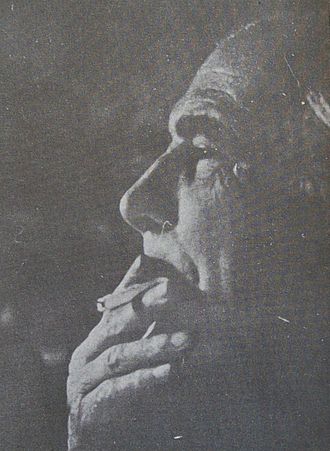
In discussing Argentina’s surrealist periodicals, it is essential to first mention Aldo Pellegrini, champion of Argentinian surrealism. Born in 1903 to a family of Italian immigrants in the city of Rosario, Pellegrini was first exposed to surrealism while studying medicine in Buenos Aires. Already interested in modernist poets such as Aldred Jarry and Guillaume Apollinaire and an avid follower of the European avant-garde, Pellegrini was “dazzled” upon reading the first Surrealist Manifesto and enthusiastically shared all that he was reading with a group of medical school classmates who shared his passion for the avant-garde: David Sussmann, Marino Cassano, Elías Piterbarg, Ismael Piterbarg and Adolfo Solar. Within only a few short months of first reading La Révolution Surréaliste, Pellegrini and his companions established themselves as Argentina’s first official surrealist group and began to prepare a periodical. The result of these efforts was to become the first surrealist periodical published in Latin America, Que.
Following Que’s brief publication, Aldo Pellegrini would continue to work until his death in 1973 as a poet, translator, and editor to maintain an active dialogue between Latin American and European literature and the development of surrealist thought. Similar to other surrealist publications outside of Europe, these periodicals embraced the exciting new ideas disseminating from Europe while simultaneously considering how they could be developed to fit Latin America’s unique culture and political situation of the mid 20th century. While Pellegrini did not serve in a directorial role for all five surrealist periodicals published in Buenos Aires between 1928-1960 (Que, Ciclo, A Partir de Cero, Letra y Línea, Boa), he was a regular contributor to all.
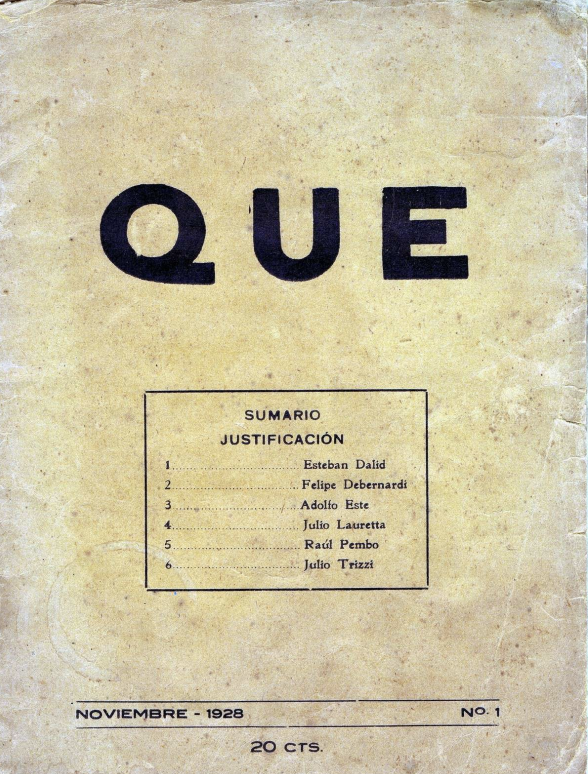
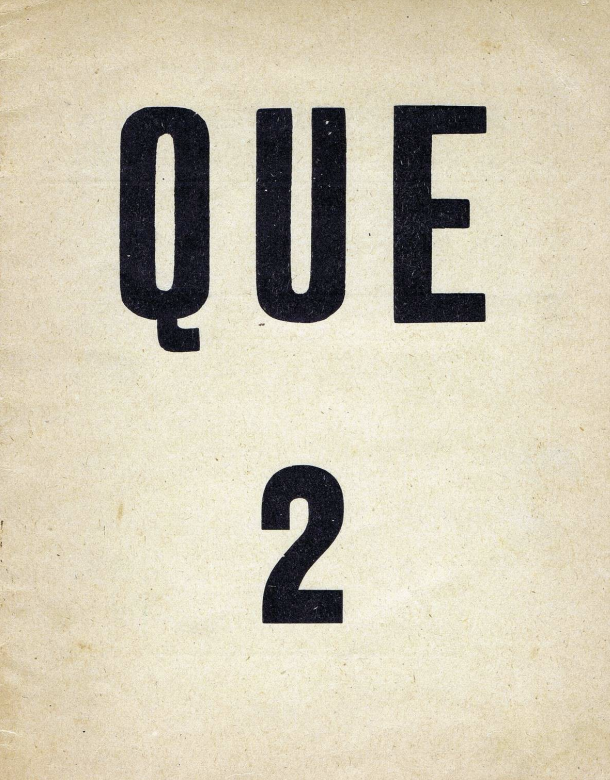
The first issue of Que was published in November of 1928, a mere four years after the publication of the First Surrealist Manifesto in Paris. With little resources to back it and no established audience, Que had a very small readership and left a negligible immediate impact on Argentina’s literary scene. The influence of La Révolution Surréaliste is clear in the format of Que, which copied the French periodical’s scientific journal layout. The cover pages were plain and unsuggestive, including only the title and the issue number, no images, and featured texts were displayed in two columns of small print. The anonymous introduction of the first issue, “Pequeño esfuerzo de justificación colectiva” ("Brief Attempt at a Collective Justification") established the group’s purpose:
“Justification of this journal: To seek in the act of depression the evidence of our own hidden structure (word, mirror of man), and perhaps also something like an irresistible necessity to think out loud. Justification for ourselves: Beings drawn to each other by an extraordinary centripetal force."
The group emphasized its collectivity and defined “the word” as their principle tool, asserting “the value of language not as a tool for communication but as the very mirror of self, applying a fundamentally psychoanalytic metaphor.” The group was not yet concerned with the pursuit of social and political upheaval, but rather with “the integrity of the solitary human being,” inviting readers to search within themselves, through the psychoanalytic process of introspection, the “transcendental answers of being” and the pleasure of an unlimited, expansive liberty. The final section of this manifesto concerns itself with language: “Justification for our expression: every word is found in the very heart of the problem of being. That is, any given man’s mystery takes the shape of his words (in the broadest sense: it takes the shape of his signs)”. Here the group’s alignment with the founding precepts of French surrealism is especially apparent in their belief that poetry, unrestricted by moral and aesthetic prejudice, becomes a direct conduit of the unconscious capable of expressing all the illogicity and incoherence of the reality of being. Similar to the French surrealists of La Révolution Surréaliste, the writers of Que saw the absolute integration of life and poetry as vital to the evolution of human consciousness given that “the problem of being cannot be conceived apart from the problems – or the powers – of writing”. This line of epistemological thought, in which the written word served as a point of departure from which the imagination could move beyond the constraints of conformity, would continue to be developed in subsequent Argentinian surrealist periodicals.
After its second issue was published in 1930, Que succumbed to the reality of its meager budget and insufficient readership, falling out of publication. Argentina’s next surrealist periodical, Ciclo, would not be published until 1948, at the end of a nearly twenty year period of surrealist “dormancy” caused by the era’s increased political and cultural rigidity which dampened the effect of avant-garde activity within Argentina. Surrealism would not truly gain traction within Argentina until the 1950s, this revival largely thanks to Pellegrini’s lifelong devotion to the development of surrealism. Despite Que’s negligible immediate impact, it served as a crucial starting point which paved the way for the fertile surrealist literary movement of the 1950s.
Ciclo: Arte, literatura y pensamientos modernos
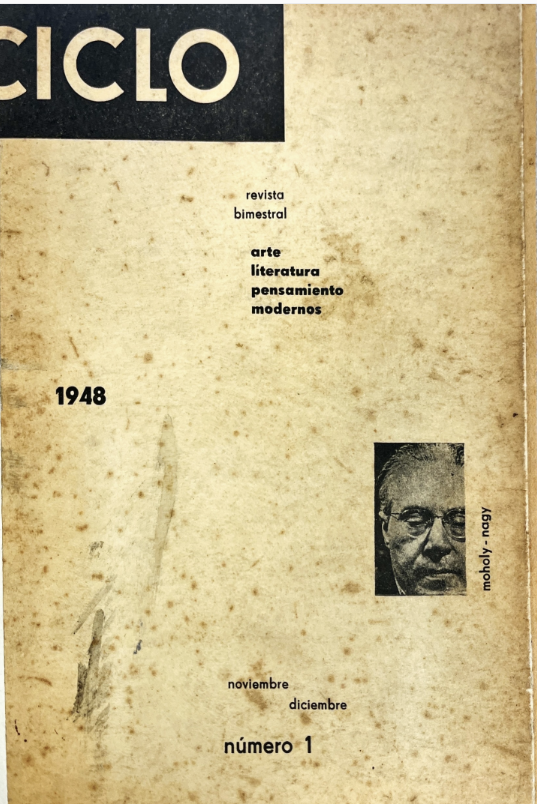
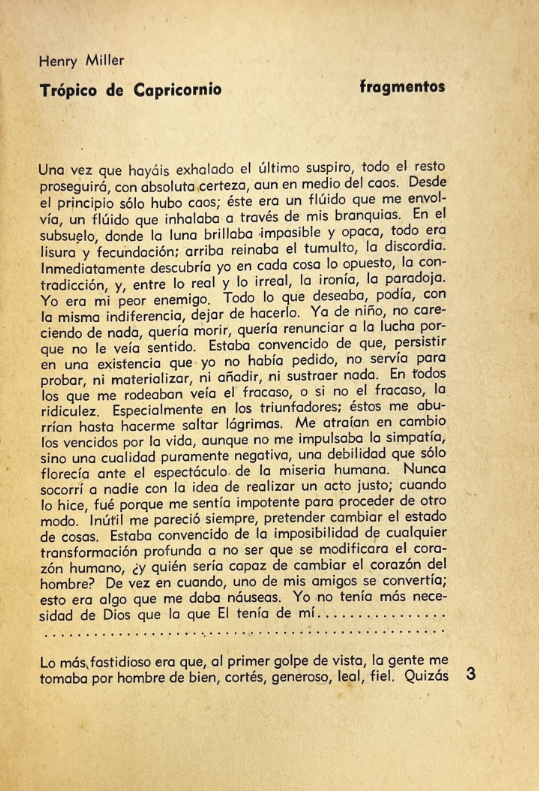
Similar to Que, Ciclo was published in only two installments, the first issue appearing in December of 1948 and the second in April of 1949. The periodical was co-directed by Aldo Pellegrini, Elias Piterbarg, a member of the original 1920s group, and Enrique Pichon Riviere, psychoanalyst and writer. In contrast to the format of Que, Ciclo was designed with a wider subject matter and, seeking to introduce new perspectives, expanded its focus to feature some visual arts. Furthermore, the periodical displayed a greater interest in criticism than artistic endeavors: the first issue presented translated excerpts of Henry Miller’s "Tropic of Capricorn", a commentary on Miller’s works by Georges Bataille, a note by Breton on the surrealist painter Jacques Herold, and Pellegrini’s commentary on the work of Wolfgang Paalen, including reproductions of Paalen’s paintings. The second issue similarly included several essays on contemporary painting and a biographical sketch of Lautréamont.
Within the context of Ciclo’s largely critical focus, Piterbar’s essay “Surrealism and Surrealists in 1948” stands out in its criticism of European surrealism. Emerging from Piterbarg’s trip to Paris that same year, during which he conducted interviews with André Breton, Paul Eluard, Benjamin Peret and the Yugoslav surrealist Marko Ristich about the political role of surrealism, the essay reflects a growing ideological rift within the movement that had developed in the 20 years since the first publication of Que. Writing with a tone of disillusionment, Piterbarg claims that the dialectic between poetic and political action has not in fact been resolved by the surrealists. He himself a strong believer in the union of the poetic and the political, Piterbarg conveys in his essay a deep frustration with the appreciable gap between surrealism’s promise of total revolution and reality: “In Paris I was struck by the impression that, whether they admit it or not, the surrealists… are limited to expressing their surrealism in the only way possible for them today: artistic or literary expression”. Piterbarg saw the French surrealist’s denunciation of both capitalism and communism as a form of neutrality contradictory to the objective of social upheaval upon which the movement had been founded; surrealism had, in his own words, “lost its revolutionary vigor”. Piterbarg’s critique of surrealism’s lack of political alignment represents an essential point of conflict within surrealism inflamed by the aftermath of WWII. Breton and many of his French contemporaries saw the act of psychoanalytic introspection as a radical means of personal emancipation which, in illuminating the “truths created by error” embedded in everyday life, became an act of collective liberty. Piterberg, however, viewed the surrealist’s prioritization of individual intellectual freedom over political affiliation as a way of disengaging from the reality of social oppression. The inclusion of “Surrealism and Surrealists in 1948” in a journal otherwise open to surrealist thought and expression suggests a more nuanced critical consciousness around surrealism which had developed between the publication of Que and Ciclo. While Que had merely reproduced the ideals expressed in early French surrealist periodicals such as La Révolution Surréaliste, a more nuanced discourse on the political implications of revolutionary surrealist poetry began to evolve within the brief circulation of Ciclo.
A Partir de Cero: Revista de Poesía y Antipoesía
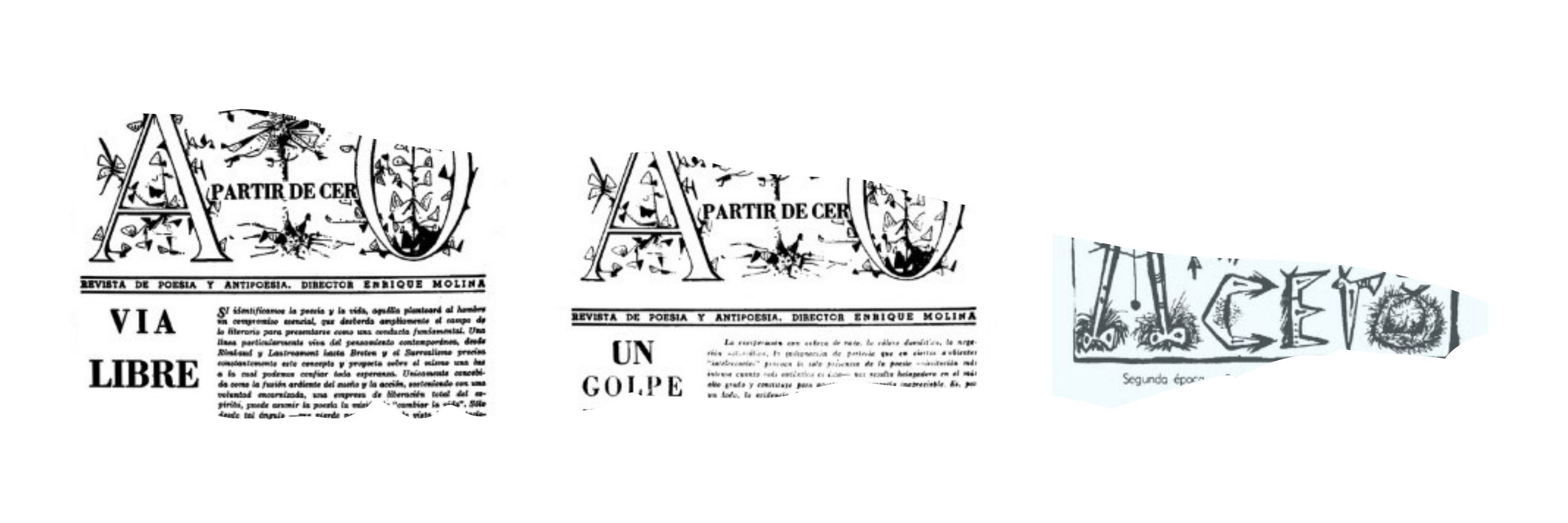
A Partir de Cero (1952-1956) was published under the direction of Enrique Molina, who was to become the leading Argentine poet of the second generation of surrealism. In “La Poesía Surrealista”, Pellegrini claimed that the title of the periodical (which translates to “starting from zero”) refers to the project of “true aesthetic revolution” initiated by Dada and carried to fruition by the surrealists. In contrast Ciclo’s focus on literary critique, A Partir de Cero’s three issues featured a variety of original poetry, stories, and even a one act play. Representing Argentinian surrealism at its peak, the periodical featured works by both Argentinian writers and some of the principal names of international surrealism, including Antonin Artaud, André Breton, Paul Eluard, César Moro, Benjamin Peret, Leonora Carrington, and Gisèle Prassinos. A Partir de Cero broke new ground within the development of Argentinian surrealism in its marriage of the verbal and the visual, dissolving distinctions of genre to demonstrate the connection between the verbal and the visual. Reflecting the surrealist insistence on the pursuit of revelation beyond the phenomenal world, the careful pairing of written and visual elements remind the reader to look beyond the words on the page. For example, one small drawing by Juan Batlle Planas featured in the first issue shows an antiquated textbook illustration of an eye accompanied by the caption “Inner Workings of the Eye”; later in the first issue also appears a schematic drawing of a camera obscura, illustrating the photographic principle of image reversal. Similarly, in the third issue a crudely rendered drawing of Claude Cahun’s “Object” shows an eyeball turned on its axis and embellished with pubic hair.
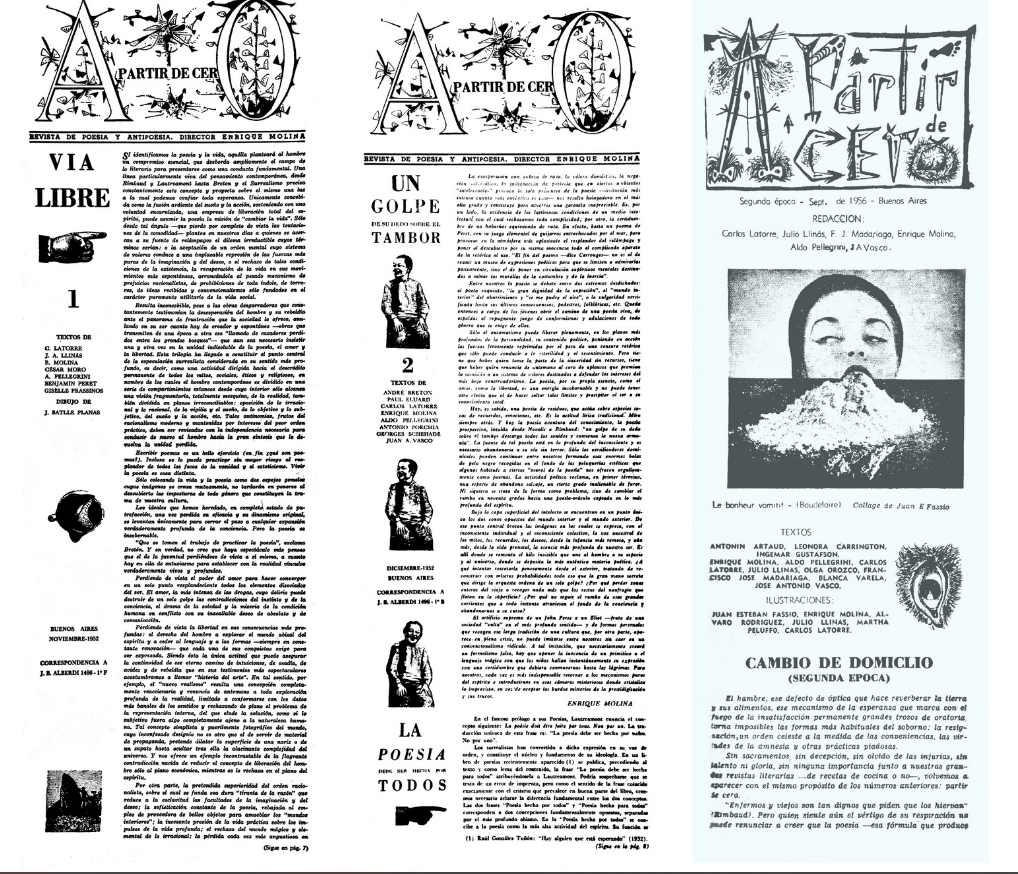
Molina’s lengthy introductory essay “Vía Libre”, which occupies three of the eight pages of Ciclo’s first issue, serves as a manifesto for the renewed surrealist movement in Argentina. Molina begins by expounding on the surrealist ideal of the total alignment of life and poetry: “If we identify poetry with life, poetry will set forth an essential commitment that extends well beyond the field of literature, to present itself as a fundamental mode of conduct”. According to Molina, only poetry is unique in its ability to alter the essence of life, since it is “uniquely conceived as the ardent fusion of dream and action, holding on with a savage will to the enterprise of the total liberation of the spirit”. Poetry, beyond merely a beautiful exercise, is:
“an activity directed toward the permanent discrediting of all myths – social, ethical, and religious – in the name of which contemporary man is divided into a series of watertight compartments from whose interior he glimpses only a fragmentary and paltry vision of reality, a reality in turn divided into irreconcilable planes; opposition of the irrational and the rational, of waking and sleeping states, of objective and subjective, of dream and action, etc”.
In “El huevo filosófico” (The Philosophical Egg), featured in the second issue, Pellegrini writes about the surrealist epistemology. Pellegrini claims that, “whereas the ‘common man’ learns primarily through sense perception, the more fully realized surrealist learns from the full range of his faculties, in particular those associated with inner life. The surrealist’s insistence on accessing ‘total thought’, whose primary vehicle, claims Pellegrini, is the language of poetry, places him at odds with the society he inhabits”, making him a “perpetual nonconformist”. While some writers of the Argentinian surrealist movement such as Piterbarg were looking toward how poetry can and cannot act as a force of social change, Pellegrini speaks of nonconformity only in the realm of the self, echoing his earlier writings in Que, his opinion on surrealist political affiliation closer to that of Breton than Piterbarg.
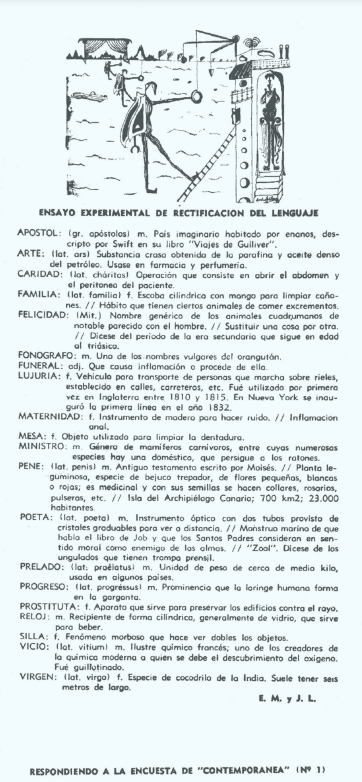
The third issue of A Partir de Cero, published in September 1956, contains a wide array of surrealist texts, including the story “The Sand Camel” by Leonora Carrington, a variety of poems, a one-act play written as a “collage of languages'' by Llinas, and a humorous surrealist lexicon called “an experimental attempt at the rectification of language” written by Llinas and Molina. This text pairs words with definitions that have no logical connection to them, obliging the reader to reconsider conventional assumptions about the communicative function of language. The term “poet” for example is given an absurd triple definition: “Optical instrument with two tubes containing adjustable lenses for viewing at a distance. / Sea monster mentioned in the Book of Job and which the Holy Fathers consider in moral terms to be the enemy of souls. Zool. Said of ungulates with a prehensile trunk”. This identification of the poet with an optical instrument reminds the reader once again, through the invocation of sight, of the search for objective truth within the subjective imagery of the unconscious.
Letra y Linea
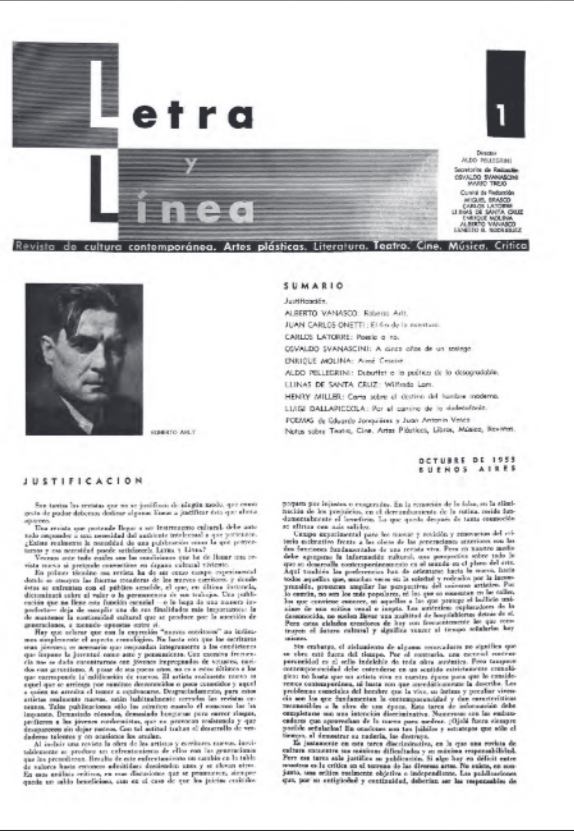
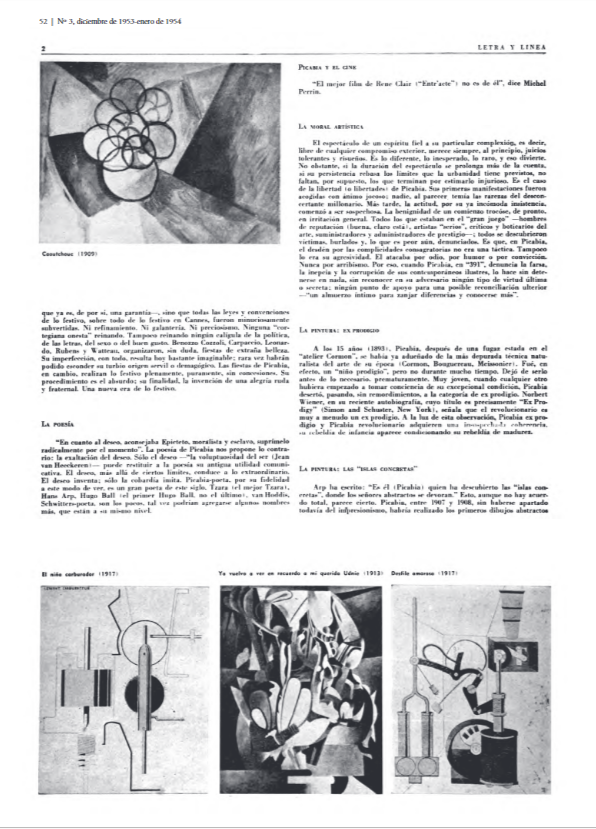
Letra y Linea, yet another periodical shepherded by Pellegrini, was published in four issues between 1953 and 1954 during the three-year interim between the second and third issues of A Partir de Cero. Although the focus remained on poetry, Letra y Linea broadened its scope to include several forms of artistic expression. Unlike the previous Argentinian surrealist journals, the periodical was formed by an editorial group of more diverse perspectives, only three of the nine editor-contributors being self-declared surrealists. In comparison with its predecessors, Letra y Linea was more polemical, building upon the critical discourse on surrealism established in Ciclo. In the third issue appears “Epistle to the Surrealists", a piece by Osiris Troiani directed primarily towards Aldo Pellegrini. Troiani accuses the surrealists of constituting a mere literary salon that is incapable of engaging with its own historical context. “To make matters worse, Argentine surrealism pays homage to the greats from other countries, but here it is only unruly; it toes the party line in Europe, but here only raises opposition”. In “Response to Osiris Troiani”, Pellegrini counters Troiani point by point, ending his response with the clarification that “the only dogma that surrealism imposes is that of total freedom. In this regard I have clashed continually with some of my surrealist friends”. The clash between Troiani and Pellegrini reflects competing visions of revolutionary poetics. Both writers desire the complete rupture of social conformity; the question is whether European surrealism can retain its revolutionary quality within the context of Latin America, or whether surrealism as defined by Breton and his French contemporaries was an essentially eurocentric artistic movement and failed to fully reflect the constant conflict of indigenism and colonialism within Latin American everyday life, and the social implications thereof.
Boa: Cuadernos Internacionales de Documentación sobre la Poesía y el Arte de Vanguardista
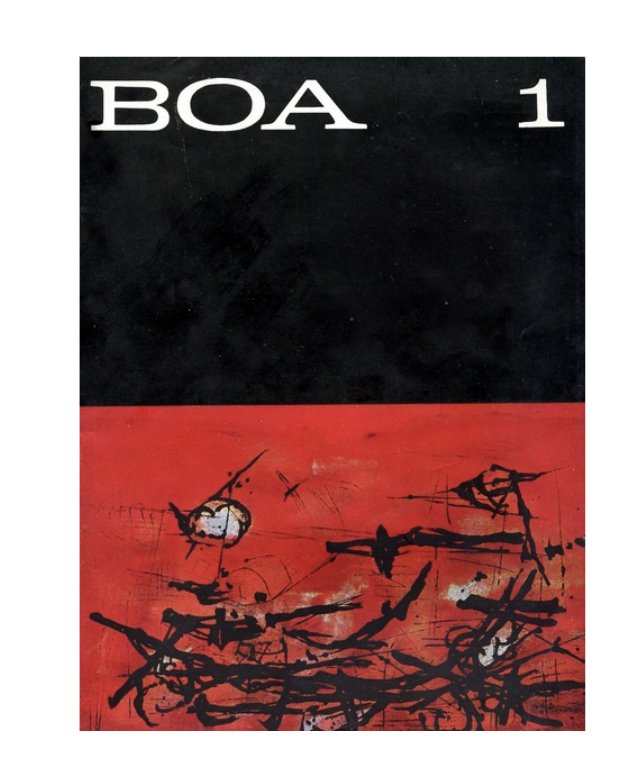
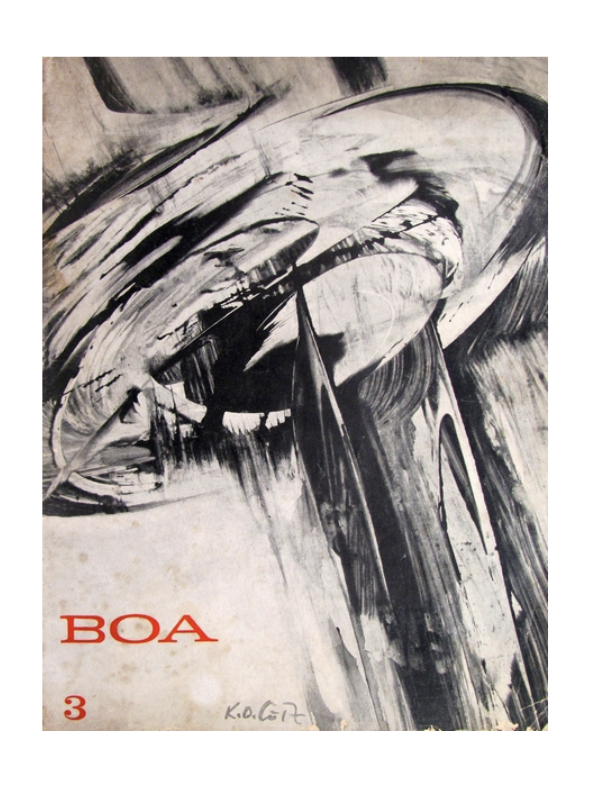
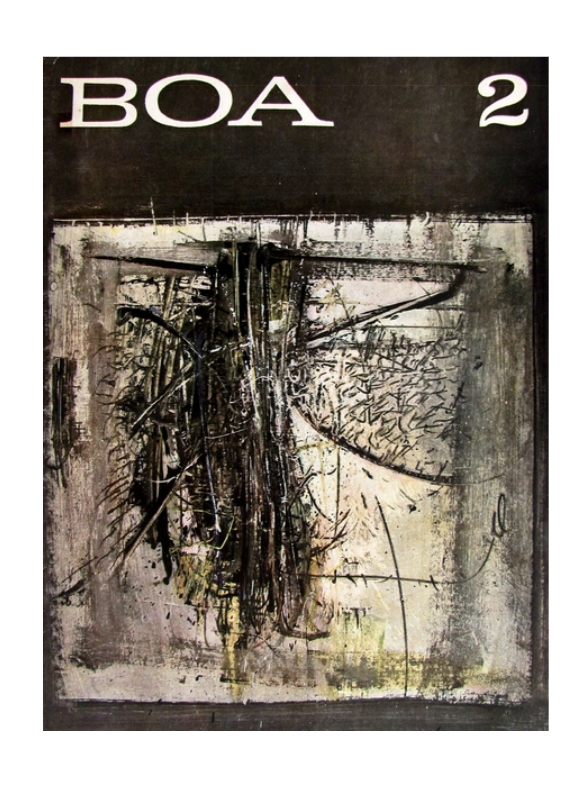
Boa (Boa: International Notebooks of Documentation on Avant-garde Poetry and Art), would be the final and most ambitious and international of the surrealist-affiliated journals in Argentina. While the Argentinian periodicals La Rueda (1967) and Talisman (1969) continued to feature many surrealist texts and artwork, these later artistic journals broadened their scope to other avant-garde movements. Directed by Julio Llinas, the youngest member of the group that had convened around Aldo Pellegrini and Enrique Molina to publish A Partir de Cero, Boa appeared in three issues between May 1958 and July 1960. Claiming an an indigenous South American snake as its namesake, Boa simultaneously referencing the influence of the European journal CoBrA of the homonymous group (1948-51) and declaring its separate and autochthonous character. Although Boa maintained a strong literary element, presenting original texts in Spanish alongside translations of international poets, the periodical leaned more toward contemporary visual arts. Embodying the international scope of surrealism and the inclusiveness of the category of art, Boa featured work by painters from Argentina but also from Belgium, Canada, Denmark, Germany, Egypt, France, Italy, Mexico, Poland and Portugal. In publishing the works of Argentinian writers and visual artists alongside a vast selection of international poets, Llinas sought to bring to fruition the long-lived hope of integrating the artistic centers of the world. Following the final issue of Boa in July 1960, the publication of Aldo Pellegrini’s 1961 Antología de la poesía surrealista de la langua francesa would mark the end of the decade of surrealist-affiliated journals in Argentina. The anthology is a remarkable piece of literary history in which Pellegrini details the development of the international surrealist movement and the structure of its thought. Including Pellegrini’s translations of the work of nearly 70 surrealist poets from around the world, Antología can be considered the culminating work of Pellegrini’s lifelong commitment to the surrealist movement and a testament to the realization of the international vision of surrealism. The impact of Pellegrini’s nearly 50 year surrealist project can be seen in the presence of surrealist aesthetics of several important Argentinian poets of the latter 20th century, including Enrique Molina, Olga Orozco, and Alejandro Pizarnik, who would take inspiration from the surrealist idea of introspection to explore both collective and individual identity.
Bibliography
Bravo, Felipe Gamboa. "RASGOS TRANSTEXTUALES DEL SURREALISMO ARGENTINO EN REVISTA QUÉ." Alpha no. 45 (12, 2017): 343-351. https://login.ezproxy.princeton.edu/login?url=https://www.proquest.com/scholarly-journals/rasgos-transtextuales-del-surrealismo-argentino/docview/2010821101/se-2.
Minguzzi, Armando V. “La Revista Qué: Prácticas Editoriales y Filiaciones Estéticas En El Inicio Del Surrealismo Argentino .” Tramas impresas: Publicaciones periódicas argentinas (XIX-XX), 2014, 221–42. https://www.libros.fahce.unlp.edu.ar/index.php/libros/catalog/book/33.
Mendez Castiglioni, Ruben Daniel. Aldo Pellegrini, Surrealista Argentino. Porto Alegre, Brazil: Pontifica Universidade Catolica do Rio Grande Do Sur, 1999.
Poblete Araya, Kira. “LAS REVISTAS LITERARIAS DEL SURREALISMO ARGENTINO.” Revista de Literaturas Modernas 46, no. 2 (2016): 210–36. https://bdigital.uncu.edu.ar/app/navegador/?idobjeto=9760.
Stedile, Verónica. "Síntesis, Depuración y Restos Espectrales: La Imagen Surrealista e Invencionista En Las Revistas Argentinas De Mediados De Siglo." Escritura e Imagen 16, (2020): 173-189. doi:https://doi.org/10.5209/esim.73032. https://login.ezproxy.princeton.edu/login?url=https://www.proquest.com/scholarly-journals/síntesis-depuración-y-restos-espectrales-la/docview/2501516752/se-2.
Nicholson, Melanie. Surrealism in Latin American Literature: Searching for Breton’s Ghost. New York, NY: Palgrave Macmillan, 2013.