The Stamp Act Crisis


In the 1640s, the English Civil War arose from conflicts between King Charles I and the Parliament about who had the power to impose taxes. Following the 1688 “Glorious Revolution” in which King James II was overthrown in reaction to his policies that many considered oppressive, many English people—including British colonists in North America—came to believe that taxation was only permissible when approved by elected representatives.
The colonists paid taxes imposed by colonial legislatures, but not direct taxes imposed by the Parliament, to which they did not elect representatives. In 1765, Parliament, led by George Grenville, imposed a tax on paper goods in the colonies, called the Stamp Act, which provoked widespread rebellion against colonial governors until it was repealed the next year.
The Stamp Act Crisis presaged disputes about the locus of authority in the American and French Revolutions.
Unless otherwise indicated (§), all items on exhibit are from the Sid Lapidus '59 Collection on Liberty and the American Revolution, Princeton University Library. All items on loan from other libraries are gifts of Sid Lapidus.


Magna Charta: Made in the Ninth Year of K. Henry the Third, and Confirmed by K. Edward the First, in the Twenty-Eighth Year of His Reign, 1680
Edward Coke (1552–1634), translator and annotator
London : Printed by the assignees of Richard and Edward Atkins, Esquires, for Thomas Simmons
In 1215, King John of England appeased nobles with Magna Carta, a document defining limits on royal power; it was confirmed by his son Henry III. The seventeenth-century jurist Edward Coke popularized an understanding that Magna Carta affirmed the ancient law that no English subject could be denied certain rights without due process of law. Coke’s annotated Magna Carta was reprinted often and circulated widely, influencing advocates for the rights of colonists.
On loan from Wolf Law Library, William & Mary Law School

A Declaration of the People’s Natural Right to a Share in the Legislature, Which Is the Fundamental Principle of the British Constitution of State, 1774
Granville Sharp (1735–1813)
Philadelphia: Reprinted, and sold by Benjamin Towne
Although an Englishman, Sharp set out one of the most cogent explanations of the principle that British government requires that the people be represented by elected officeholders. Sharp extended his defense of the “natural rights that are essential for their own preservation” to people held in slavery, and was a prominent abolitionist. This pamphlet originated in London but was popular in the colonies (it had six editions in three cities).
Courtesy, American Antiquarian Society

An Act for Granting and Applying Certain Stamp Duties, and Other Duties, in the British Colonies and Plantations in America, towards Further Defraying the Expences of Defending, Protecting, and Securing the Same; and for Amending Such Parts of the Several Acts of Parliament Relating to the Trade and Revenues of the Said Colonies and Plantations, as Direct the Manner of Determining and Recovering the Penalties and Forfeitures Therein Mentioned, 1765
London: Printed by Mark Baskett, Printer to the King's most excellent majesty
The Lapidus copy of the Stamp Act appears as one entry among the compiled laws passed by Parliament in the fifth year of the reign of George III. As the title explains, the Parliamentary justification for the Stamp Act was to secure revenues for equipping the army posted on the frontiers of the colonies to ward off attacks from the French in the Louisiana territory and their Native American allies.

The Rights of the British Colonies Asserted and Proved, 1764
James Otis (1725–1783)
London: reprinted, for J. Almon
Even before the Stamp Act passed, parliamentarians considered the idea of taxing the colonies. Bostonian lawyer James Otis lodged his pre-emptive protest in this pamphlet (first printed in Boston and re-printed in London), which argues that taxation of unrepresented colonists is a violation of the natural rights of the colonists. Otis was one of many colonial writers who offered to Parliament their objections even before the Stamp Act was proposed.

Considerations on the Propriety of Imposing Taxes in the British Colonies, for the Purpose of Raising a Revenue, by Act of Parliament, 1765
Daniel Dulany (1722–1797)
Annapolis: Printed by Jonas Green
Proponents of the Stamp Act argued that the colonists were “virtually represented” in Parliament, because its members were elected to serve the whole of the British empire, regardless of who voted for them. Maryland lawyer Daniel Dulany objected, noting that no English subjects are taxed by a vote of those who live elsewhere, as seen in the last paragraph of page 7 in this exhibit. Still, in the face of violent protests, he urged compliance with the law until its repeal.

The Objections to the Taxation of Our American Colonies, by the Legislature of Great Britain, Briefly Consider'd, 1765
Soame Jenyns (1704–1787)
London: Printed for J. Wilkie
Dulany’s pamphlet was a response to several works, including this pamphlet by Soame Jenyns, a Member of Parliament who asserted the authority of Parliament to impose taxes on anyone. In a dismissive tone, he rejected Otis’s claims and advocated for the Stamp Act as a necessary assertion of that right not merely for its practical purposes, but to establish the precedent that Parliament had the right to tax the colonies.

Considerations on Behalf of the Colonists in a Letter to a Noble Lord, 1765
James Otis (1725–1783)
London: J. Almon
James Otis was quick to respond to Soames Jenyns, whose pamphlet appears in this case. Otis, a Boston lawyer, published a pamphlet in London. Realizing his earlier argument (seen in this case as well) against Parliamentary taxation of the colonies had failed, he took a new approach and argued for Parliamentary restraint in dealing with the colonists, in the interests of prudence during a tempestuous era and to secure the loyalty of colonists seeking reassurance that their rights would be respected.

Authentic Account of the Proceedings of the Congress held at New York in MDCCLXV, on the Subject of the American Stamp Act, 1767
London: Printed for J. Almon
As soon as the Stamp Act was announced, representatives from nine colonies made plans to gather in New York in October 1765, to organize protest and resistance. This irregular gathering debated and finally issued an address to the king (a portion of which can be seen in this case), stating the principles which they understood to control Parliamentary authority. The Stamp Act Congress was among the first organized instances of political action that developed outside of the royal governors’ control.

The Examination of Doctor Benjamin Franklin, Before an August Assembly, Relating to the Repeal of the Stamp-Act, &c., 1766
Philadelphia : Printed by Hall and Sellers
Violent revolts prevented the Stamp Act from being enforced, and in early 1766 Parliament—whose leadership had changed—began hearings about its repeal. Among the witnesses was Benjamin Franklin, then in London serving as an agent, or lobbyist, for several colonies. In his testimony, Franklin downplayed the constitutional dispute and observed that the colonists would support taxes fairly imposed. The act was repealed within a few weeks.

State of His Majesty's Privy Council with Respect to the Repeal of the Stamp Act, 1766
Manuscript
In the eighteenth century, British government included a committee of the leading members of Parliament called the Privy Council. Their decisions usually controlled legislation. As prime minister, Charles Watson-Wentworth, 2nd Marquess of Rockingham, had aides keeping track of which privy councillors favored or opposed repeal. This document is one such memorandum. It shows that a majority of members in the House of Lords are against the repeal which eventually occurred, indicating that it dates from early in the debates. Among those in opposition was John Montagu, 4th Earl of Sandwich, who invented the food that shares his name.

A Thanksgiving Sermon on the Total Repeal of the Stamp-Act, 1766
Nathaniel Appleton (1693–1784)
Boston: Printed by Edes and Gill
Relief and exultation about the repeal of the Stamp Act were widespread in the colonies. An example is found in this sermon by Congregation minister Nathaniel Appleton of Cambridge, Massachusetts. Appleton celebrates not only the return of domestic peace but the assertion of the colonists’ rights.
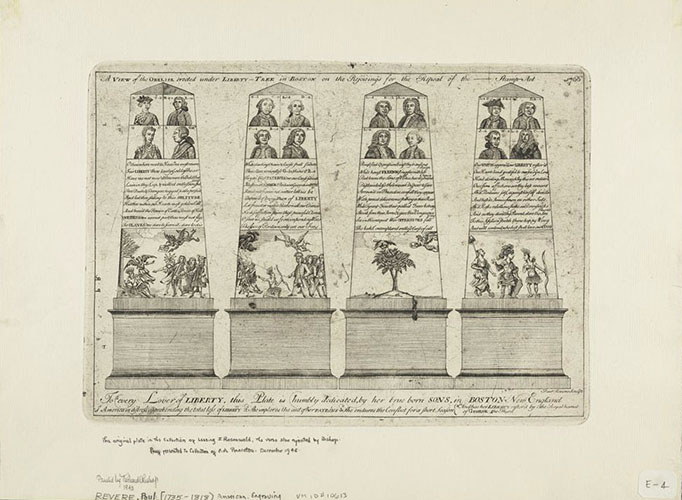
A View of the Obelisk Erected under Liberty-Tree in Boston on the Rejoicings for the Repeal of the Stamp Act, 1766 §
Paul Revere (1735–1818)
Engraving. Boston: The artist
(this copy is a restrike made in 1943)
News of the repeal was met in Boston with a grand fête featuring bonfires, bell-ringing, and firing of cannons. On Boston Common, the Sons of Liberty erected a monument, depicted in this engraving by Paul Revere. (The wooden obelisk was destroyed when fireworks went astray and lit it on fire). Revere shows four sides, each with the faces of English supporters of repeal and an allegorical rendering of one phase of the Stamp Act crisis. America is represented by the figure wearing stereotypical clothing of a Native American. The scenes represent: “1. America in distress apprehending the total loss of Liberty. 2. She implores the aid of her Patrons. 3. She endures the Conflict for a short Season. 4. And has her Liberty restord by the Royal hand of George the Third.”
Dispatch box, 1760s §
James Season (active in the 1760s)
Pine and leather
London: The artisan
This box designed to carry messages, or “dispatches,” is reputedly the one in which news of the Stamp Act’s repeal was brought to America. It is embossed with the monogram of George III and inscribed “GR | Stamp Act Rep’d | March 18, 1766.” The box is lined with pages from an agricultural journal. It was later owned by John Witherspoon, sixth president of the College of New Jersey (now Princeton University), and a signer of the Declaration of Independence.

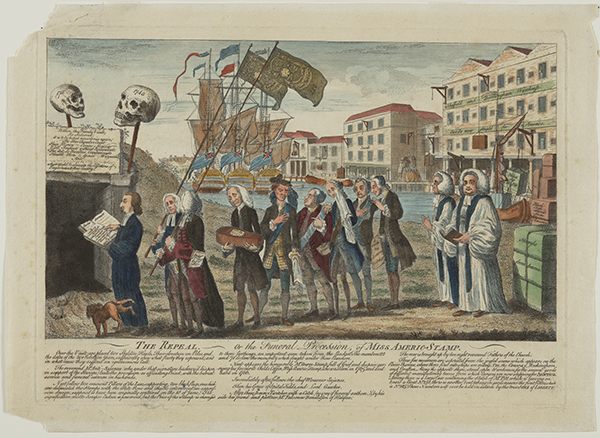
The Repeal. Or the Funeral Procession of Miss Americ-Stamp, 1766 §
Benjamin Wilson (1721–1788)
Engraving. London: Carington Bowles
Published on the day the Stamp Act was repealed, this satirical print was one of the most popular ever. George Grenville, sponsor of the act, leads a funeral procession with a coffin labeled “Miss Americ[a] Stamp.” The ships are named for pro-repeal ministers, and the warehouses are labeled with manufacturing cities in England which had suffered from the boycott on British-made goods that arose in protest of the Stamp Act.
The Bostonians Paying the Excise-Man, or Tarring & Feathering, 1774
Attributed to Philip Dawe (1745?–1809?)
Mezzotint and etching. London: R. Sayer and J. Bennet
One form of violent resistance to enforcement of the Stamp Act was “tarring and feathering.” Vigilantes would seize a government official, strip him, pour hot pine tar over his body, and cover the tar with feathers. While painful, this treatment is not fatal; however, the resemblance of the tax collector to a chicken was intended to be humiliating. This print shows a later instance of tarring and feathering related to the collection of taxes on tea in 1774.
Reproduced from Library of Congress Prints and Photographs Division.


