Jewish Oppression & Liberation in England and the United States

Jews were expelled from England by King Edward I in 1290. While historical records do not have much information about the presence of Jews in England during the late Middle Ages, it is known that a few Jews lived and worshipped there illegally starting in the 16th century. During the 1650s, the republican parliament considered the question of re-admitting Jews; while the edict was not rescinded, the rule went unenforced, and a few hundred Jews settled in England by 1700.
In the 18th century, Jews were allowed to become naturalized subjects, but were limited in their enjoyment of political rights and privileges; they could neither vote nor hold office. Over the next century, the laws gradually changed until in 1858 the first Jewish member of parliament was allowed to be seated.
Throughout these centuries, debate occurred regarding the inclusion of Jews in English society. Anti-Jewish prejudice, along with concern for religious uniformity, competed with Enlightenment ideals of the natural rights of individuals to participate in their own government and to worship according to their consciences. Many works on this topic from the Lapidus collection were donated to the Center for Jewish History in New York.
Unless otherwise indicated (§), all items on exhibit are from the Sid Lapidus '59 Collection on Liberty and the American Revolution, Princeton University Library. All items on loan from other libraries are gifts of Sid Lapidus.

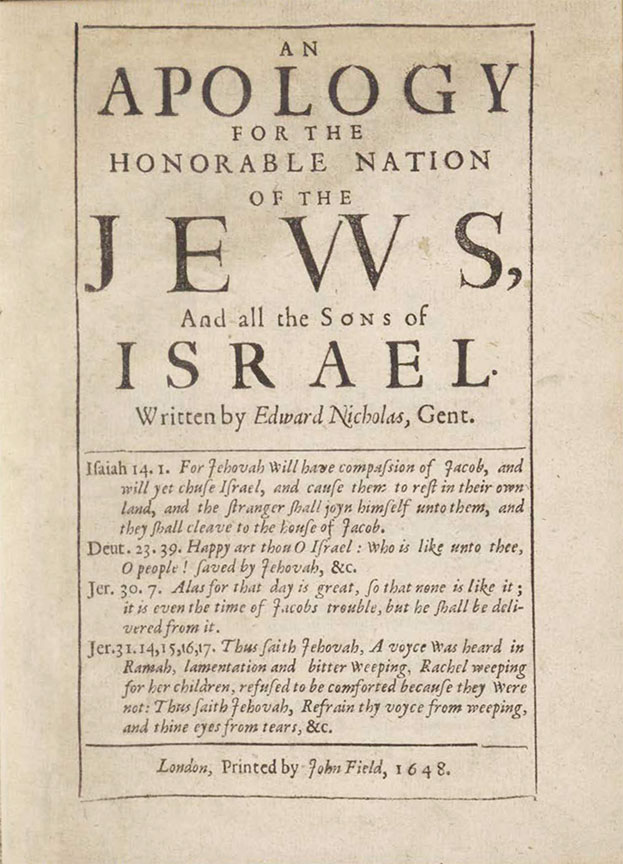
An Apology for the Honorable Nation of the Jews and All the Sons of Israel, 1649
Edward Nicholas (active 1648)
London: Printed by John Field
Edward Nicholas published one of the first works advocating for the admission of Jews into England. In the 1649 work displayed here, he offers religious justification, citing Christian compassion for the downtrodden generally. More specifically, he notes that England has “denyed that commerce allowed to all others, even to barbarous Infidels” to Jews, adding to the misery of Jews when the Bible calls for them to be relieved instead.
On loan from the Center for Jewish History
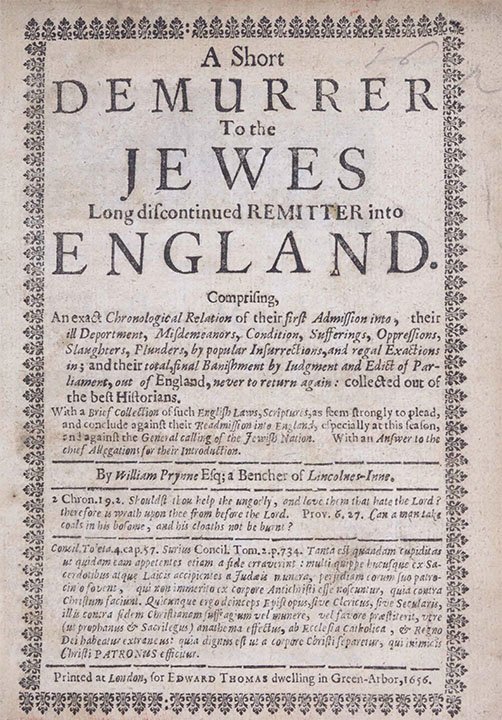
A Short Demurrer to the Jewes Long Discontinued Remitter into England, 1655
William Prynne (1600–1669)
London: Printed for Edward Thomas
Oliver Cromwell, the Lord Protector who ruled England from 1653 to 1658, convened a conference in 1655 to consider the readmission of Jews into England. William Prynne, a Puritan and royalist pamphleteer, rushed into print this lengthy argument against the proposition, which influenced the attendees. He repeats the calumnies and slanders against Jews that were used to justify expulsion in 1290 and argues that the presence of the “enemies of the Crosse of Christ” will draw English Christians away from the true faith.
On loan from the Center for Jewish History
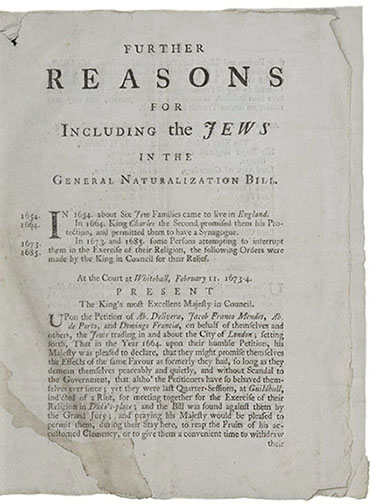
Further Reasons for Including the Jews in the General Naturalization Bill, around 1751
Attributed to Josiah Tucker (1712–1799)
Perhaps London: Publisher unknown
Foreign-born English residents could not own property; a proposed reform (which did not pass) would have allowed Protestant foreigners to be naturalized. In this pamphlet, the political economist Josiah Tucker points to the many exemptions from religious requirements already given to Jews, as support for waiving the Protestant requirement. In 1753 a separate law allowed naturalization of Jews, but it was repealed in the face of public protest the next year.
On loan from the Center for Jewish History
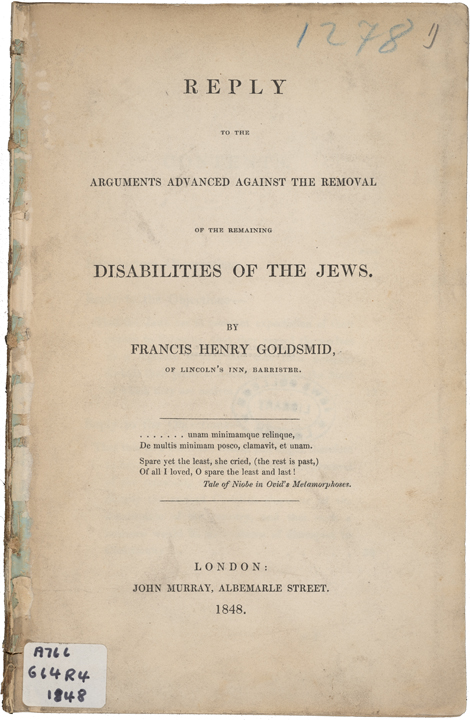
Reply to the Arguments Advanced against the Removal of the Remaining Disabilities of the Jews, 1848
Francis Henry Goldsmid (1808–1878)
London: John Murray
In the 19th century, Jews were barred from Parliament, because members swore a Christian oath. Between 1848 and 1858 several bills to reform this practice were advanced, leading to the seating of Lionel de Rothschild as the first Jewish member of Parliament. In this book, Francis Goldschmid, a Jewish community leader, rebuts justifications for Jewish exclusion, advancing the Enlightenment idea that “those who share the burthens of a state, ought… to share its honours also.”
On loan from the Center for Jewish History
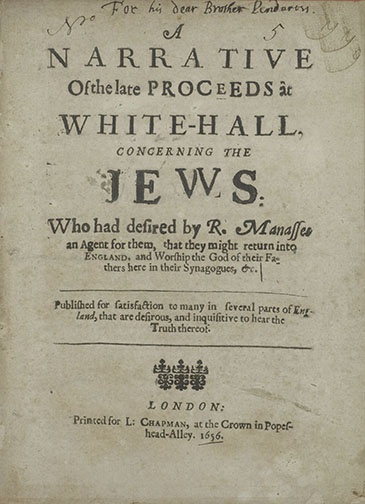
A Narrative of the Late Proceeds at White-hall, Concerning the Jews, 1656
Henry Jessey (1603–1663)
London: Printed for L. Chapman
In the 1650s, the internationally respected Dutch rabbi Menasseh ben Israel heard of a growing movement to readmit Jews to England, and in 1655 petitioned Oliver Cromwell to permit it. Cromwell called a council of government officials to consider the question. After many days of debate, reproduced in this pamphlet, the council recommended the continued exclusion of Jews. Cromwell nonetheless declined to enforce the edict of expulsion.
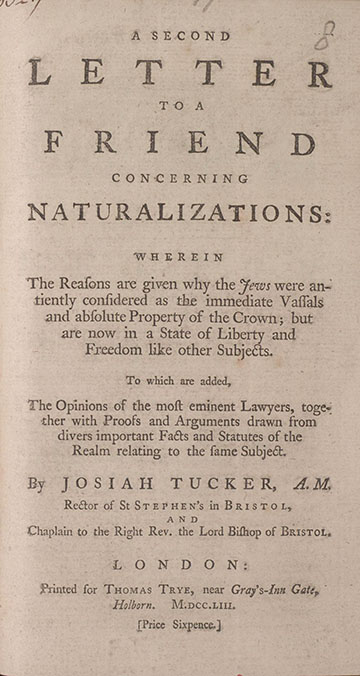
A Second Letter to a Friend Concerning Naturalizations, 1753
Josiah Tucker (1712–1799)
London: Printed by Thomas Tyre
When the “Jew Bill” (as it was called) allowing naturalization passed in 1753, it was met with outrage among the general public. Josiah Tucker, a political economist who favored naturalization for economic reasons, wrote this pamphlet to discourage the repeal. Its strong wording appeals to the English understanding of the virtues of limited government, and considers Jews as possessing the same natural rights as other English subjects.
The Claims of the Jews to an Equality of Rights: Illustrated in a Series of Letters to the Editor of the Philadelphia Gazette, 1840
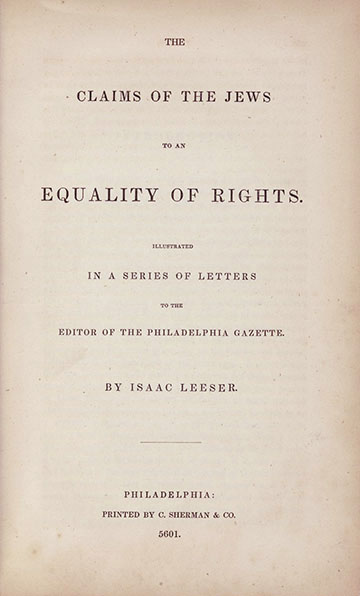
Isaac Leeser (1806–1868)
Philadelphia: C. Sherman & Co.
Unlike in England, in the United States Jewish men have always enjoyed nominal religious freedom and the right to vote and hold office. Despite that, Jews have often faced discrimination in America. Isaac Leeser, a Philadelphia rabbi, here argues that Jews are entitled to respect from their Christian neighbors, admittance to public institutions, and an equal share of justice.
Cries of London No. 7: Old Cloaths, Any Old Cloaths, 1799 §
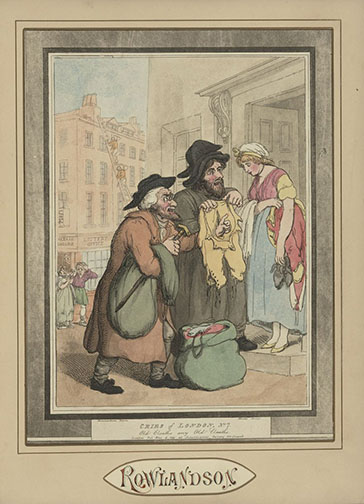
Thomas Rowlandson (1756–1827)
Etching
London: Published by Rudolph Ackermann
The Jews of England faced not only legal disabilities but also social exclusion. Stereotypes circulated that they were likely to be thieves or engage in distasteful professions such as ragpicking. Rowlandson, a satirical artist, created derogatory images of Jews. This etching is part of a series called The Cries of London (“cries” being phrases used by street vendors), and shows a pair of Jewish ragpickers soliciting clothes from an upper-class home.
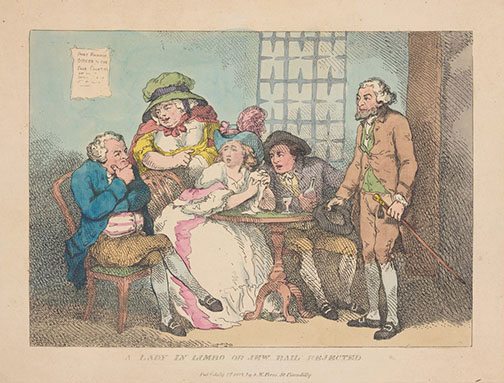
A Lady in Limbo or Jew Bail Rejected, 1802 §
Thomas Rowlandson (1756–1827)
Etching
London: Published by S. W. Fores
In this etching, a woman under arrest (likely for prostitution) is held in a “sponging-house” where she could wait while attempting to raise bail; if she failed, debtor’s prison awaited. A Jewish neighbor stands at the right to offer security for the suspect, but the sheriff’s officer on the left gives a distrustful look and refuses to accept the “Jew Bail”.
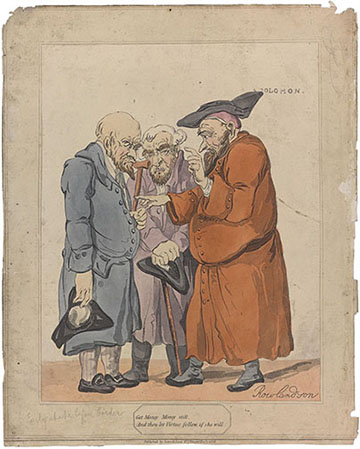
Get Money Money Still and Then Let Virtue Follow If She Will, 1808 §
Thomas Rowlandson (1756–1827)
Etching
London: Published by Reeve and Jones
The stereotype of Jewish merchants as conniving tricksters is reinforced here. In this cartoon, set within the Great Synagogue of London (built in 1690 and destroyed by German bombs in 1942), the guidance offered by the figure on the right (under the name of the wise king of Israel, Solomon), is “Get Money, Money still / And then let Virtue follow if she will.”
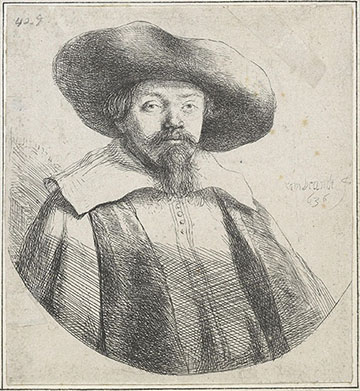
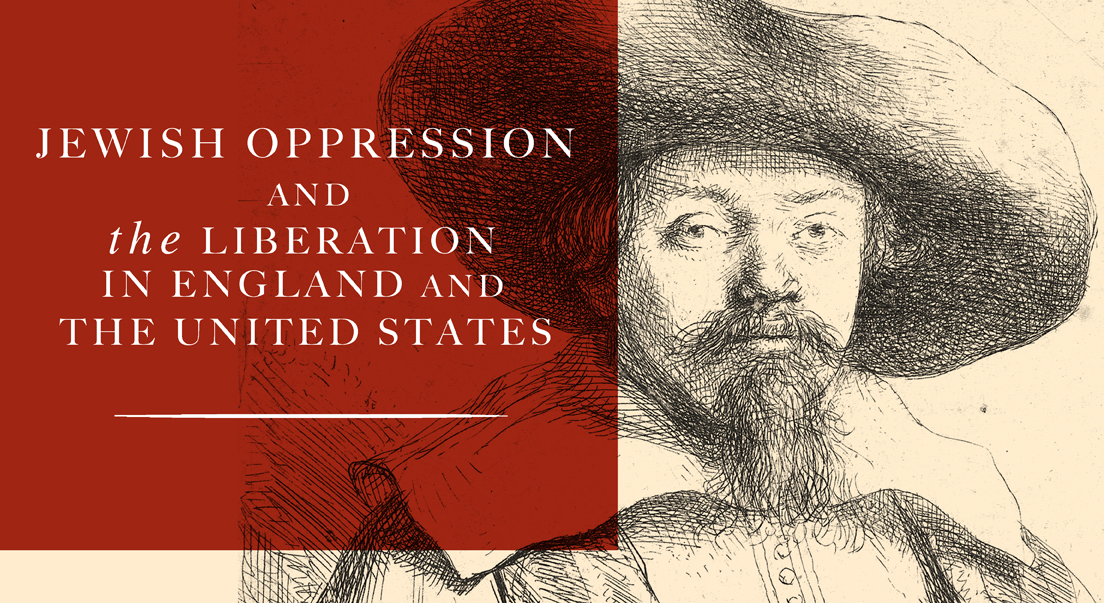
Menasseh ben Israel, 1636
Rembrandt van Rijn (1606–1669)
Etching
Menasseh ben Israel (1604–1657) was a prominent Dutch rabbi, sometimes considered the most famous European Jew of his time, who petitioned Oliver Cromwell to readmit Jews to England (see A Narrative of the Late Proceeds at White-hall, Concerning the Jews above). The famous Dutch artist Rembrandt, who lived in the same Amsterdam neighborhood as Menassah, made this portrait for sale to the rabbi’s admirers.
Reproduced from ©The Trustees of the British Museum. All rights reserved.