Clothing and Power in the Decades Since
Women’s pants were periodically revived as a practical consideration and/or a fashion choice until the late 20th century, at which point they became more firmly established as unremarkable. With each wave of women choosing alternatives to skirts and dresses, we continue to see judgment and anxiety related to women’s clothing when it deviates from established norms. In wartime, when women took on roles that had previously been seen as belonging to men, wearing pants often came with the reassurance to those who saw them that this was only temporary.
Advertising in later eras also sent clear messages about the consequences that might follow if one’s choices were less traditional. Women in the 1970s were warned that choosing pants might mean men would choose other partners in skirts. These pressures extended into the 21st century and to men’s clothing, as well.
1910s
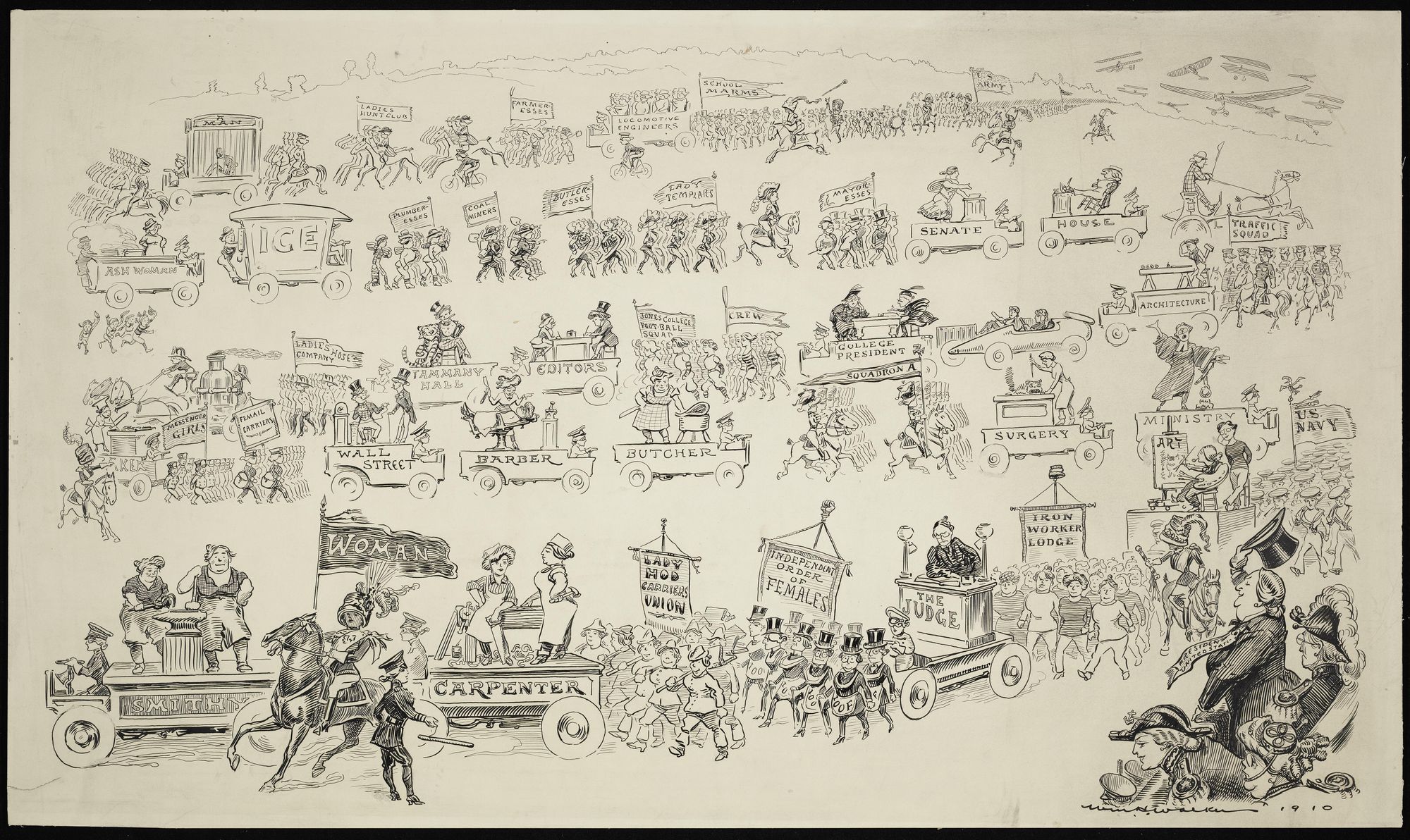
Anxieties about women extending beyond appropriate spheres lingered well beyond the 1890s. In May 1910, 10,000 people gathered in Union Square in New York for what was, at the time, the largest demonstration in support of women’s suffrage that had been held in America. Although women’s voting rights weren’t constitutionally guaranteed until 1920, five states had already granted women the right to vote and the movement was gaining momentum. Another 22 states gave women at least some voting rights in the decade prior to the ratification of the 19th Amendment. Women’s political power was no longer a bogeyman to be feared but an active reality.
In December of 1910, Walker again drew women in pants taking over every role in society, potentially reacting to that spring’s large demonstration. Although to modern eyes this may initially look like Walker had an optimistic outlook, a closer look shows his anxieties about the expansion of women’s rights, feelings many in the era shared. Some of the notable aspects of this particular cartoon include the only man in the parade is being imprisoned in a cage and shown off like a curiosity, the range of both white- and blue-collar jobs that the women in the parade have taken over, and the float representing Tammany Hall in the center.
Tammany Hall was the dominant political organization in New York well into the 20th century. In 1871, Thomas Nast depicted Tammany Hall as a tiger killing democracy in an editorial cartoon. Here, the Tammany Tiger—widely understood to be a symbol of unchecked political power—cozies up to a woman in a suit and a top hat smoking a cigarette. Women generally did not smoke in public; in fact, New York made it illegal for women to publicly smoke in 1908. Women smoking quickly became an icon of their push for equality, with cigarettes dubbed “torches of freedom” in an ad campaign in 1929. This part of the cartoon symbolizes women’s unchecked tyranny as well as defiance of gender norms.
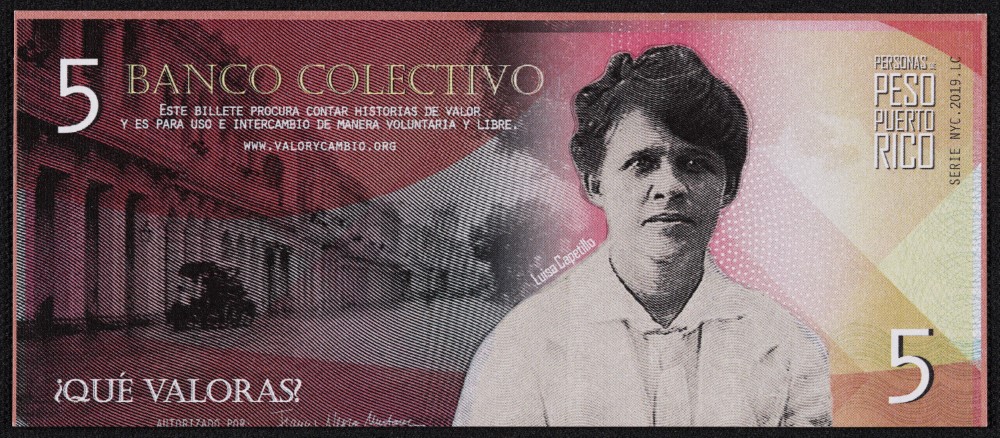
“5 peso note,” 2019, Valor y Cambio Project
Luisa Capetillo (1879-1922), shown here on a community art project, was a women’s rights and labor activist who habitually wore pants throughout her travels in New York, Florida, Puerto Rico, Cuba, and the Dominican Republic. Some media of her time referred to her as “the Puerto Rican Joan of Arc.”
She is widely considered to be one of Puerto Rico's first suffragists, and was advocating for women's right to vote as early as 1908, though she focused just as much on labor rights, traveling widely to assist striking workers and advocating for their causes. She also wrote opinion pieces for radical and union newspapers, including her own, La mujer, which was focused on women's issues. In 1915, she was arrested in Havana for wearing pants. She told the judge, “Your Honor, I always wear pants. And on the night in question, instead of wearing them underneath, I wore them just like men do, based on my perfect civil right to do so on the OUTSIDE.” Like many other activists of the time, she used the controversy stirred up by wearing pants to draw attention to the causes she championed.
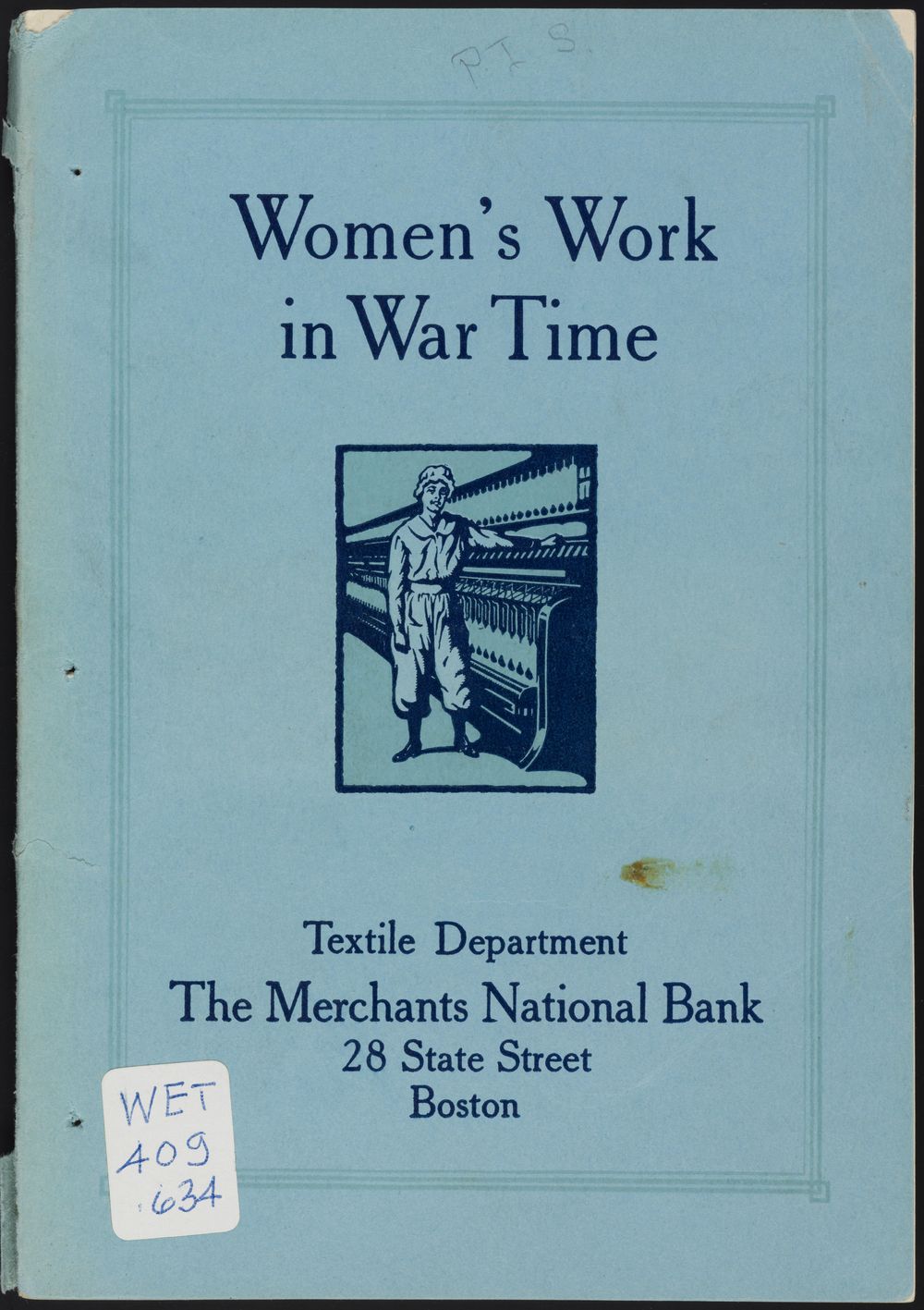
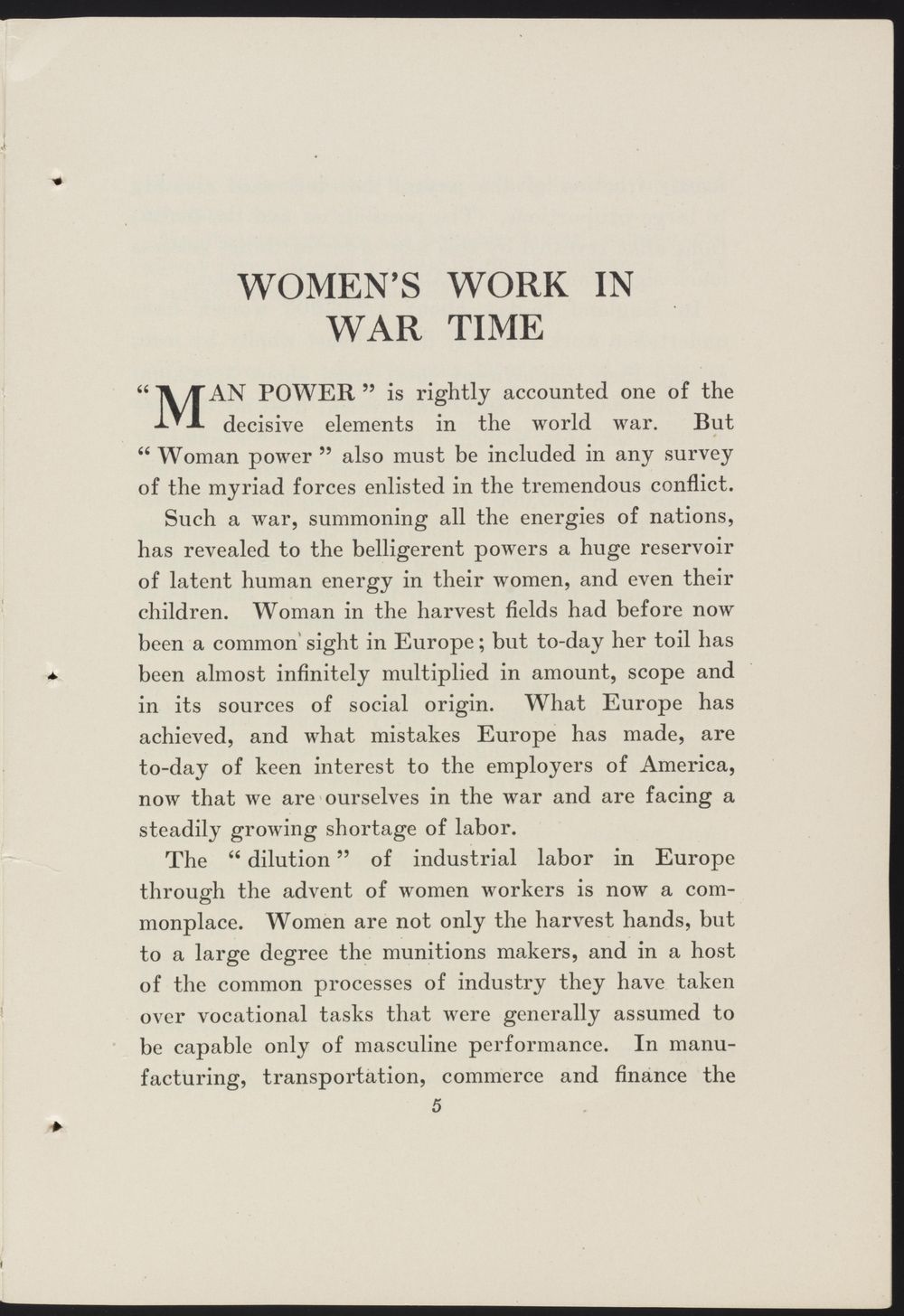
“Women’s Work in War Time,” 1917
During World War I, women began entering the workforce to do jobs left vacant by men overseas. The hard, physical labor led some women to wear pants for practical reasons and expanded this option to women in the working class, instead of being limited to middle and upper class women. Still, it was relatively rare to see women choosing to wear pants during World War I, regardless of occupation. This 1917 pamphlet published in Boston details the contributions of women working in various industries, and features a cover with an image of a woman in pants. The opening chapter highlights the importance of “Woman power” alongside “Man power” as part of the war effort.
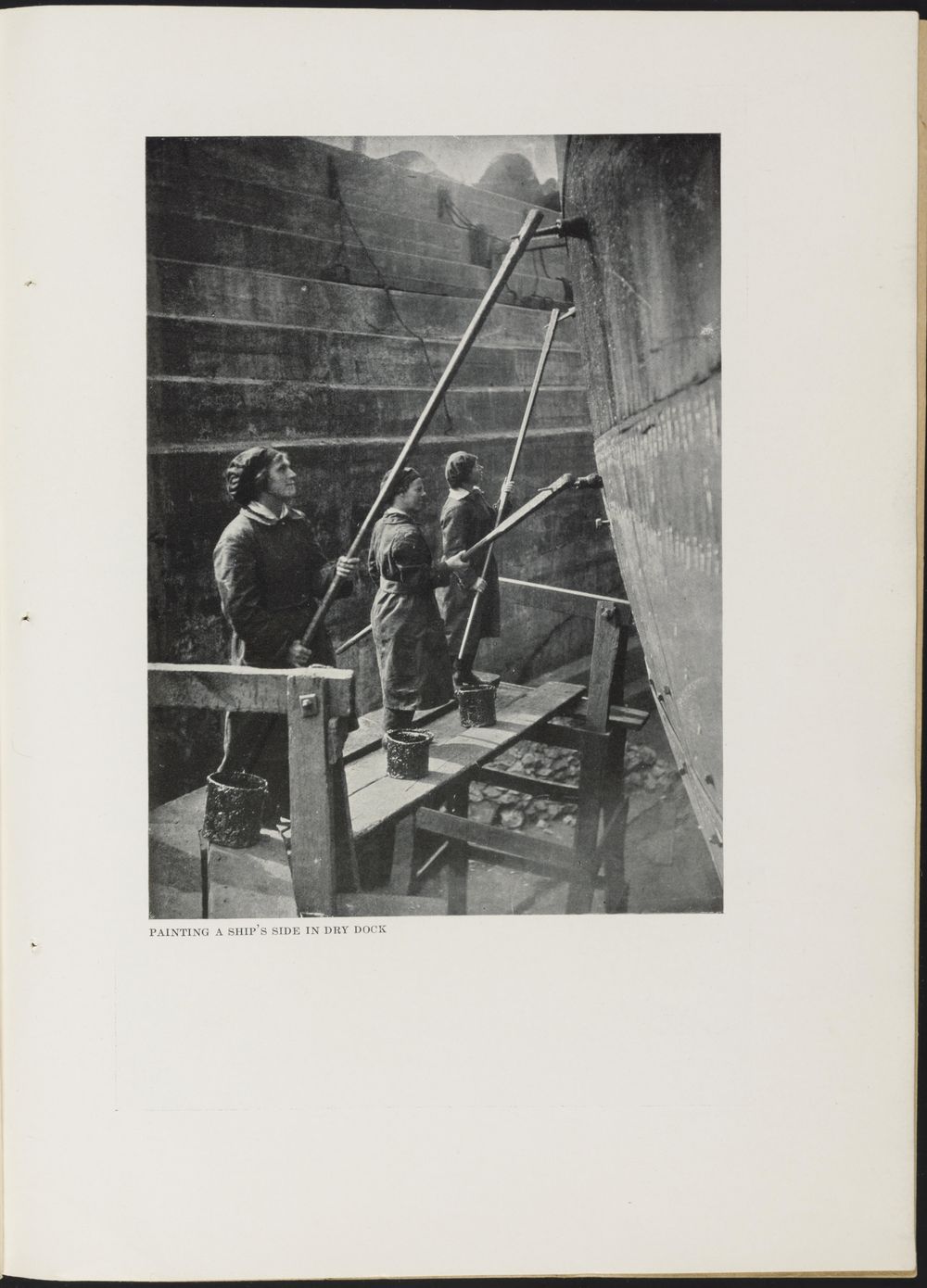
Another publication, "The Woman’s Part: A Record of Munitions Work," seemed uncomfortable with the possibility of women in pants, no matter how practical it might be. This 1918 pamphlet noted that one third of the people working in the munitions industry of Great Britain were now women, and remarked that this was “an omen of deep significance," though its author did not specify whether this significance was a positive or negative one.
Though there are a few photographs of female factory workers wearing pants in its pages, the camera angles generally seem to obscure this, perhaps a reflection of the uneasiness about it on the part of the photographer or publisher.
1940s
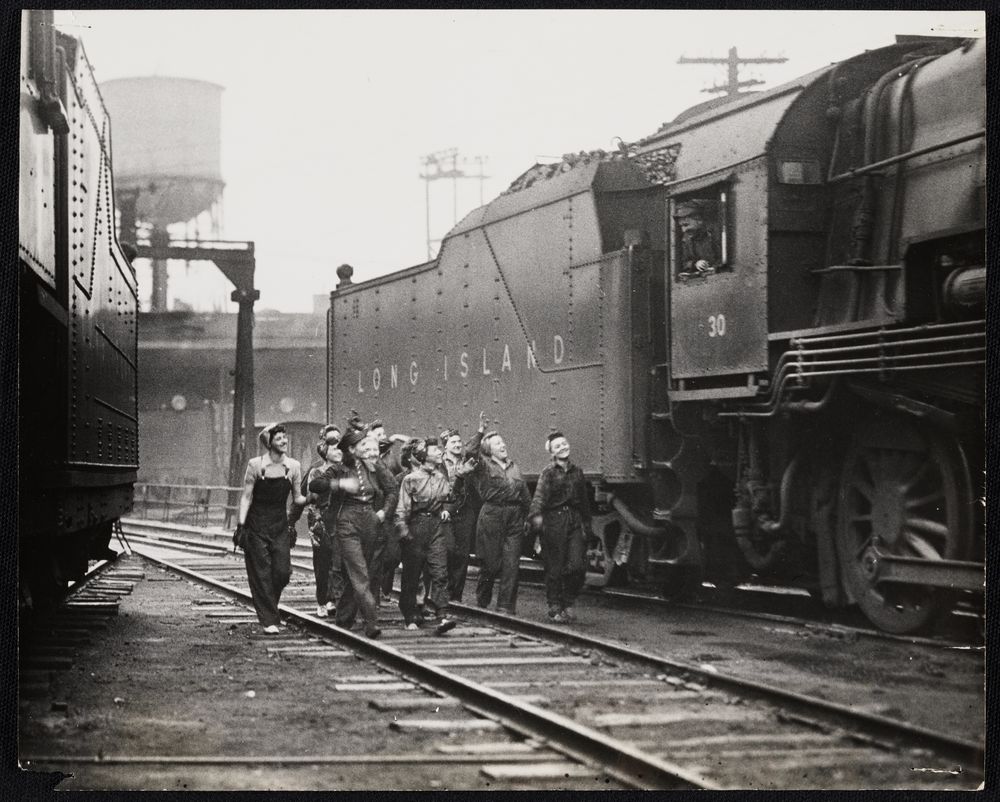
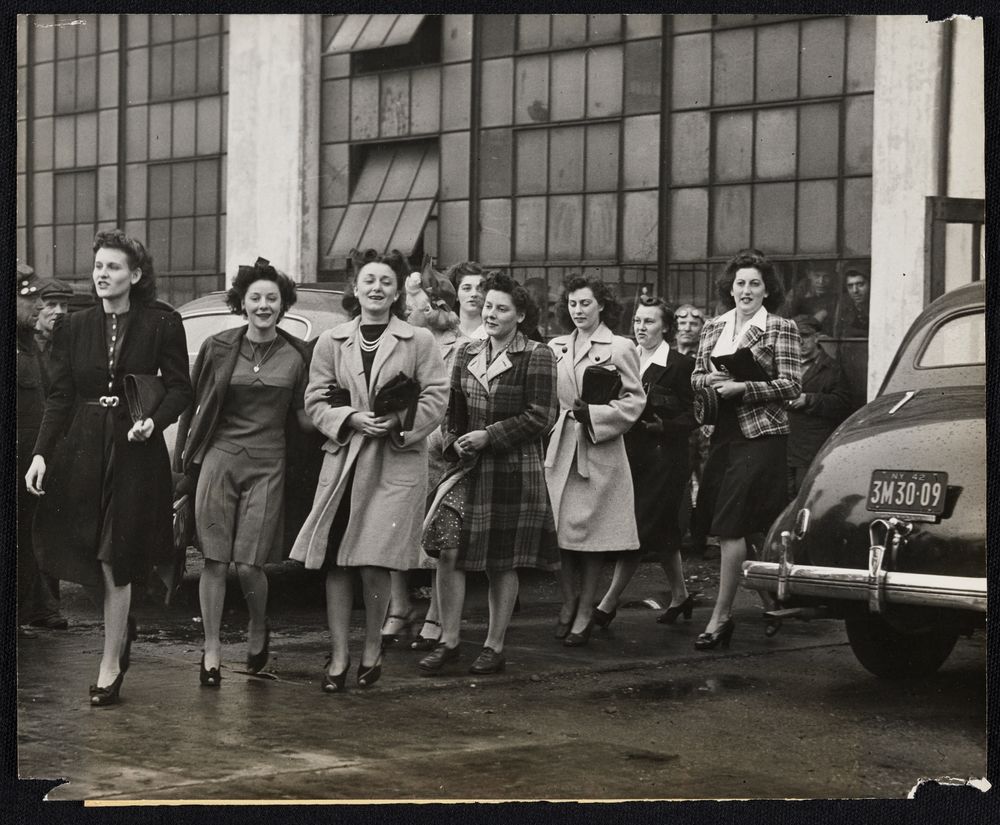
During the next World War, similar circumstances led to women on the home front taking a more active role in the workforce, and their clothing shifted once again to match the labor they performed. These two photographs of women reporting to work at the Morris Shops of the Long Island Railroad (LIRR) and then leaving that same day were part of a public relations campaign meant to reassure the public that the women involved were only doing so to help the war effort, and wearing pants was purely situational. Photos and text associated with this publicity campaign offered reassurance that the women were not trying to do anything radical, and after World War II ended, they would return to traditional roles and clothing.
1970s
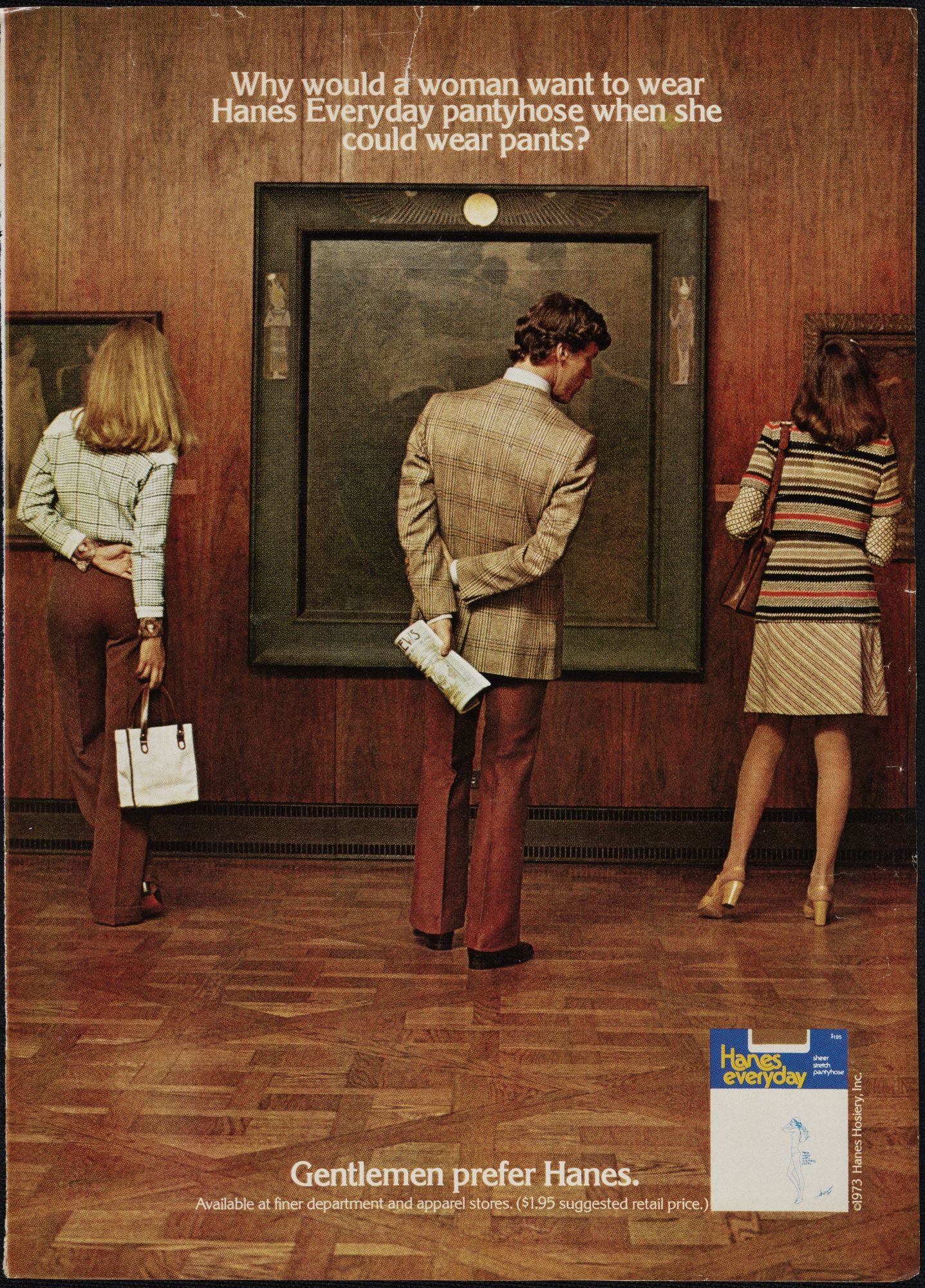
"Gentlemen Prefer Hanes," 1973.
In the 1970s and 1980s, second wave feminism made pants much more common for women, but much of the media and society still discouraged them from wearing them, albeit in comparatively subtler ways. The “Gentlemen Prefer Hanes” ad campaign, which included commercials in addition to print ads, featured men openly staring at women’s legs in skirts, something portrayed as positive rather than problematic. Within the context of the Women’s Liberation Movement, ads like these sent the message that women should not pursue their own desires and should prioritize men’s instead.
The 1970s brought with it a great deal of societal change, and fashion went right along with that. The rise of cheaply-made, ready to wear clothing changed societal perceptions of fashion to a more individualistic practice where the wearer was trying to express themselves and their interests and personality via their clothing choices.
Wearing pants was no longer the confusing and threatening concept it might have been in Walker's era—Levi's was making a killing in women's bell-bottom jeans, and the idea of women in pants had gone decidedly mainstream—but ads like this portrayed women's pants as unappealing and, worse, unattractive. This narrative did acknowledge that women had a choice in what they wore, but with this acknowledgement came the underlying communication that some choices were the right ones and some were the wrong ones.
2000s
By the time the 2000s hit, gendered lines in fashion had blurred even more. Pants for women had become more ubiquitous and the pantsuit or power-suit had become common cultural shorthand for a career-minded woman. Rising trends in the 1990s and early 2000s also brought the slim-fitted suit and eventually the skinny jean, first introduced as a women's fashion item and making its way into men's clothing racks in the late 2000s. With these shifts, however, came new attempts to re-draw and redefine the lines between the genders.
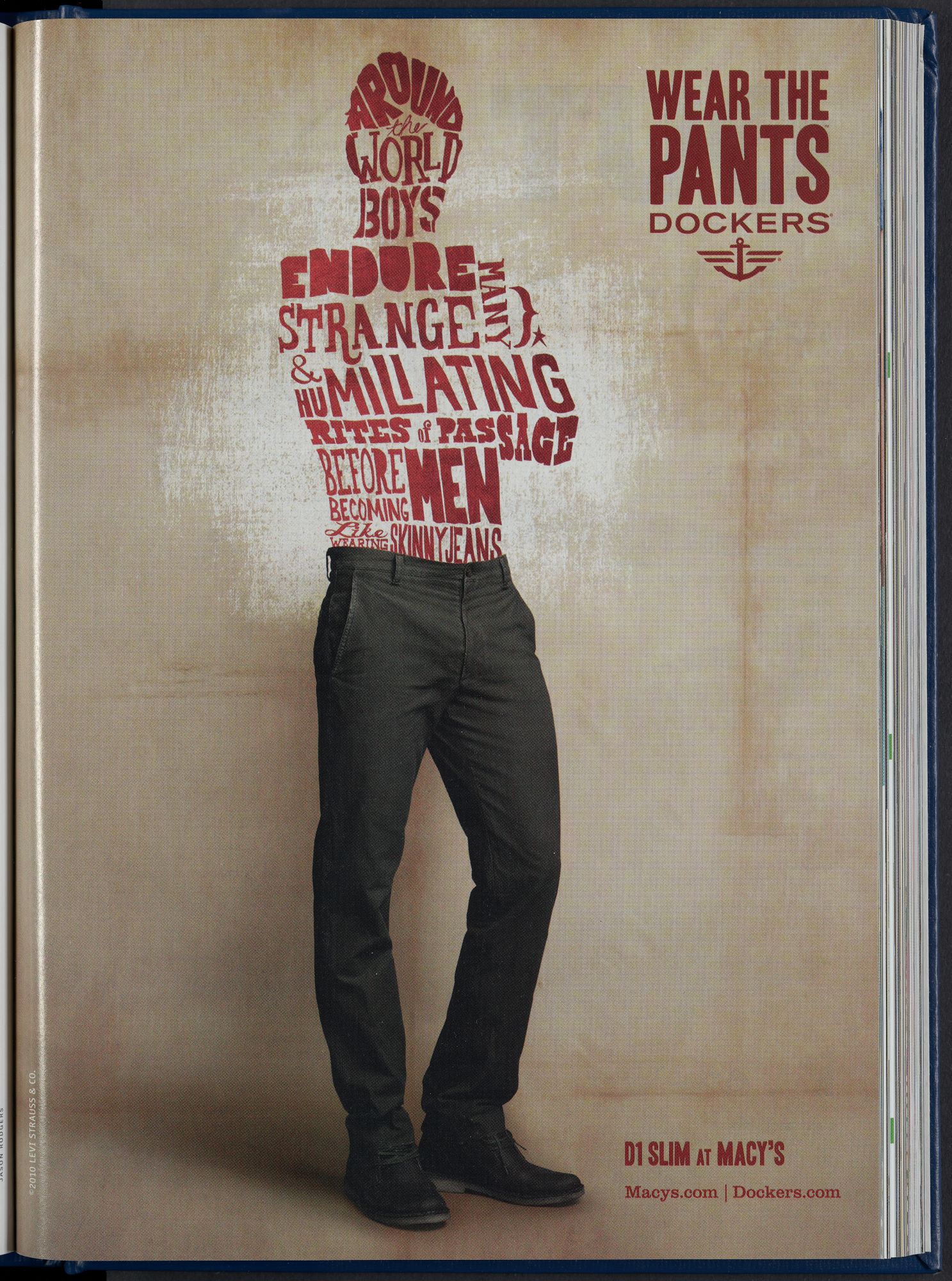
In 2009 and 2010, Dockers ran a controversial ad campaign encouraging men to “wear the pants,” alongside text that associated wearing Dockers work pants with masculinity, demonstrating the lingering link between manliness and pants in our own century. As wearing pants became more normalized for women, a distinction was instead drawn between men’s and women’s pants, with skinny jeans—as seen in this Docker’s ad—becoming “humiliating” because of their association with femininity. Here, masculinity is also directly linked with maturity—Dockers are for “men,” while skinny jeans are for “boys.” Within the larger ad campaign, this was one of many different messages Dockers communicated centered on the theme of men needing to wear styles deemed “masculine” in order to be men.