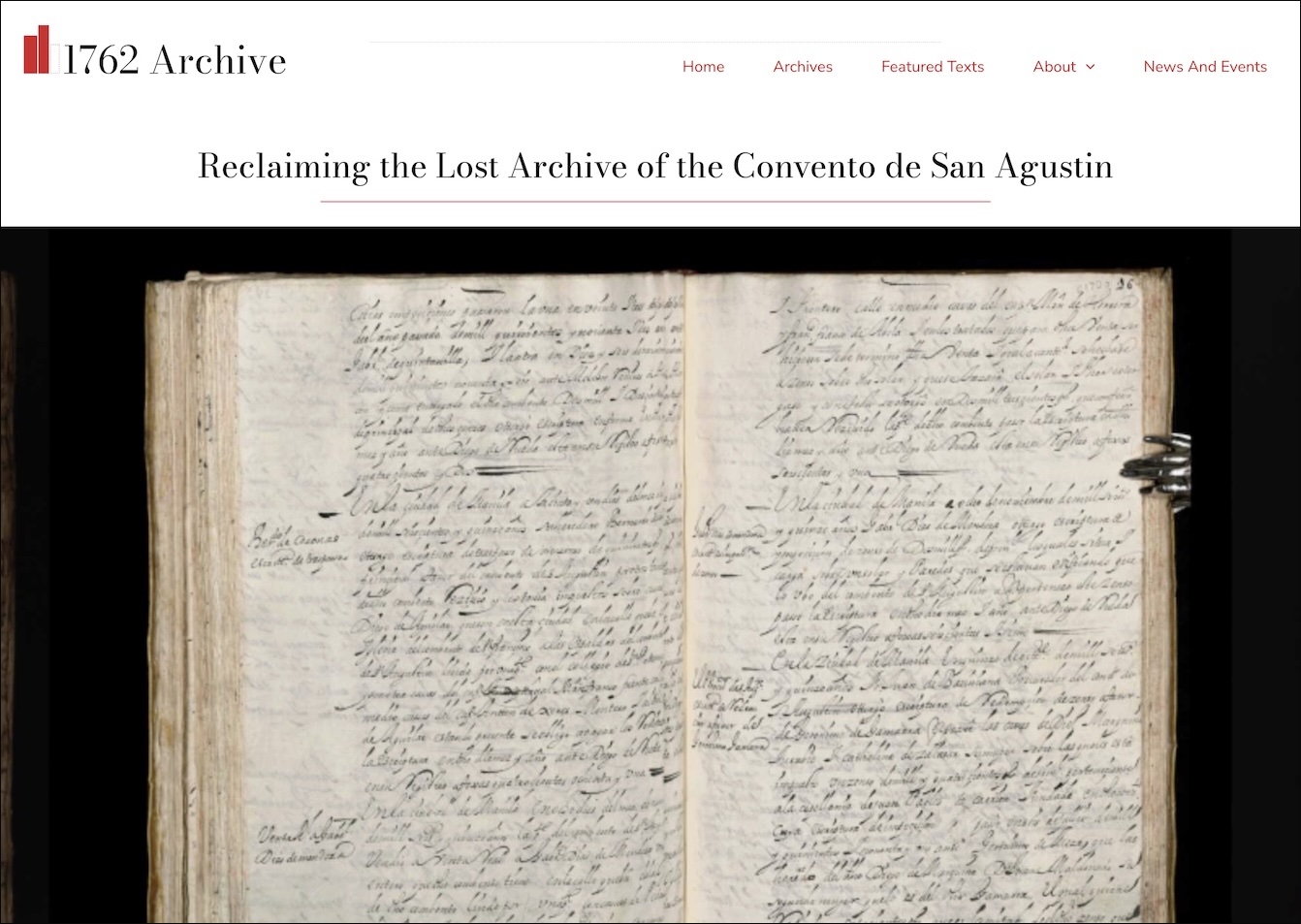
The 1762 Archive is a transnational, inter-institutional research and community engagement project focused on the digital reconstruction of the context and contents of the dispersed 18th century Library of the Convent of San Agustin in Manila.
It occupied a big space; lighted, and lovely; it had twenty shelves made of a very fine and exquisite wood called 'narra', with many moldings in different colors, and a carving representing an Augustinian scholar in the extreme end of each shelf. Each shelf had eight compartments or divisions; in each one there were from twenty to thirty books […] old and new, dealing about all types of subject matters."
Until 1762, the top floor of the Convent of San Pablo in Manila was home to an expansive collection of maps, manuscripts, and printed books—histories, ethnographies, language manuals, and testimonies of historical events—many of which served the Augustinian mission to convert peoples in the Philippines and elsewhere in Asia to Christianity. During the British invasion of Manila, in September of 1762, these valuable collections and rare manuscripts were pillaged by British troops. The collection was eventually taken to London, where it would be used by Scottish hydrographer Alexander Dalrymple to publish a number of works. After his death, the books and manuscripts were slowly dispersed between private libraries in the United Kingdom throughout the 19th and 20th centuries, with a large portion being auctioned off in 1966 at Sotheby's.
Tracing the Dispersed Collections
In response to these dispersed items, Dr. Cristina Martinez Juan (SOAS University of London, Philippine Studies - School of Languages, Cultures and Linguistics), collaborating with Dr. Christina Lee (Princeton University, Department of Spanish and Portuguese), have traced the books and manuscripts of the Convent of San Pablo to libraries throughout the world. This digital humanities project, an international partnership between institutions, attempts to digitally reconstruct the library as it might have looked before the British invasion. Beyond the digital reconstruction of the archival corpus, the “return” of the library is reimagined to include the reconceptualization of the library’s original systems of knowledge production, modes of access, its audience and use.
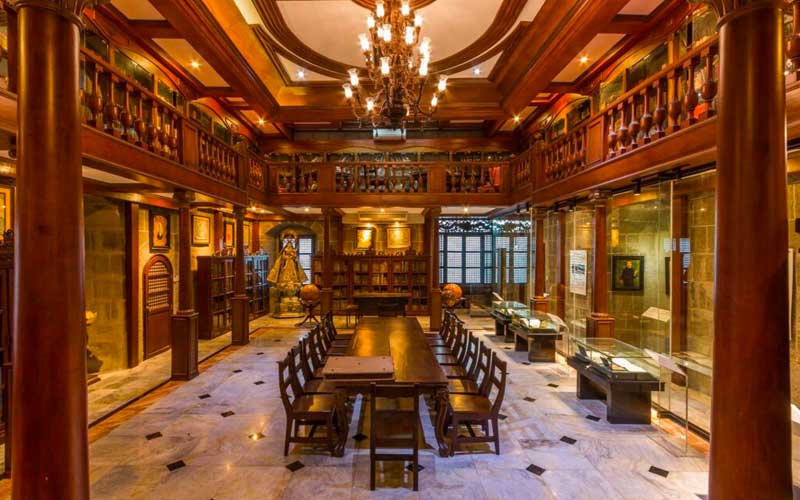
Reconnecting the scattered pieces of the original San Pablo library has provided an opportunity for collaboration between libraries throughout the world. Only sixty-seven volumes survived the sacking and, as the project was getting off the ground, they were moved from the storage to the main library of the Church of San Agustín. The rest of the San Pablo collection is spread out between the Lilly Library, the British Library, King’s College, SOAS, and the Lopez Library, among others. Princeton University Library joined these efforts in order to provide a digital repository for items within the online library. This digital exhibit showcases items held within Princeton's repository and provides links to those held in other repositories.
Transcribing and Translating Primary Sources
The reconstruction of the San Pablo Convent Library aims to make new primary sources available and more accessible for study of the history of the Spanish Pacific and Spanish Colonial Philippines. With this in mind, faculty and students at Princeton and at the University of the Philippines Diliman and the University of Santo Tomás have undertaken the transcription and English translation of some of the manuscripts within the collection. You can access the current collaborative transcriptions here
[1] Father Agustin María de Castro, Historia del Insigne Convento de San Pablo de Manila, Orden de N.P.S. Agustín, Escrita por Fray Agustín María de Castro, de la Misma Orden, Natural de la Villa de La Bañeza y Bibliotecario de este sobredicho Convento. Año de 1770. Published together with a preliminary study by Merino, M. El Convento Agustiniano de San Pablo de Manila, in "Missionalia Hispanica", Madrid, 1951,22, pp. 65-122.